
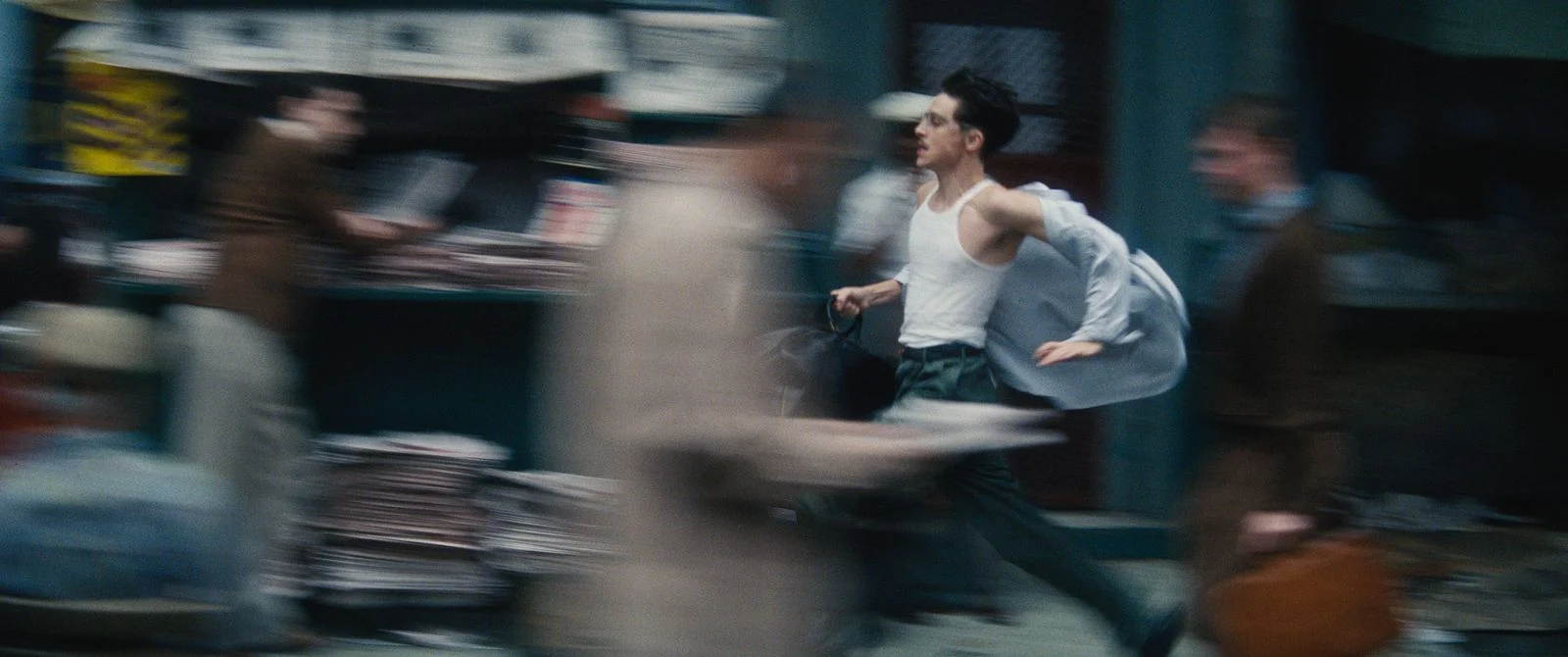
There is a common conception that something that is overhyped will necessarily engender disappointment. Can a pre-conceived notion or another’s opinion really influence our own enjoyment of a film to this extent? I was convinced, on my way to see Josh Safdie’s Marty Supreme, that I would hate it. What would there have been to like? I’m not a particular fan of Safdie’s work, and even less of a fan of Timothee Chalamet as an actor. I had heard mixed reviews, but those that exclaimed how “incredible” it was only furthered my belief that at the very least, I’d leave the cinema mildly irritated. Yet, I now believe the above to be a misconception. In the end, there is very little that could have thwarted my enthusiasm for Marty Supreme.
It’s 1952 in New York City, and Marty Mauser has one dream, and one dream only: to play table tennis to the highest standard. Young and ambitious, dreaming of bringing American attention to the sport, Marty will stop at nothing to get what he wants – even if it costs him everything.
Chalamet is excellent as the eponymous Marty, a vagabond and businessman with more than one trick up his sleeve. He is the perfect definition of “taking one day at a time” – it’s unclear where he will eat or sleep at each instance, though his mother, who professes constant sickness to get him to come home, has a perfectly lovely apartment in New York. He’s torn between requesting help from those who do not wish to give it, and refusing the love of those who have it in abundance for him – in more than one instance, he’s positively awful. It’s hard not to reframe the “Dream Big” slogan as “Dream Cocky”, as rare is it that Marty ever doubts himself. Should dreaming big really be synonymous with having the most inflated ego of all time, with casting aside those who care for you? Everything that doesn’t involve table tennis, or a route to achieving his goals (that is, his way of living, his family, his relationship with childhood best friend and lover Rachel, an incredibly performance from Odessa A’zion) is just a footnote in Marty’s life. Somewhere along the way, he loses all sense of values – a scene in which he asks his friend and old rival Kletzki (Géza Röhrig) to recount an episode of his time in Auschwitz as entertainment for pen magnate Milton Rockwell (Kevin O’Leary) is particularly unsavoury (as beautiful as Kletzki’s storytelling is). It’s a strange moment, but one that perhaps bares the most weight – two Jewish men, post-war, with very different experiences, one a survivor of the camps and a symbol of “Hitler’s defeat”, the other an American with everything to prove, echoed by Marty’s shocking comment during an interview that he will do to Kletzki in their match what the Holocaust couldn’t. The latter is his friend, of course, a man who has his back as much as any other. Why is it, then, that they all root for him, just as we root for him in the mayhem he calls life? His sheer dedication, perhaps, the tunnel vision that makes him impervious to all obstacles. For those living it with him though, it probably isn’t as much fun as it is for us, watching from the outside.
Those who expect to watch two and a half hours of tantalising matches may be disappointed – the real battle Marty must face is getting to the championships in the first place. Then, gradually, when he has mobsters on his back and quite a bill from the Ritz, it is learning what truly matters, though Safdie never makes this cushy or cliché (if anything, the final scene is one of the most moving sequences of 2025). In the first instance, Marty must raise the money to play, which of course means stealing “what he is owed” from his uncle’s shop and holding his dutiful coworker at gunpoint. It’s an impressive first twenty minutes, one that cements Marty Supreme as nothing short of chaos. This is perhaps how many people felt about Paul Thomas Anderson’s One Battle After Another, a nonstop rush of obstacles and quick-fire shots that leave both character and audience exhausted for one another. Yet Marty Supreme is a lot more effective in its pure insanity, and on more than one occasion, I found my jaw literally dropped without my noticing, either spellbound by something I didn’t think Safdie would dare do (was the opening scene crass or pure comedy?) or downright shocked (one word – bathtub). Of course, there is perhaps a plot line too many, and some get cast aside halfway through – Dion, his father, and the orange balls are quietly forgotten – but you either embrace the chaos, or you don’t. It’s certainly a lot more fun if you do though.