
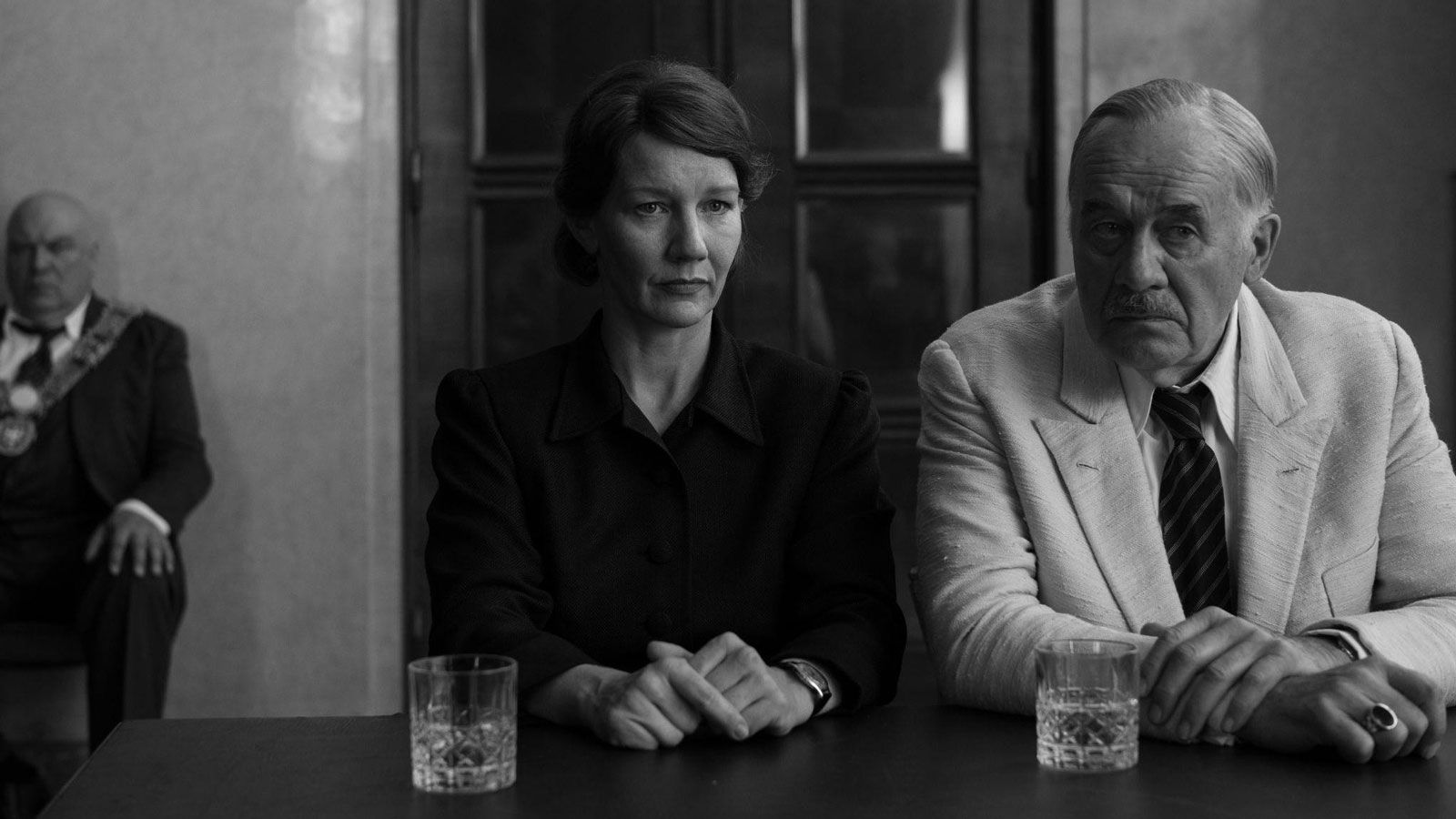
Closely following Oscar winner Ida (2013) and nominee Cold War (2018) is Pawel Pawlikowski’s latest drama Fatherland, a fictional account of a brief episode in the life of Thomas Mann and his daughter Erika upon their return to Germany in 1949. On paper, Fatherland should be a masterpiece, and Pawlikowski’s intricate knowledge of the man and his life reads like an engrossing character study – yet onscreen, it feels oddly empty, a collection of scenes that, despite the road trip plot point, feel vastly unrelated to each other.
Sandra Hüller and Hanns Zischler star as Erika and Mann on their journey from West to East as the latter prepares to receive the Goethe prize. There are cocktails parties, long drives with Erika at the wheel (she was also a rally driver in addition to an actress and novelist by her own right), and loaded silences – but most importantly, there is Mann’s disillusionment with the collapse of Germany and the clashing of his ideals with the audience he delivers his impassioned speeches to, and the lingering presence of Erika’s twin, Klaus (August Diehl), who has not yet joined them on the trip.
As with Ida and Cold War, Fatherland is shot in a crisp black and white by cinematographer and regular collaborator Łukasz Żal – interior and exterior shots alike are visually elegant, as is the overall atmosphere of the film which, even in sequences of violence or disagreement, retains an honourable quality about it. Hüller is unsurprisingly the standout here as, while Mann is the focus, it is the impact of his decisions and presence on Erika – and Klaus – that is most interesting. But inevitably, with little context about the man/Mann (perhaps there is something to be said about an audience’s gap in knowledge regarding this particular period of time and/or author), Fatherland falls short without the necessary information. At the risk of sounding too pejorative, there are two truly memorable scenes in Fatherland – the opening prologue, in which Diehl is sat on the floor naked talking to Erika on the phone while a man sleeps on his bed, is like a tableau, the beginning of a tortured love story. He has not felt anything in years, he tells her, a foreshadowing of the tragedy that is to come. In another, Erika is reunited with her ex-husband (Joachim Meyerhoff), a Nazi actor, who taunts her at a cocktail party until she slaps him cleanly across the face. It is, quite obviously, real – a nerve has been hit, and in that moment, Hüller is Erika entirely, no nonsense and yet in the midst, as is the country, of collapse. Zischler is perfectly adept as Mann, yet little depth is felt – he remains by and large vastly unknowable despite being so forthcoming with his opinions. The issue here is inevitably the attempt to merge both father’s and daughter’s stories, along with political and personal concepts. Perhaps this could have worked, but Fatherland is too short to really get into any of these dynamics without feeling greatly surface level – philosophical concepts are explained, rashly, at the dinner table, and there is more than one speech sequence that feels overwrought in a film that seeks to be deeply personal. These things are two sides of the same coin no doubt, political/personal, father/daughter – but in as characters come to understand, there must always be room to breathe.