It is difficult to judge a film solely based on itself when it has already been lauded as one of the best – if not the best – film of 2025. It is more difficult still to judge it adeptly when one has read the book, and found it to be a wonderfully detailed piece of work, quietly bitter in its ability to portray the woes of motherhood. What Chloe Zhao has created with her adaptation however, is, despite month-long ravings and original work, something that certainly isn’t something worth writing home about. I had diligently listened to reports of needing to “recover” from the trauma, of entire cinemas falling apart (mine felt well enough put together, besides the woman sat next to me, perhaps). And watching it, I understood how this phenomena came to be. While others saw despair and career-defining performances, I saw only the outlines of Maggie O’Farrell’s book, blurred and crass, and an obsessive need to make the audience miserable. Perhaps it is that a piece of work being so ‘hyped’ inevitably leads one to disappointment. But in this case, I am not entirely sure it was central to my indifference.
Jessie Buckley stars as Agnes, the eldest daughter of a reconstructed family, said to be a witch, her deceased mother rumoured to have simply emerged from the forest one day. While on a walk with her prized hawk, her brothers’ Latin teacher (Paul Mescal) happens upon her, and is immediately infatuated with her. After a brief courtship, they are married, and Agnes with child. Though life is sweet to begin with, her husband gradually falls into a deep depression, weighed down by his father’s unceasing cruelty and whippings, and his desire to be something bigger. As the resourceful woman that she is, Agnes orchestrates a move to London for him under the guise that he will grow his father’s business there. In truth, he begins to work at the playhouse, and Agnes raises first one, then three children, Susanna, and twins Hamnet and Judith. While her original intention was for the family to join him in London once established, Judith proves to be a sickly child, in need of the countryside air. Their distance and ways of life draw them apart, and Agnes begins to resent her husband for this blurry life in London. That is, until Judith falls gravely ill.
Hamnet both book and films covers just about very unhappy episode of existence, from marital problems and grief, to violence towards children and the inevitability of death. While O’Farrell’s book portrays such themes with delicacy, merely inscribing events onto the page and allowing her reader to sit with them, Zhao’s adaptation is loud and blatant, inherently devoid of any subtlety whatsoever. Hamnet original relies almost exclusively on the small details of life, emphasising the beauty of nature, the pain of childbirth, the healing qualities of rosemary – Agnes is the central character, a sorceress of the woods, wild and feared, yet eventually well-respected for her ability to see and treat her community with care. Her trademark, pressing her fingers between a person’s thumb and forefinger, allows her to see into their soul, to envision their future. This man will only last until the end of the year, while this one will travel far and wide. Meanwhile, only two children will stand at her deathbed. Descriptions of her care for the elderly are picturesque, as soothing as the balms she applies to their ills. While Zhao does highlight this wild side in Agnes, the driving force of the story, it feels like merely an afterthought, rendering Agnes a simple housewife with a couple of herbs up her sleeve. Both book and film allow her husband to lead the narrative to begin with, certainly – but while the book lets her gradually take over, the film casts the husband to London, only to focus on her almost by default. It is a shock, frankly, that O’Farrell helped write the script, she who tiptoed so effortlessly around its celebrity, who dared make him a secondary character. In this Hamnet, Agnes might as well have been batting the camera away.
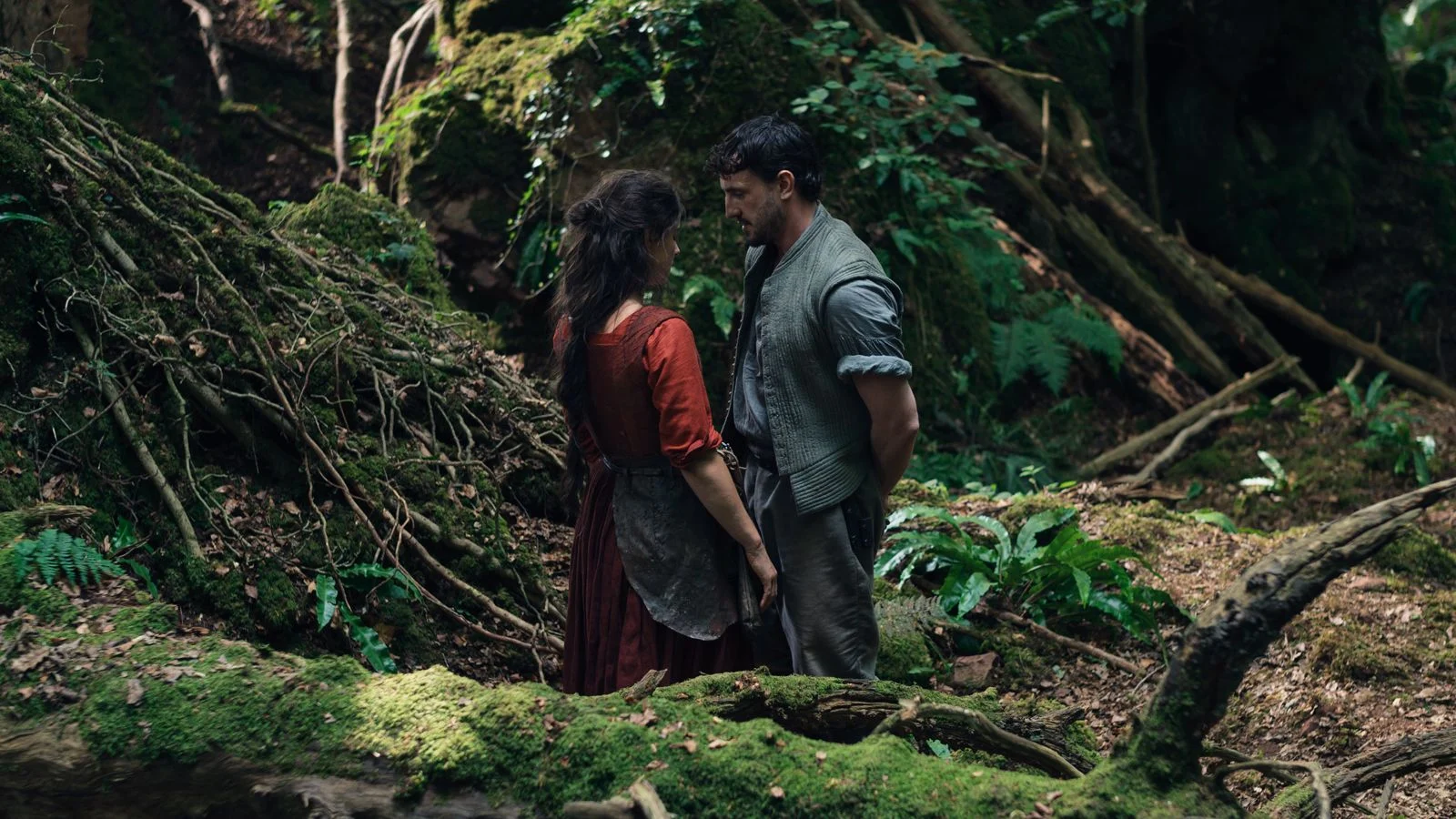
Their courtship, tender and gradual in the book, is also grossly underdeveloped, a flurry of montages of Buckley and Mescal running through the trees and giggling mercilessly at each other. When they are married, Zhao chooses to showcase a loving family whenever the husband is home, piggyback rides and organised plays in the garden that feel forced and utopian. Agnes’ reactions feel out of place and her sourness at this growing distance comes all at once without warning. Strong is the sense that she isn’t entirely aware of what is going on in London – her husband is, of course, for those not in the know, the William Shakespeare, but naturally, this does not mean the same to her as it does for us. Her blindness when she is supposedly clairvoyant is what drives O’Farrell’s narrative, the powerlessness of a woman with supernatural capabilities.
It is generally impossible for a film to mirror a novel, to replicate every detail and internal monologue. Yet, to add such trite literary device does Hamnet an injustice. Despite its title and subject matter, O’Farrell’s novel is not about Hamlet or Shakespeare – in any way, shape or form. The latter is known as husband, or father, and his work is only referred to in the final sequence, carefully quoted, barely depicted on stage. Naturally, this is not the case for Hamnet film, where everything must be shouted about from the rooftops, just in case the audience hasn’t understood. Zhao embeds Shakespeare wherever she an – the three children perform a draft of the three witches opening to their mother with the upmost glee, the final scene is lengthened out to showcase large quantities of the play being performed, and we are even given an origin story for the famous “to be or not to be” monologue, as Mescal stands on the edge of the murky Thames, contemplating life. Where Hamnet truly falls short however – nay, plummets – is in its inability to take anything other than the framework of O’Farrell’s story – that is, the tragedy. It leaves behind all of the messy details, all the nuances and ambiguities of a story that, in the end, certainly isn’t the most complex in narrative. Inevitably, Hamnet is just so on the nose that, in the words of my dear friend who left the cinema as unfeeling as I, it felt like emotional porn. Something is to be said, certainly, for Buckley’s performance, but it is shocking how insignificant it feels compared to past works, understated and refined like Wild Rose and Beast. Was Zhao’s only stage direction to “make sure the audience cries, whatever you do”? If anything, Mescal’s happy-go-lightly wooziness in the opening act is more of a feat here. Nevertheless, Hamnet twists and manipulated, as Agnes screams in pregnancy, screams in grief, screams in rage. Of course, the death of a child is a tragedy – but Hamnet uses this to its advantage, forcing cheap tears and condemning all those who shed none.