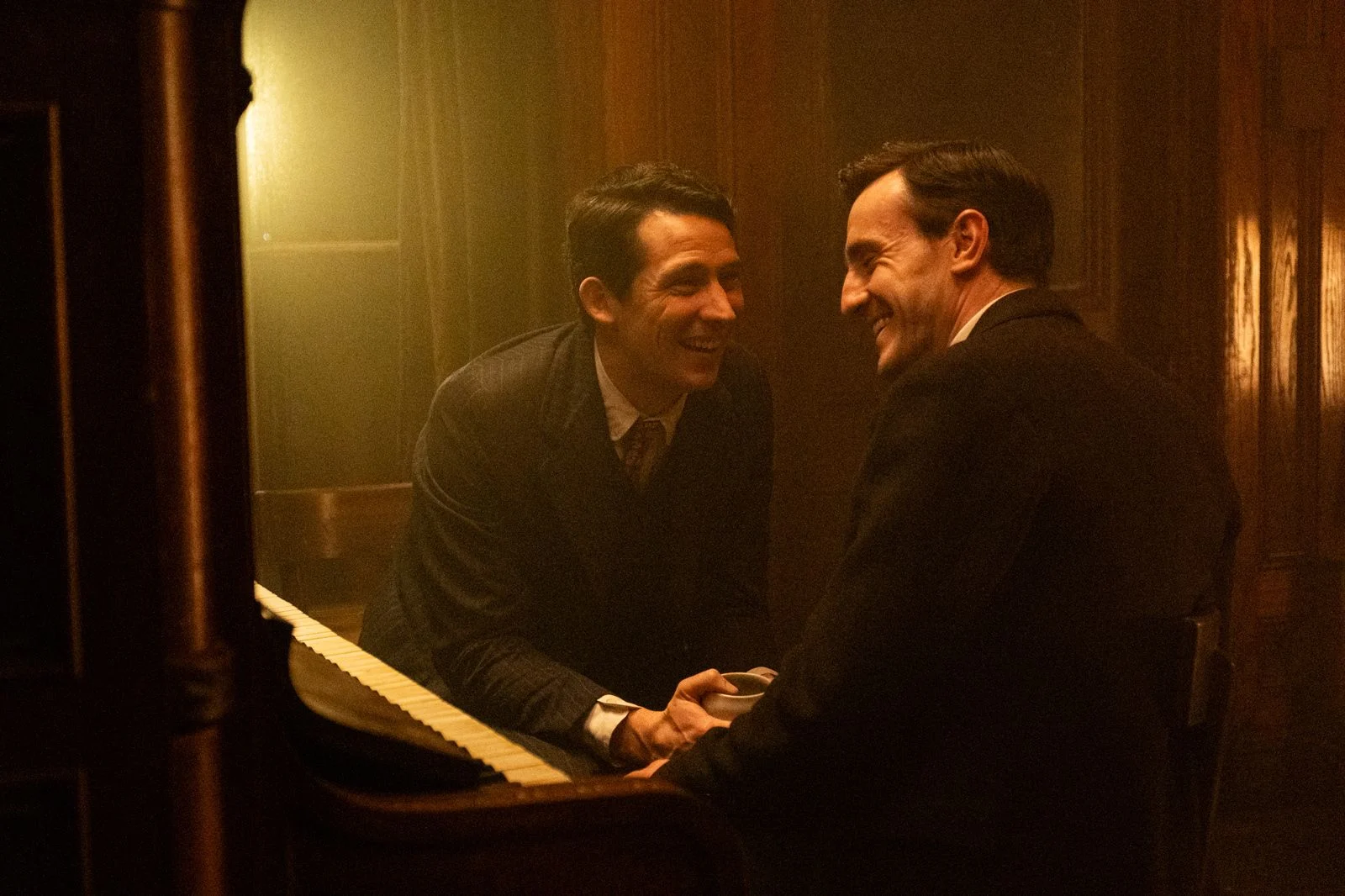
Josh O’Connor and Paul Mescal form quite the harmony in Oliver Hermanus’ The History of Sound, a star-crossed lovers-esque tale based on two short stories by Ben Shattuck, who also penned the script. Hefty in content and emotion, its primary success is its performances, particularly Mescal’s, who doesn’t so much as bat an eyelid to convey the deepest of upsets. Paired with nature shots, from the sultry farm on which his character dutifully works to the blossoms of Maine through which they walk, and the mesmerising song that first brings the two together, The History of Sound should be a roaring success. And yet, there is something distinctly lacking here – for all of its feeling, its content feels oddly empty, like singing a note in the wrong key.
Set across a flurry of years, The History of Sound follows the relationship between Lionel (Mescal) and David (O’Connor) who meet in 1917 at the New England Conservatory of Music, bonded by their love of folk music. Separated during the war, during which David is sent to the trenches and Lionel returns to the family farm in Kentucky, they reunite in 1919 for a trip funded by the department in which David has found a job, a journey through Maine to collect and record folk music on wax cylinders. Separated again by responsibility and travels, the memory of this expedition stays with Lionel long after as he navigates Rome and London, new relationships and fresh voices – and it isn’t long before he is drawn back to Maine and to the memory of the one person with whom he could be himself.
Those who expect a love story marked by the weight of historical fact will find themselves somewhat disappointed. Besides brief mentions of David’s time in the trenches and the weight he carries around in his tired eyes thereafter, The History of Sound is, indeed, just that, a story fuelled first and foremost by folk music, and the way it brings Lionel and David together – as they set up the wax cylinders before their singers, hesitant townspeople who have never seen such a contraption before, there is a certain apprehension in the air, an excitement that points to something revolutionary. Just as Lionel considers this trip the best days of his life, choosing to omit much of the detail – since happiness as powerful as this cannot, really, be put into mere words – it is also the strongest element of the film itself. This is where the songs truly take flight, where a stolen glance between the two is a thing of wonder, where the cracks begin to emerge. Once separated, it morphs into a different kind of history, that of a relationship and of an existence, as Lionel embarks on romantic relationships with a man in Rome, then a student socialite (Emma Canning) in London in a drawn-out recounting of his life post-David. Here, he is haunted by the memory of something beautiful, a glimpse of a moment, something perhaps too idealistic. I was reminded of the “what could have been” timeline of Ian McEwan’s Atonement, the heavy, passionate first instances of connection, followed by the realities of war, deceit and shell shock. The fact that the travels through Maine are so short is, in the end, perhaps why The History of Sound feels flat everywhere else – because without David, Lionel’s life feels somewhat flat too.