
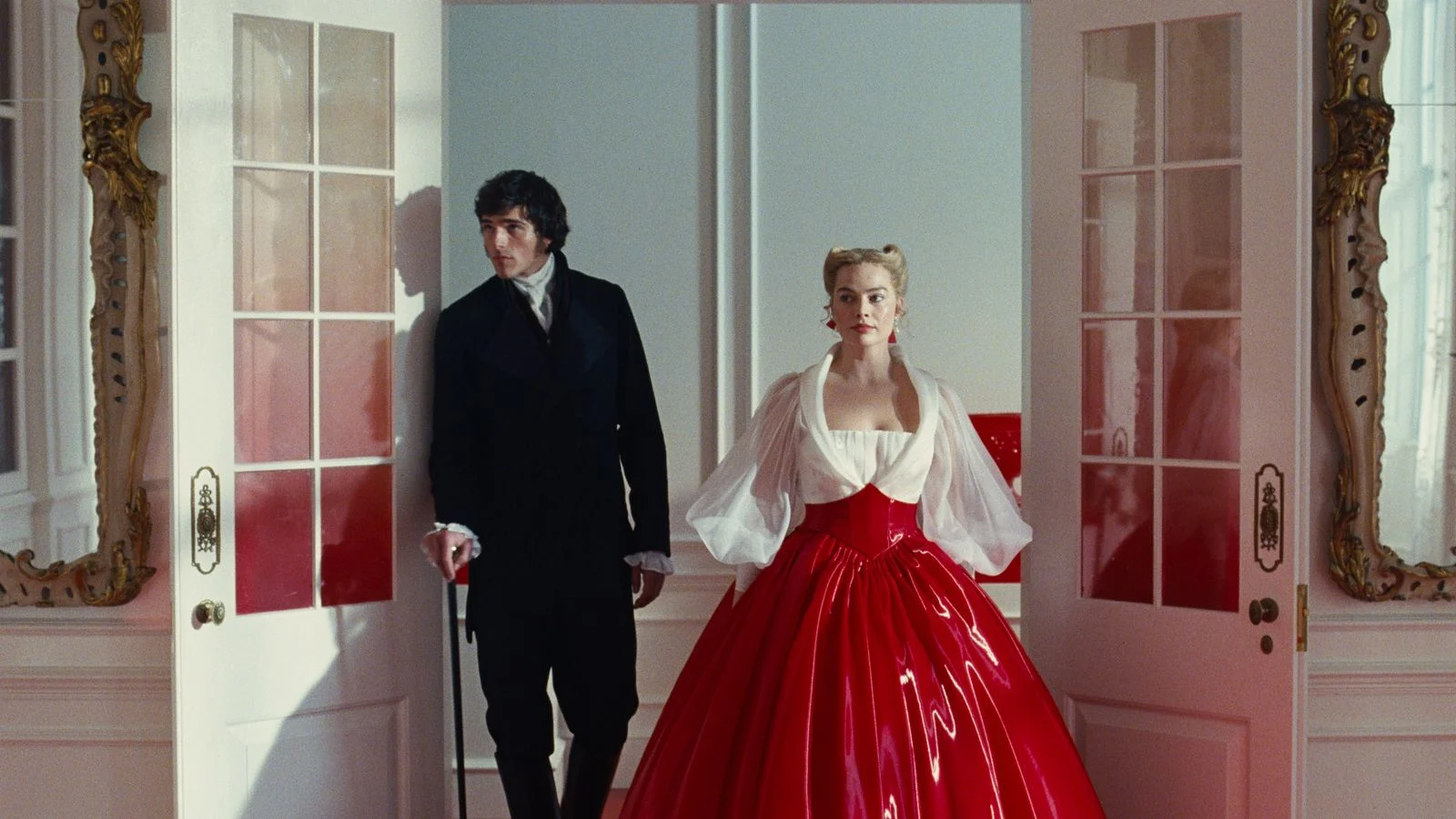
Considering the polemical nature of Wuthering Heights, which has been garnering sceptical interest since its first trailer was released, it seems tricky to offer anything that hasn’t already been said. However, hindsight is also a powerful tool in assessing the worth of a piece of work – and it is clear now, with Emerald Fennell’s, that there are a multitude of camps: the hardcore fans, the disbelief suspenders, the unconvinced, and the critics who see it both as abomination and insult to Emily Bronte’s original work, a gothic masterpiece and hefty tragedy. As an enthusiast of her work, I expected to find myself de facto in the latter camp. Nevertheless, coming out of it, I was shocked to feel more aligned with the disbelief suspenders – or, those who chose to accept Wuthering Heights as something separate to its source material, and embrace the entertaining slop bringing together two very attractive Hollywood stars. Then again, perhaps I was feeling generous that evening.
There is little use in recounting original Wuthering Heights as a baseline for this version – but grossly, Bronte tells the tale of Catherine and Heathcliff, raised as children together, enamoured in their teenage years, but forced apart by convention, social status, and their own pride, eventually descending into mania, destructive love, and obsessive revenge. Fennell’s version picks up some of these themes but, as many have been quick to point out, takes extreme liberties with the source material, completely thwarting its initial intentions. Where to begin, really? Aside from the fact that Heathcliff is not supposed to be white, described as “gypsy”-like and “dark-skinned” in the book, that Hindley, Catherine’s brother and Heathcliff’s prime tormentor, is omitted, that there is a whole framework involving their children and a new tenant that does not feature, that no, Catherine and Heathcliff do not have constant, insatiable passionate sex on the moors, Fennell’s version largely feels like a piece of heavily aesthetic fanfiction rather than an adaptation of one of the greatest pieces of English literature. There is a seemingly obvious fascination with Jacob Elordi, who plays Heathcliff, and a desire to follow him onscreen, to see him yearn and lick his lips and swing an axe over a poor piece of wood. As Catherine, Margot Robbie – regrettably much too old to play the swooning eighteen year old – clutches her pearls with nothing much other than an overly sophisticated British accent to guide her. When they eventually do get together, they are so unlikeable and Edgar Linton (Shazad Latif), Catherine’s husband, so kind and accepting that one cannot help but snort, suffocating on their insufferable nature.
Shocking too is Fennell’s decision to make the only two characters of colour – Linton and Catherine’s maid Nelly, played by Hong Chau – the villains. Linton supposedly keeps the two apart – rightfully so – while Nelly is the very reason that they could never be together in the first place, driven by jealousy to create a misunderstanding between the two of them, inevitably leading to Heathcliff’s disappearance. We all would have done it, maybe, but nevertheless, it’s a terrible, unthinking take. It is all well and good to adapt source material into a new genre, or with new intonations – but to hesitate with it is to do it a disservice. Fennell indeed never fully espouses the message she is trying to convey – to ingrain BDSM into Catherine and Heathcliff’s story is an interesting take, but it inevitably falls flat when most scenes feel lukewarm, more Fifty Shades than Secretary. None of the symbolism feels relevant – why is Wuthering Heights depicted as a barnyard with a glacier behind it and a gaping tunnel in the entrance? What’s with Isabella (Alison Oliver), Linton’s ward, and her dollhouse rendition of her guardian’s mansion? Why is Catherine’s wallpaper a printing of her skin? The tunnel is a vagina, the dollhouse symbolises her entrapment, the wallpaper her beauty – peace can be made with these easter eggs, but it cannot when everything always feels like a half-formed thought slapped into a horny screenplay. All performances are adept enough, particularly Martin Clunes’ offensive Mr Earnshaw, terrifying in certain scenes, and Chau’s no-nonsense Nelly who delivers an excellent retort to the by now hateable Catherine, but it all just feels a little bit off. Its only real redeeming feature is the fact that people, myself included, enjoy fanfiction and tart romance – it’s easy to revel in silly love stories, in dramatic sweeps of dresses over Yorkshire moors, of sex scenes that never quite fall into the realm of the uncomfortable. Unfortunately, I don’t think this is what Fennell, who based her rendition on her initial reading of the novel as a teenager, was looking to achieve.