
“When my soul fainted within me I remembered the Lord: and my prayer came in unto thee, into thine holy temple.” – Jonah, 2:7
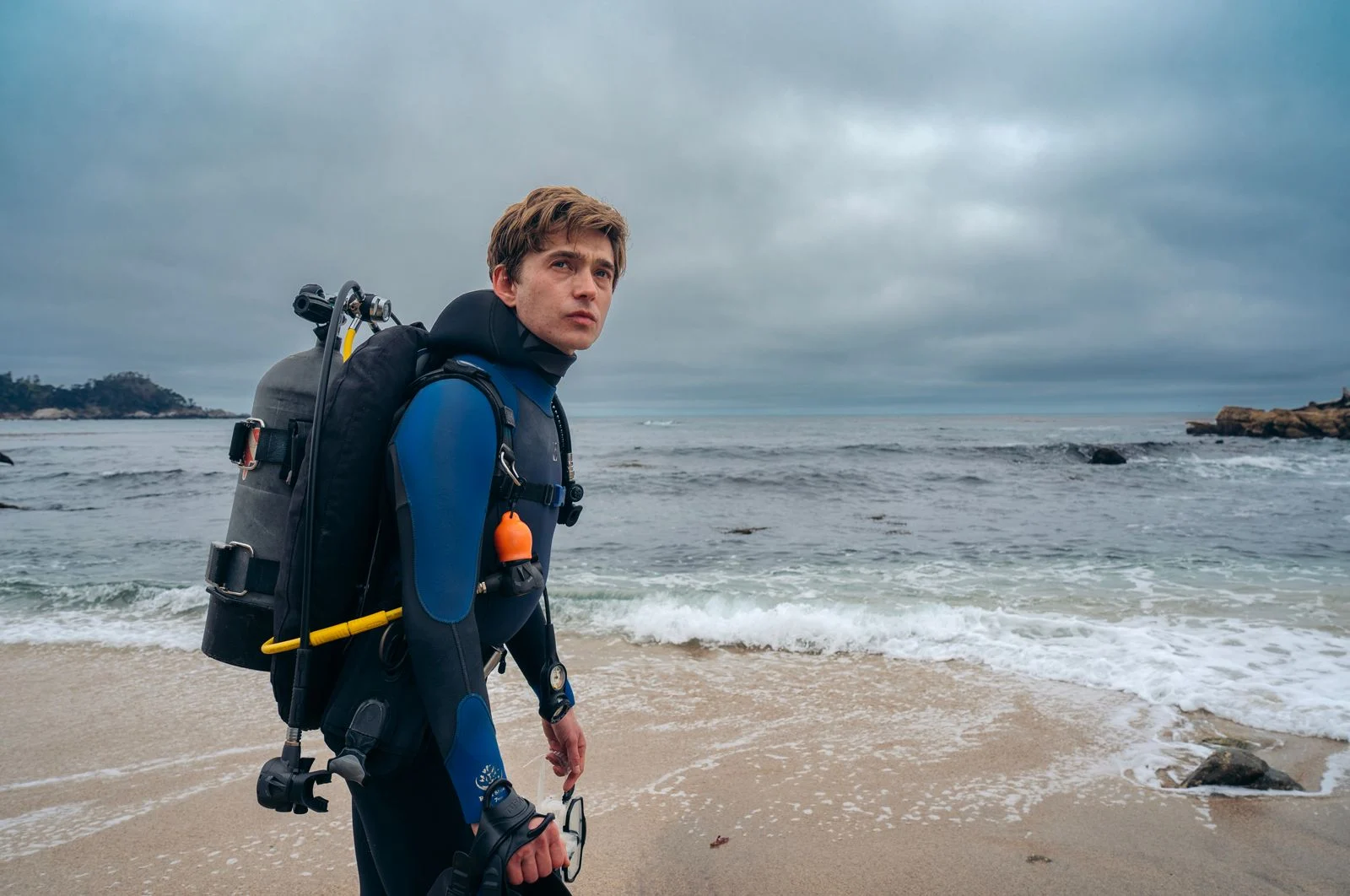
Thus spake Jonah, having jumped into the ocean to save those who were not doomed to die, only to be eaten by a great fish (the Hebrew does not specify whale; that is a construction of later art and theology) where he finds connection with the (heavenly) father whom he has been attempting to outrun. Whalefall, Brian Duffield’s latest abyssal thriller, is the story of a young man, Jay (Austin Abrams), who is swallowed by a seemingly fathomless cachalot while diving off the coast of his native California, and the ensuing struggle to escape. Fairly simple? Not quite. Backgrounding this Lovecraftian nightmare is a Jungian psychodrama of a boy wrestling with the loss of his overbearing, sometimes cruel, father-cum-diver who sought to instill in him all that which he would need to survive in a whale-eat-man world. Even so, it’s doubtful even Josh Brolin’s Mitt would’ve anticipated quite how biblical things would get for his son.
Duffield finds relief in what would otherwise be an almost unendurably claustrophobic ninety-minute torment by using Jay’s lowest moments to flash back to conversations between him and his father. In these scenes, and the few other conversational moments with his shallowly rendered (but admirably performed) female family members that serve mostly to exposit the emotional and situational circumstances, Duffield has opted for a refreshingly naturalistic style, marked by overlapping lines and improvisation, which helps imbue what could be a gratingly rote format with a sense of life, helping us invest in the more incredulous aspects of the film. As we near the end of the story, this naturalism gives way to something more aggrandised but no less truthful, with a moving voiceover by Brolin of which I shall say no more.
Whilst it is Brolin who towers in this cast, Abrams gives a no less admirable performance as the perennially-tortured Jay, who, like the other J from whom his story is taken, is far from the perfect hero: in particular it is his avoidant nature that he must learn to overcome. Abrams instils a humour and a likeability in Jay that provides levity even in the film’s nadirs, and his performance makes an implausible conceit feel all too frighteningly real. A special mention must also go to Elisabeth Shue, who does more than can reasonably be expected with her criminally limited screen time as Jay’s mother.
The real stars of the film, however, are the primordial and chilling sound design by James Miller, whose roarings, clickings and sloshings make a situation no viewers will have ever experienced feel more visceral and immediate than we might like, and Ramsey Avery’s production design, which gives comprehensible and defined geography to the whale’s interior when it could very easily have ended up a non-specific sludge of indecipherable organic matter. It is these, along with urgent but restrained editing from Pietro Scalia, that keep us engaged (and somewhat nauseous).
Carl Jung posited that the story of Jonah and the whale was a metaphor for death and rebirth, and that is very much the language of Whalefall. Aaron Morton’s cinematography at one point frames Jay almost as a baby in the foetal position in the whale, from which we cut to shots of Jay as an actual baby with his father. It is only by venturing into the belly of the beast that Jay can confront the most irrepressible foibles of his psyche and attempt to come to terms with those most gargantuan of beasts: trauma and loss. Duffield goes further, situating Jay within an ecological context as he learns to both fear and respect the whale and the creatures he encounters within it, and possibly even love them. Indeed the eponymous ‘whale fall’ describes the ecosystem that develops in the carcass of a whale after death: that is to say, we all return to the earth in the end.
Entering the cinema to watch Whalefall I did not think I was in for a masterpiece. And I wasn’t. What I got was as much as I could’ve hoped for: a competently made nautical thriller in the tradition of Spielberg and Cameron, with enough emotional depth to feel like it was the point rather than just an afterthought to fill the runtime. If anything it has made me curious to explore the book upon which it is based, which is perhaps as much as one might hope for from an adaptation of this sort of fare. Whalefall may not make too many waves, but it gets enough right throughout to keep its head above water.