
An ambitious functionary travels to the continent at the behest of his employer in order to close a deal with a wealthy client, who lives in a secluded stronghold high up in the mountains, a client of whom the locals speak with fear and avoid at all costs. In the night, the host draws blood from the neck of the visitor in an incident which, by the next morning, seems as if it was almost a dream.
Lovers of gothic literature will recognise this as the first act of Bram Stoker’s classic masterpiece, Dracula. It is also the plot of A Talent For Murder, a fictional reimagining of the final days of bestselling crime author Patricia Highsmith, written by Joanna Murray-Smith and based on her own play Switzerland, and directed by Anton Corbijn.
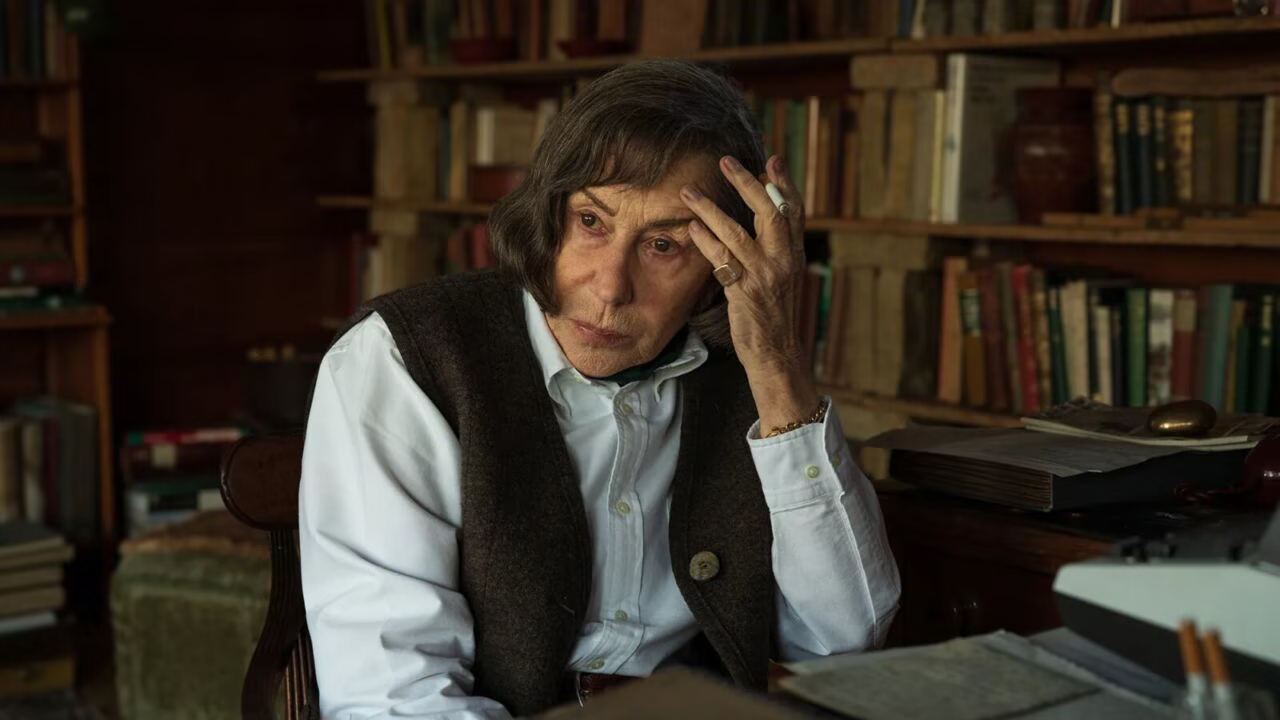
Patricia Highsmith, known best for her seminal thriller The Talented Mr Ripley and its eponymous antihero who went on to feature in a series of successive novels, cuts a formidable figure here, portrayed by the dauntless Helen Mirren in yet another of the powerhouse roles with which she has become indelibly associated. Opposite her is a passable but unremarkable Alden Ehrenreich as the unassuming Edward Ridgeway, whose own nature is perhaps not all that it initially seems. The cast is rounded out by the ever-reliable Juliet Stevenson as Peggy Balfour, a rich English socialite living nearby, and a particularly memorable performance from Olivia Cooke as her niece, Clementine, who becomes slowly entangled with Edward after a chance meeting on a train and must navigate a relationship with a man whose nature she does not truly understand. Cinematography by industry stalwart Robbie Ryan soars in its exteriors, loses a bit of imagination when confined to Highsmith’s mountainside residence, but is ultimately polished and aesthetically pleasing, and finds moments of genuine revelation, particularly around a menacing spiral staircase which serves as the threshold to the scriptorium.
There is nothing drastically wrong with this film. But it is also not particularly thrilling. Despite all the components of a tense, unnerving and potentially even disturbing two-hander, the overriding feeling for much of the film is of simple detachment, occasionally intermingled with a mild confusion. I was about as far back from the edge of my seat as I might be in a light comedy, which is not where I expected nor wanted to be for this type of film. When Edward first sees Highsmith in a remarkable piece of filming through a window, her reveal is accompanied by an almost comically bold musical cue that recurs every time Mirren emerges unexpectedly from the dark in this film – and that is about as scary as it gets.
Amidst the conversations between Highsmith and Ridgeway we experience cutaways to the imaginary world of Ripley, against the grand backdrop of Rome. The absurdity of some of the impromptu plotting that ensues could have given Corbijn an opportunity to lean in further to the pulpy pastiche and generate some humour, or to instead heighten the psychological stakes. Instead he does neither, and a great narrative device ends up adding very little. The story plays out as the characters describe and that is that. There is a suggestion later from Ridgeway about the way in which Highsmith identifies with Ripley or relates to him through the lens of her gender, sexuality and profession which perked me up considerably, especially after some fascinating context earlier regarding Highsmith’s relationship with her mother. The film, however, seems disinterested in exploring this much further, and most of the running time is instead dedicated to exploring a more surface-level connection between Ripley and Ridgeway himself, before culminating in a twist, clearly meant to shock, but which instead feels simultaneously obvious and trite. By the time the credits roll, the knee-jerk reaction is: “Was that it? Not that I mind.”
My interest in reviewing this film initially was piqued by having seen Switzerland at the Ambassadors Theatre back in 2018 and, aside from the premise, not being able to remember a great deal about it. Unfortunately this is how I imagine myself trying to recall A Talent For Murder in 2032. Despite clearly riffing on Dracula, much of that work’s incisive commentary and suspense is forgone here in favour of something more de rigueur. It was not an unenjoyable two hours at the cinema but it was not a memorable one either. I expect this to mildly entertain households nationwide in the few days between Christmas and the New Year when it inevitably ends up on streaming, which is probably where it belongs.
A Talent For Murder is in cinemas now.