
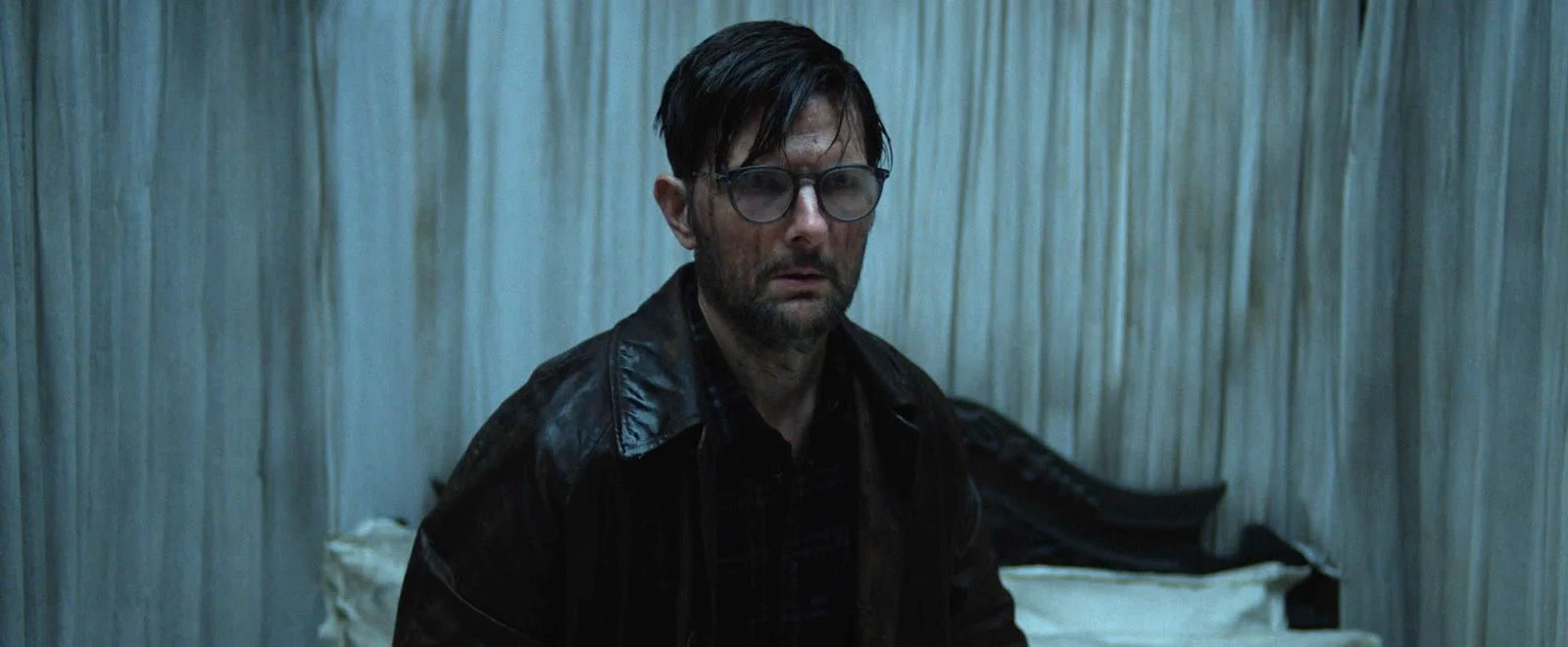
Adam Scott is strangely magnetic in the dark and twisted horror Hokum, Irish director Damian McCarthy’s latest instalment in what rapidly feels like a thematic trilogy alongside his earlier works Caveat (2020) and Oddity (2024). Tense, brilliantly shot, and deeply unsettling both in theme and setting, Hokum feels like a classic, Shirley Jackson-esque haunted house horror, but its rarity lies in its ability to allow supernatural and thriller elements to coexist comfortably without overloading the storyline. The result is something deep-rooted in Irish folklore, mythical and phantasmagorical – and yet, at the same time, disturbingly ingrained in reality.
Scott is the unhappy Ohm, a rundown and particularly unpleasant writer from the US who takes a trip to a hotel in rural Ireland where he appears to be the only guest. It was also his parents’ destination honeymoon, and where he believes they were last truly happy before his mother’s untimely death – so, fittingly, this is where he spreads their ashes, perhaps in the hope of finally making peace with it. Struggling with the ending of his novel, the hotel however brings up unhappy memories for him, particularly in regard to the honeymoon suite, prison to a four hundred year old witch according to hotel folklore.
Despite following the typical attributes of surly writer, Ohm is just the right balance of unlikeable and vulnerable – it helps that his cruelty is at times so odd that one cannot help but laugh. This is certainly no slapstick comedy, but rather behind-the-scenes, under-the-skin joking, from unwitting concierges to eerie happenings: in one scene for instance, the local homeless Jerry (an excellent performance from David Wilmot) explains that goats climb onto the bonnets of cars to see their reflections whilst high on his mushroom concoction. Colm Hogan’s brusque camera movements or sudden cuts may work in favour of terror, but at the right moments, they play a similarly comedic effect. At times in fact, Hokum almost feels like Fawlty Towers were it a horror film – Scott plays grump and angst with vigour, and the secondary cast, from bellhop to groundskeeper, mix in the same way bumbling attention to detail for the celebrity of the day with slightly uneasy local tradition.
Nonetheless, what Hokum does best is naturally its horror, and more particularly, its sudden scares at the least expected moment. Not only do they come out of nowhere, McCarthy’s script has an affinity for turning the tables at the most inopportune of times, so much so that every scene is near impossible to predict. Nothing is more impressive however than his craft paired with Til Frohlich’s production design and Ciara McKenna’s set decoration. The hotel and its interiors are a treat to the eye, a grizzly location caught up in an indeterminate period, and full of nooks and crannies leveraged for the jumpiest of experiences. Dumbwaiters, hidden doors behind vanities, creepy statuettes of children being led into the forest – anything and everything could lurk in, behind or under anything and everything, Hokum tells us, and when the monster does come, it is (to begin with at least) partially hidden by the curtains of a marital bed, through distorted glass panes, upside down at a distance. Needless to say, whatever the moment, whenever the moment, Hokum will certainly catch you off guard.