
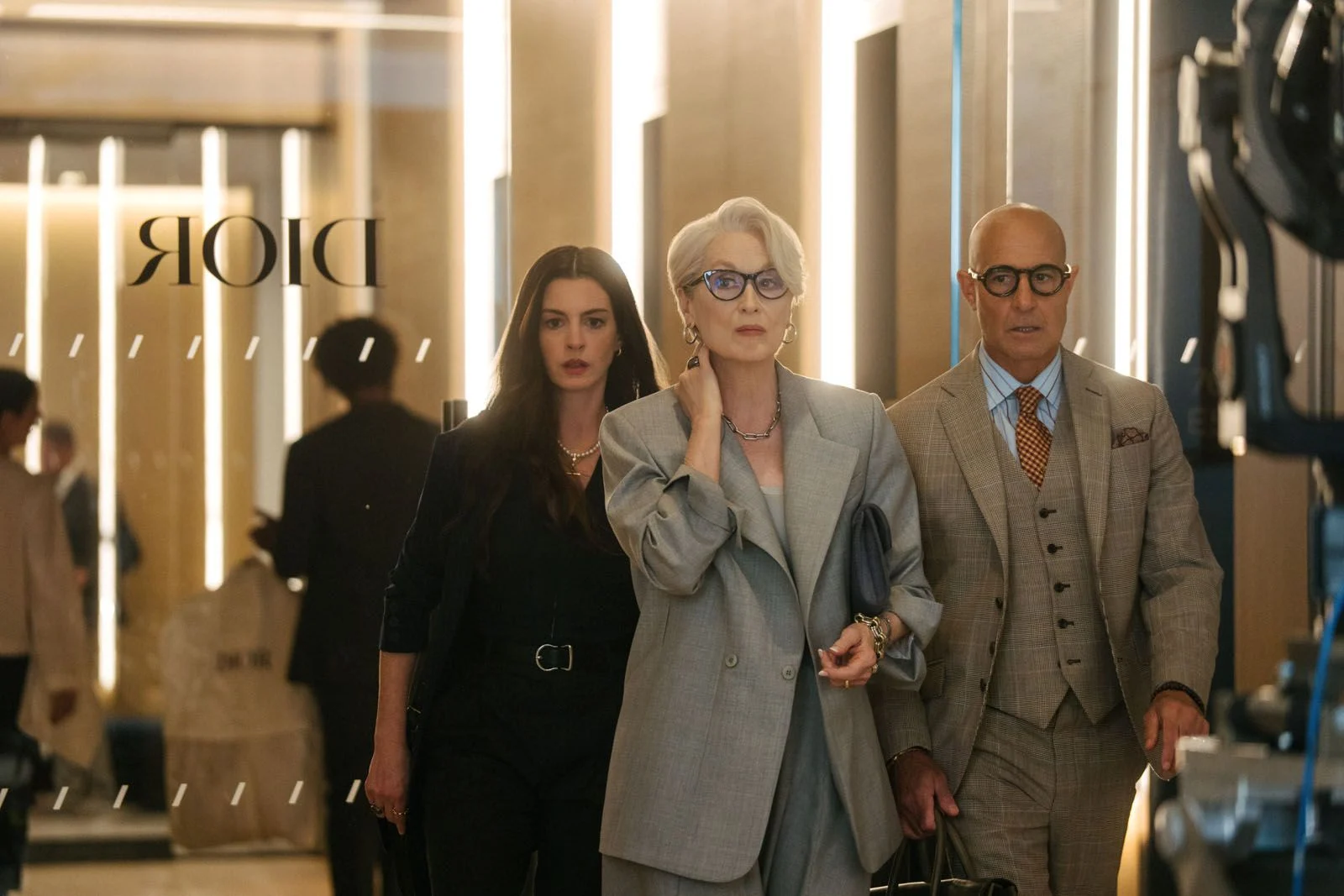
It has been twenty years since the team at Runway coined some of the most iconic phrases in comedy lore today. In the words of Nigel then, all loins were girded for the surprise sequel of the much loved original The Devil Wears Prada, the adaptation of Lauren Weisberger’s novel that grossed over 300 million dollars upon its release and essentially launched Emily Blunt’s career. But while this has stood the test of time, idioms and all, it is fair to say that The Devil Wears Prada 2 is unlikely to – despite an on-form return from the entirety of its core cast and an as ever stunning wardrobe, there are just too many faux pas on this catwalk.
Two decades after leaving Runway, Andy (Anne Hathaway) is now a respected journalist – however, at an awards ceremony, she and her entire newsroom are laid off by text, leading her on a acceptance-speech-cum-tirade about how “journalism still matters”. Meanwhile, back at Runway, editor-in-chief Miranda (Meryl Streep) is under fire after failing to vet a piece about a brand using sweatshop labour. To preserve the magazine’s reputation, owner Irv Ravitz (Tibor Feldman) hires Andy as Runway’s Features Editor – and with Nigel (Stanley Tucci) still working tirelessly behind-the-scenes and Emily (Emily Blunt), now a senior executive at Dior, threatening to pull their advertising, she certainly has her work cut out for her.
Looking at The Devil Wears Prada 2 from a topical point of view, there is, really, no other route that the script – written by Aline Brosh McKenna, who also penned the first one – could have gone down: everywhere artificial intelligence threatens the livelihoods of writers and publications, and the film isn’t slow to establish it as public enemy number one. The issues however is not so much the conflict but the way in which it is addressed as, while Runway is being washed out, forced into clickbait material and cheaply made short-form content, and Andy watches her options shrink and her serious articles go unread, this translates onscreen to a complete lack of tact and nuance, because, quite simply, characters just say things. Andy launches into monologues about the death of journalism, shouting from the top of the hills about how important her voice still is, while Nigel laments that he has a third of the budget to create ten second videos people watch on the toilet. This is no secret to anyone, and it is wasted space in a modern society that already understands the impact of artificial intelligence on writing – not to mention that never does The Devil Wears Prada 2 attempt to assuage these grievances by offering a bit of (very real) hope that writing is still meaningful.
This bloated approach also extends to scenes that could have had a genuinely comedic, cult impact – Lady Gaga is a wasted opportunity, a measly couple of lines in response to Miranda, with whom she has an apparent rivalry that is addressed for half a minute. Lucy Liu plays the divorced wife of a Silicon Valley billionaire (Justin Theroux), a recluse who lives in the countryside by herself and who has let her marriage “define her”. A poor script even goes as far as to impact the leads’ very personalities – Andy’s (re)introduction to Miranda is nothing short of cringe-worthy, and though this is the point, it is directly countered by the closing “lesson” at the end of the first instalment, that sense of emancipation, albeit appreciation and acknowledgement for everything Miranda had taught her, in her own twisted way. Twenty years in the field and a status as a respected, award-winning reporter would have only reinforced that – yet no sooner has Andy set foot in the Runway office has she reverted to square one, making for very poor (and to be honest, very annoying) character development. Her publishing friend says it best: “Stockholm wants their syndrome back”. Wouldn’t it have been refreshing for Andy to stand her ground, and for Miranda to accept this without losing her trademark villainy?
A sequel would not be complete without a roster of fresh new faces, and while Simone Ashley’s Amari, Miranda’s new first assistant, is the perfect level of cold and a wonderful recall to the original, the rest are a confusing mish mash of characters who are neither amusing nor memorable, and only service the plot for roughly one point five scenes. These are Kenneth Brannagh as Stuart, Miranda’s new husband apparently, though he gives more butler vibes (use: lets Andy into Miranda’s house and walks the dog); Patrick Brammall as Peter, Andy’s love interest (use: as a property developer and renovator of old houses into cold modern ones, he has a good metaphor for artificial intelligence – improvement, embellishment, etc. etc.); Helen J. Shen as Jin Chao, Andy’s assistant (use: she manages to record an important conversation on her phone); and Rachel Bloom as Talia, Andy’s friend (use: she wants Andy to write a very expensive book). It’s difficult to critique a sequel without brief comparisons to the first, but it is undeniable that even with limited screentime, the secondary cast of the original was a lot stronger, and continues to solicit discussion (we will never hear the end of the “was Nate the villain?” debate, for instance). Amari aside, the only other characters who offer anything mildly interesting are B. J. Novak’s Jay Ravitz, the heir of the publishing house, and Justin Theroux’s Benji Barnes, the aforementioned Silicon Valley billionaire, who bring dystopian visions of the future in which fashion is either obsolete or a product of artificial intelligence (“no designers, no models, just AI”).
It is always pleasurable to see old characters return – the stardom of its four core cast members, and their friendship/familial ties (Tucci is now brother-in-law to Blunt following his marriage to her sister Felicity) over the years, has only contributed to the feeling that this sequel feels like a happy family coming together again. Naturally, no expense was spared from a production design perspective – costume designer Molly Rogers is the standout here, with a wardrobe of memorable outfits such as Miranda’s tassel jacket, or Amari’s, made of ties. If there was carnage when the first trailer was released due to “the sad colours of Netflix”, the costume design more than makes up for it. Unfortunately, The Devil Wears Prada 2 is a product of what it criticises – the script is reduced at times to slop, and its high-stakes corporate reputation/downfall of creative jobs feels as oversaturated as its colouring. There was something quaint about this universe, a couple of offices and a quick trip to Paris, a cheese toastie in a tired-looking apartment. But in its efforts to portray modern society, The Devil Wears Prada 2 becomes just as newfangled – new, washed-out offices, Milanese villas, over-the-top galas. If the original is what Runway used to be, the sequel is like the retail brands it seeks to admonish – more money, more means, but far less class and elegance.