
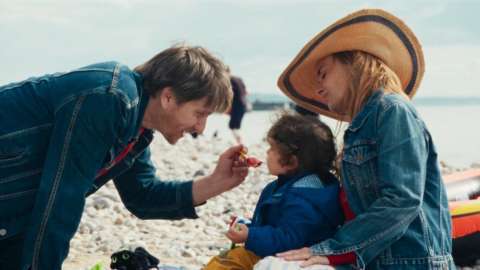
Élodie Bouchez is magnetic as a determined mother in Laetitia Masson’s Ulysse, a love and resilience epic about a boy born with a genetic condition and his growth from his first to eighteenth year. If there is a relative simplicity to this tale about what it is to live with disability, it is more than made up for with its gentility and tenderness.
Alice (Bouchez) and partner Volodymyr (Stanislas Merhar) are overjoyed when they find out they are expecting. At one years old however, their beautiful son Ulysse is still not walking or recognising simple tasks, resulting in the diagnosis of a genetic condition that will slow his learning capacities. While the couple struggles under the weight of countless doctor appointments and the “rights” and “wrongs” of raising a differently able child, Alice will stop at nothing to ensure Ulysse is given the best education and the best opportunities available to him. No is never an answer for her.
Ulysse is a gentle film, carried by a rostra of actors with the communal ability to showcase the tenderness in humanity – as in Jeanne Herry’s Pupille (In Safe Hands, 2018), Bouchez plays the dedication of motherhood with natural ease, her smile up to her ears wetting the eyes at each instance. Husband Volodymyr meanwhile struggles with the limitations his son will have to face due to his condition, a very real reaction that culminates in him moving to America to pursue his musical career – this should be cause for outrage, and yet Masson emphasises the love that prevails. The trio maintains a warm relationship, Alice and Ulysse’s homelife frequently accompanied by the sounds of Volodymyr’s piano playing, a symbol that he is still with them despite his distance. At a certain point in the film, Alice develops a strange relationship with one of her son’s doctors Ahmad, played by renowned French rapper Gringe, something a little off the cuff and perhaps too far-fetched here – they find unity in their mutual experience (his daughter is also disabled), but the circumstances of their attraction are a little unclear and contradictory to the film’s message (he is married and yet neither questions hanging out as a foursome in a field of grass, apparently guilt-free).
With four actors playing Ulysse at different ages, there is an impressive regularity between them, with the standout performance from the eldest, Alphonse Roberts, as Ulysse begins to come into himself. Meanwhile, Romane Bohringer as Alice’s friend offers up the comedic relief necessary to alleviate any tension, the fun aunt personality along with her partner who, in one of the most moving scenes of the film, calmly tells a baby Ulysse to “just take his time”. It’s a beautiful way of normalising his disability without downplaying it, echoed by the many doctors who Alice will cross paths with, assuring her that things will be slower for him, but that he will manage in the end. There is something to be said about the apparent absence of Ulysse’s voice in a film named after him – rarely is he filmed alone, for instance. Nevertheless, in many ways, Masson’s message mirrors Alice’s fight, one that, for better or worse, Ulysse cannot do without her – it is only when this steadfast mother has fought for her child’s rights that he can begin to blossom without her by his side in every frame.