Up until a year ago, all I knew about Anthony Bourdain, infamous celebrity chef, was that he believed Ratatouille was the most accurate portrayal of haute cuisine cooking in film. And because he was Anthony Bourdain, his word was gospel. As a longstanding fan of film and Ratatouille in particular, I spouted out this fact to anyone who would listen – Pixar had gotten it right. Anthony Bourdain had said so. The communication between chefs, the cleanliness of sleeves, the bustle of a busy night. And it was a film about a chef rat. So suck on that.
Then, upon a routine visit to Waterstones, I picked up Kitchen Confidential, a twenty fifth anniversary edition of Bourdain’s memoir/warning to aspiring chefs. And from there, I learnt a little bit more. Bourdain’s first brush with food on a family holiday in France, his beginnings in a seafood restaurant in Cape Cod, his long-term struggles with substance abuse. I lapped Kitchen Confidential up like warm soup on a winter’s night, totally obsessed with his every move, his intricate descriptions of fellow chefs and delicate plates of food, nodding furiously to the Sunday Times’ statement that it was “more gripping than a Stephen King novel”. Christ, I had to put the bloody thing down out of brute force, just so that I could stretch out the experience. It’s surprising that for a vegetarian, and a picky eater vegetarian at that, I should be so taken by descriptions of oily meats and lobster. Bourdain hated vegetarians, and he ate everything, even the risky bits. But I didn’t care. I relish in hearing about people cooking food, meat and all. Put to the page, and suddenly it doesn’t disgust me at all – reading about the prep, cuisson, arrangement on the plate, was music to my ears, my version of savouring the meal.
It was mid-book that I heard a biopic entitled Tony, starring Dominic Sessa, was set for release in August. A marvellous coincidence, a way to keep the dream going even once the book was put to rest. The trailer however had me twisting in my seat in angst. Biopics – loose, half biopics at that – are controversial at best, always somehow embellishing or lacking, never completely loyal to their subject. There have been a few takes already on whether Bourdain would loathe a biopic – he was cocky in his own words, but also seemingly uninterested in fame and public image. Or so his persona said. Considering his documentary work and tendency to somehow, always, end up in the spotlight, there has been a certain debate about the topic. The problem with Tony in my eyes, however, is not the film itself – become famous and sooner or later, someone is going to make a film about you. I’m certain that, whether he liked the concept or not, Bourdain would have been matter of fact about this. The problem instead is that Tony’s trailer, and what its form hints the film will be, essentially renders his first experiences in a kitchen to a coming-of-age summer flick.
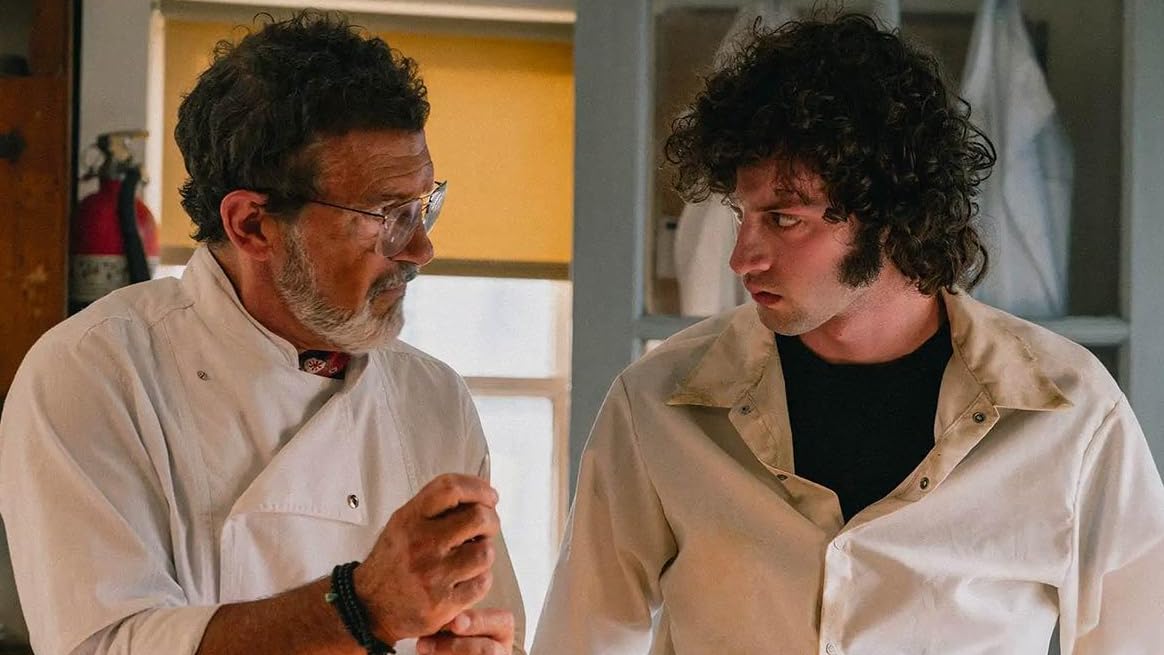
It’s a clever choice to cover only a portion of Bourdain’s life – and where better to start than where he did. Less clever however is the adoption of a generic August-by-the-sea tale in which half of the film is dedicated to the kitchen, and the other half to the girl who distracts from said kitchen. “This is a coming-of-age story”, Sessa spells out for us in the first shot. Later on, “THIS SUMMER” appears tauntingly on the screen, quenching the thirsts of those looking for nice shots of the beach. Bourdain is intent on being a writer in 1976 Cape Cod, but the scholarship he was banking on does not come through and, desperate for money, he picks up a job at a seafood restaurant under the talented ‘Chef’ (Antonio Banderas), who trains him up and shows him “the beauty of food”.
Of course, we cannot assume writers tell the truth – all we know from Bourdain’s portrayal of events was that it was a messy, drug-fuelled rollercoaster, in which self-destruction and passion co-existed, cancelled each other out, merged to the point of becoming one. Tony’s trailer showcases instead a tired, archetypal script, a Sainsbury’s advert-like discovery of cooking – and most destructively perhaps, a love story. Let us be clear – Bourdain was as consumed by women as he was by drugs. This is not to say that they play any part whatsoever in Kitchen Confidential. “In 1973, unhappily in love, I graduated high school a year early so I could chase the object of my desire to Vassar College – the less said about that part of my life, the better, believe me”, he writes, the first sentence of the second chapter fittingly entitled “Food is Sex”.
There is very little sex depicted, believe me.
Kitchen Confidential is instead about Bourdain’s sex with food, in which his “on-again-off-again girlfriend [spinning] pizza for a living” is just a part of a list, in between his need for money and his roommates’ jobs waiting tables. Bourdain loved his wife and high-school sweetheart Nancy, a stable presence in his life who he alluded to as “dealing” with his shit. But to turn his biopic into something that could easily be renamed “Summer of ‘76” is doing him – and his journey – a disservice. “Are you a bad guy or a good guy?” Nancy, portrayed by Emilia Jones, asks Sessa’s Bourdain at the midway point of the trailer. We don’t care. This is not what 1976 Cape Code was about. Whatever happened to films about teenagers that don’t involve the side quest of a love story? Whatever happened to allowing someone to be themselves without having to rewrite their life into a money-grabbing genre flick? There was no need to cut romance out of Tony completely, but there was also no obligation to turn it into a kitchen vs drugs vs girl dilemma. Its apparent performance of messiness – Sessa being kicked into the gutter after a particularly drunken night, or hastily pushing Jones up against a wall with horny aggression – does not in any way service Bourdain’s legacy. It might be clear by now that I didn’t know Bourdain, nor was I even aware of his existence during his lifetime (he tragically committed suicide in 2018), but if we are to rely on his writer’s voice, it is clear that he disliked sentimentalism and never saw any obstacle in his quest to becoming a chef besides his own limitations. Women and drugs were simply always a part of his life, and I found Kitchen Confidential infinitely refreshing in its tunnel-vision and its author’s honesty about his vices. Bourdain certainly was not afraid of coming across as “the bad guy”. He ravished cooking – his passion emanates from every pore, and every word is dipped in a deep obsession for the art of food. At times, it is clear he doesn’t care about anything. So – unless the trailer has focused on the wrong aspects – why doesn’t Tony make it look as such?
I guess we’ll find out in August.