
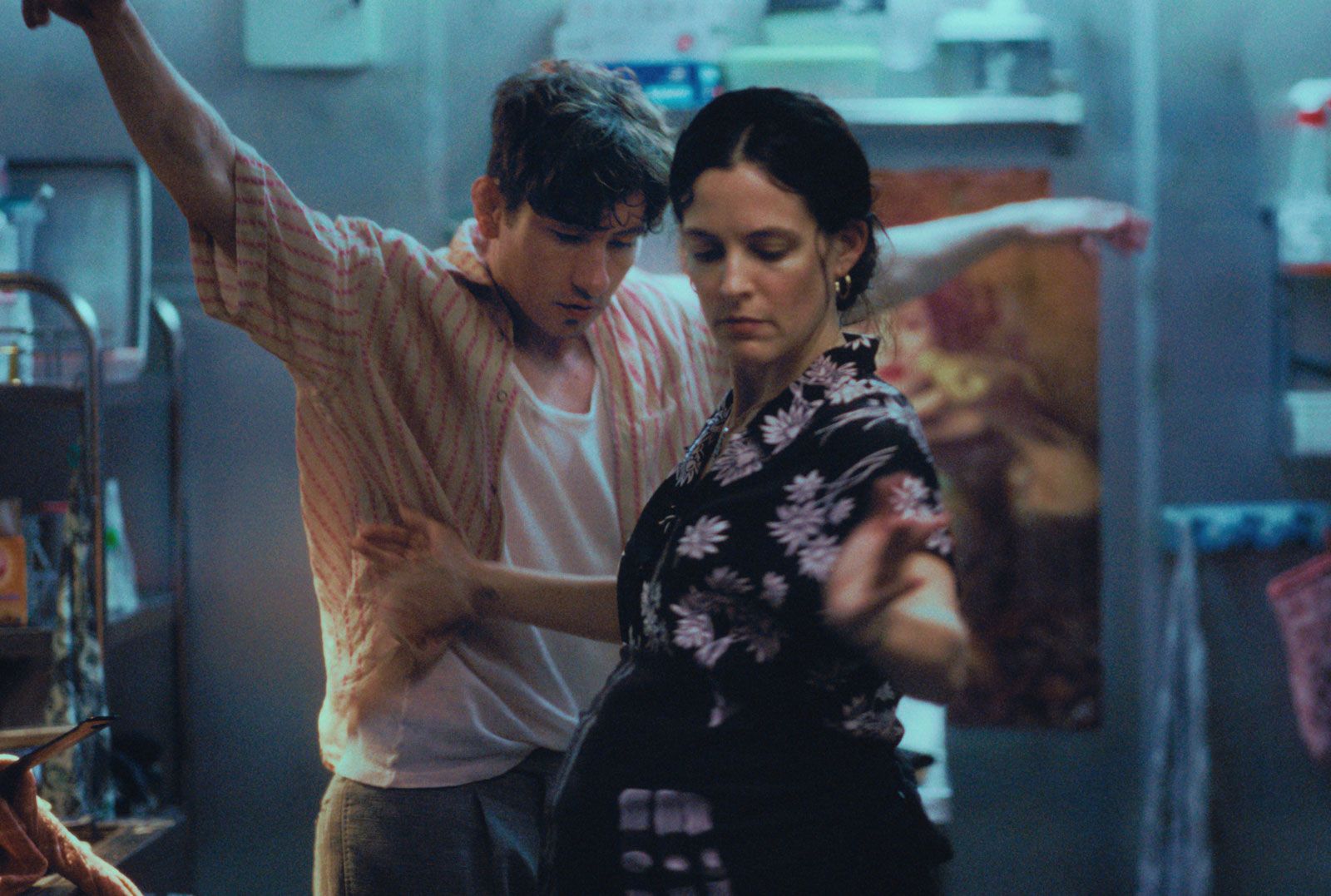
Barry Keoghan and Harry Melling star in this strange drama from Kantemir Balagov in his English-language debut, following the Circassian diaspora in New Jersey, that has all the components – location, actors, concept – to do well and yet never quite delivers on its promise. Although it has its moments, it feels astonishingly empty for a film with so many moving parts, and despite some solid performances, none of its characters ring true until another one steps forward to spell it out.
Sixteen year old Pyteh (Talha Akdogan) splits his time between the wrestling mat and Zalya, his family’s struggling diner named after his aunt (Riley Keough) where his father Azik (Keoghan) is the chef. Known for his delen – a traditional Circassian flatbread – Azik and close pal Marat (Harry Melling) waste their days away playing cards and concocting up nonsensical ideas to save the diner, the latest being a cotton candy machine. But when his father makes a spur of the moment decision, Pyteh is quickly confronted with the difficult step of becoming an adult – and a man, whatever that may mean.
At a surface level, Butterfly Jam is as sweet as the spread its characters dig into – there is comedic value in Melling’s Marat, who is taken down by Pyteh within seconds upon trying to wrestle him, and beauty in the relationship between son and father, as well as the locale where events take place. Nevertheless, it is noticeably hindered by its characters’ apparent lack of personality – Keough’s Zalya is simply “pregnant” and “strong-willed”. Azik is impulsive. Marat is the resident clown (until he isn’t). Pyteh meanwhile harbours a crush on one of the girls from his wrestling class, who is crippled by body dysmorphia. There is a particularly shocking cumulative scene that feels completely out of the blue, bordering on the inane, simply because neither character involved had previously exhibited traits that would have led them to such behaviour. Even Pyteh’s wrestling, supposedly his biggest commitment and potential future, feels surface level, reduced to one or two scenes in training and a sole competition watched on television with his father rolling around on the sofa like an overexcited child. Strangely, when taken at a macro level, all of Butterfly Jam’s elements feel like they should work – but because they are brushed at such surface level, they feel inconsistent and strangely inconsequential. A bird gone missing, the child concerned about her looks, the failing diner… even the jam Azik is so proud of is only addressed once. Is it just that they are actively crushing beautiful, delicate things in a clichéd reference to the death of childhood, or – even more simply – to the death of beautiful, delicate things? Along with this, perhaps most upsettingly, Butterfly Jam also fails to say anything real about immigration and the diaspora it seeks to portray – at the end of it, the most consequential fact it has shared about Circassians is that they have a famous bread called delen.