
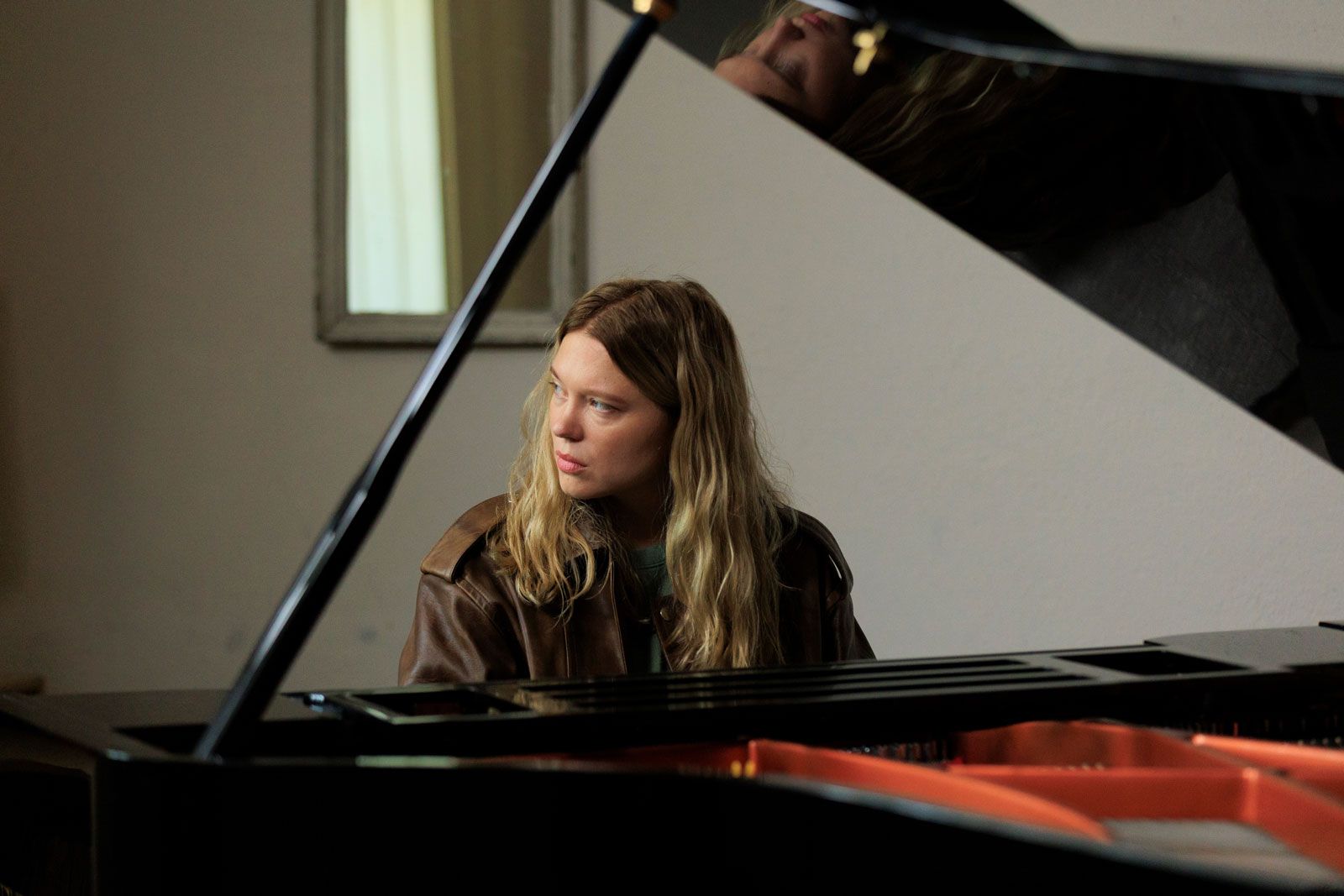
“There is only one thing worse than having children for a female artist”, Catherine Deneuve says in Marie Kreutzer’s drama Gentle Monster, “and it’s moving to the countryside”. If Lynne Ramsay’s recent Die My Love is anything to go by, she certainly has a point. Naturally, this also applies to her pianist daughter onscreen Lucy, played by Léa Seydoux, whose life unravels following a move with husband Philip (Laurence Rupp) and Johnny (Malo Blanchet). Set against the lavish greenery of their garden and old brick walls of their new secluded home, Kreutzer treats the topic at hand with great care, if slight obviousness at times. Seydoux meanwhile plays the grieving wife excellently – it’s a performance that may not ever be considered her standout, but will nonetheless emerge as a hidden gem worthy of discussion.
After husband Philip experiences a debilitating burnout, the couple and their son move to the countryside to help with his recovery. At first, it is bliss – trampoline afternoons for the boy, piano practice, sex on a mattress on the floor. But when the local police show up one morning and confiscate Philip’s electronics, Lucy is forced to confront a very new reality, and an unthinkable facet of the man she loves.
Following the release of Kreutzer’s Corsage, its lead actor Florian Teichtmeister was charged with possession of child pornography – Kreutzer was subsequently criticised for her reaction to the situation, notably by making the decision to keep Corsage on the festival circuit. Gentle Monster draws directly on this experience, focusing intensely on Seydoux’s character and on the coming to terms with rather than the act of. Uncertainty plays the role of main character here – while at first Lucy is left in the dark as to what is going on, her reaction then oscillates between visceral disgust for her husband and a desire to understand. Love doesn’t just go away, she says when her mother (Deneuve) suggests that she never see him again. So there are only two ways she can move forward: she needs to find a reason to still love him, or a reason not to. Gentle Monster focuses in on this search – but with doors shut to her and no one to speak to, it is an inherently difficult one. It may be said that Philip isn’t given the screentime necessary to create a fully-fledged character, but then this would be doing Lucy’s story a disservice – Kreutzer makes sure to leave him a question mark, even when they are face to face, discussing the trial at hand. Both, in their presence and absence, are excellent, together and apart, and Rupp does an excellent job of creating the “gentle” in “monster.” In the same way Lucy struggles, it is difficult at times to see the latter half, especially when a particularly striking opening scene sees him experience a vicious panic attack his wife must bring him down from. Instead, Kreutzer allows both Lucy and audience to piece together the character, bit by bit, in a tense exchange, or in a daring flashback at the two thirds mark, which Lucy revisits and we are invited to experience for the first time.
Despite its strengths, Gentle Monster harbours a few dissonances that render its message a little muddled at times. Parallel to Lucy’s story for instance sits Philip’s investigating officer’s, Elsa (Jella Haase), who is dealing with a father with dementia who won’t stop touching his carer inappropriately. When Lucy tries to confide in her, she remains a closed door, out of professionalism, but also as a form of self-protection. There is something to be said about the common thread between the two storylines, but there is too little screentime and too wide a gap between sexual harassment and paedophilia for there to be any real message here – it feels somewhat discordant, ill-placed. In the same vein, Lucy’s music, a terribly awful modernised take on eighties classics comprising of two pianos and a xylophone of rotating crystal glasses, seeks to shine a new light on songs written by men, those who rarely speak of their emotions (most glaringly, she reprises The Cure’s Boys Don’t Cry). There is a certain dissonance here again – is the problem here really that Philip never expressed himself, and that this is why he has sought this type of content? There is something to be said about both situations – but attempting to fit these two lines of discourse together feels inappropriate, and shines the light away from the film’s true story, a woman trying to make sense of the monster she loves.