
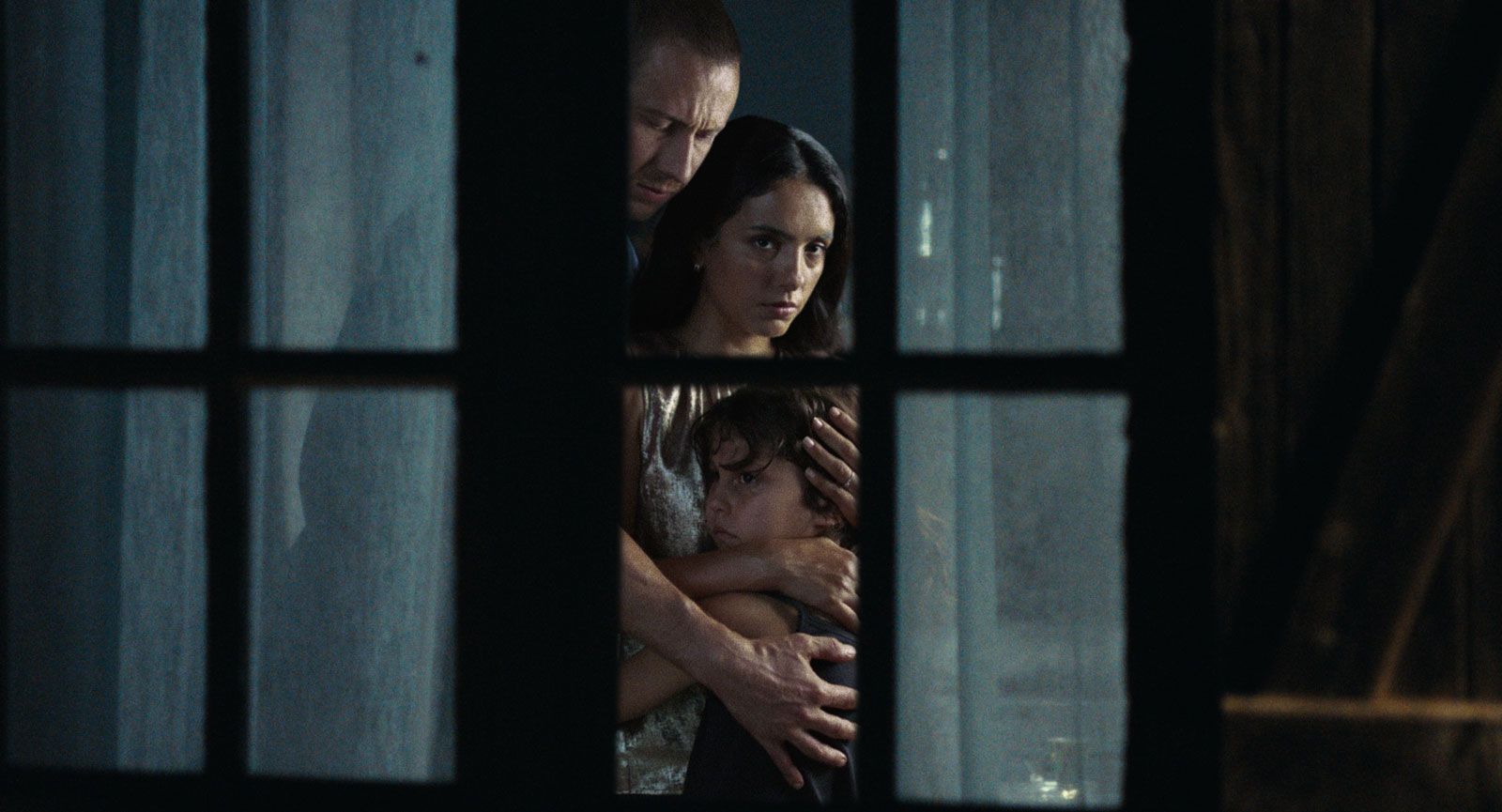
Based on Laurent Mauvignier’s 2020 novel, Léa Mysius directs this tense and thrilling adaptation of a birthday party gone wrong in rural France, a classic home invasion story that distinguishes itself with something more than brute violence. It’s somewhat of an atypical entry for Cannes, a crime film that might be a little too thrilling for the taste of some – and yet, with its quiet political commentary and understated performances, it very much has its place in this year’s competition despite its faults.
Nora (Hafsia Herzi), Thomas (Bastien Bouillon) and their daughter Ida (the fantastic Tawba El Garchi) live on a secluded farm with only one neighbour for company, Italian artist Cristina (Monica Bellucci). On the day of Nora’s birthday, as her close ones prepare the festivities, three men (Benoît Magimel, Paul Hamy and Alane Delhaye) show up at the house uninvited, waiting for one thing – the birthday girl’s arrival.
Mysius excels at building tension from the moment Ida comes home to an empty house through to the development of the action, though there are times – both in the buildup and in the second act – where there is perhaps too much buildup, inevitably stagnating slightly. The set design, particularly Cristina’s cold, modernised take on the farmhouse filled with her abstract art, serves the intrigue well, and cinematographer Paul Guilhaume captures chaos fantastically, homing in on a furtive glance, the tensing of fists, titillating between invasion and intimacy with bravado. The film is classic in its setup of the “bad guys” – there’s the big dog, the ring-leader, played by Magimel who, strangely, looks more like a Siegried and Roy impersonator than a Goodfella. Hamy is excellent as the dangerous middle child (it’s worth noting that he also starred in Olivier Abbou’s 2019 Furie, a home invasion thriller with striking similarities to this one), while Delhaye lends a vulnerable performance as the dim-witted henchman who is, in fact, not that dim-witted. His dynamic with the every classy Bellucci, his sole prisoner while the “big boys” converse in the house next door, is brilliant, at times even tender.
There is a certain lacking in context as the pieces come together, a little more meat that may have benefited Nora’s character, especially given Herzi’s slightly stoical performance. The surprise standout instead is Bouillon, who outperforms everyone and who, beside Bellucci, a strange sort of “odd one out”, feels the least caricatural – perhaps Histoires de la Nuit might have been more interesting from his perspective, belittle by three men invading his home, claiming to know his wife, treating his daughter like theirs. He is a marvel to watch, a physical embodiment of the brute, poisonous force that can at times be exchanged between men.