
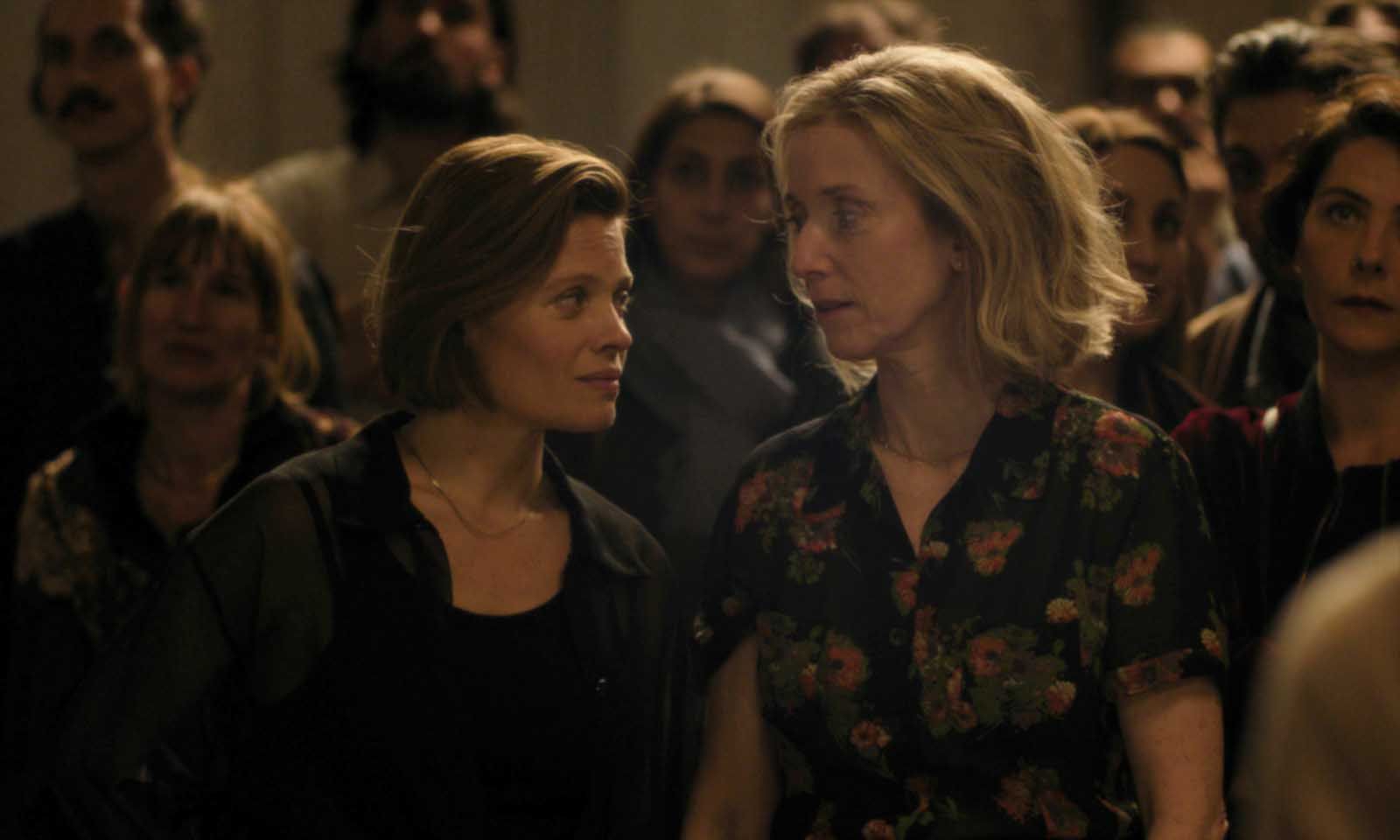
Léa Drucker is magnetic as a high-flying surgeon in Charline Bourgeois-Tacket’s second feature film La Vie d’une Femme (A Woman’s Life), a “portrait of a lady” told in eleven, almost fantastical chapters over the course of a few weeks. With a script that feels like poetry and a gentle approach to the filming of its characters, it feels, despite the pressure under which its protagonist is, like floating on a cloud, a truly heart-warming cinematic experience and a brave portrayal of a woman in her fifties whose life does not revolve around motherhood.
Gabrielle (Drucker) is head surgeon in her department, where she specialises in reconstruction post-accidents. In other words, she gives people their faces back – during a seminar, she explains, almost philosophically, that her goal is not to give them their “original” faces back, but rather to ensure that heads do not turn towards them in the street. Married to Henri (Charles Berling), stepmother to his two grown children who still live at home, and carer to her mother (Marie-Christine Barrault), recently diagnosed with Alzheimer’s, Gabrielle’s life takes a turn when novelist Frida (Mélanie Thierry) shows up at the hospital to shadow her in preparation for a novel.
Drucker is impossibly suave as Gabrielle, script and performance creating a true tour de force here – I, for one, could listen to her speak all day. In the most tense of situations, she is calm, measured, and even in her harshness – when her interns do not show up for work, for instance – there is an undeniable civility that exudes self-respect (and in turn, respect from others). There is great cohesion in the way in which her relationships to each of her close ones are presented – first, Henri, who has become a sturdy and trustworthy piece of furniture in her ecosystem. Berling portrays the devout husband here with great vulnerability, susceptible to his wife’s success and yet forevermore supportive, even when the occasional outburst occurs. They are wonderful together onscreen – it is almost a shame that more time is not dedicated to them. Then, there is Kamyar (Laurent Capelluto), her second in command, who has become her friend over time, and who is bulking under the weight of work and a new baby, which necessarily stirs conflict with the childless Gabrielle. This is treated with great dexterity and care, and no character is ever treated as a victim or perpetrator. In another chapter, Gabrielle’s relationship to her mother is explored – here again, La Vie d’une Femme might have benefited from a little more development for, when Gabrielle’s sister asks her why she goes to so much effort for a woman who was never there for them during their childhood, there is the want for a little more context. And of course, there is Frida, the breath of fresh air, the theoretical to Gabrielle’s practical, the imaginary to her realism. Both women exercise a tremendous amount of respect for each other, and it is a wonderful, soft feeling to behold onscreen. Despite disagreements and tensions and the immense pressure of Gabrielle’s job, Bourgeois-Tacquet never allows things to get out of hand – in many ways, the film mirrors Gabrielle, her precision, her ability to compartmentalize (quite literally, with the chapters), her steadfastness. The subject of her selfishness is treated quite often – the aging woman without a child is a complex character, one that is still stigmatized, and yet, what La Vie d’une Femme makes clear through Gabrielle is that she is certainly doing enough.