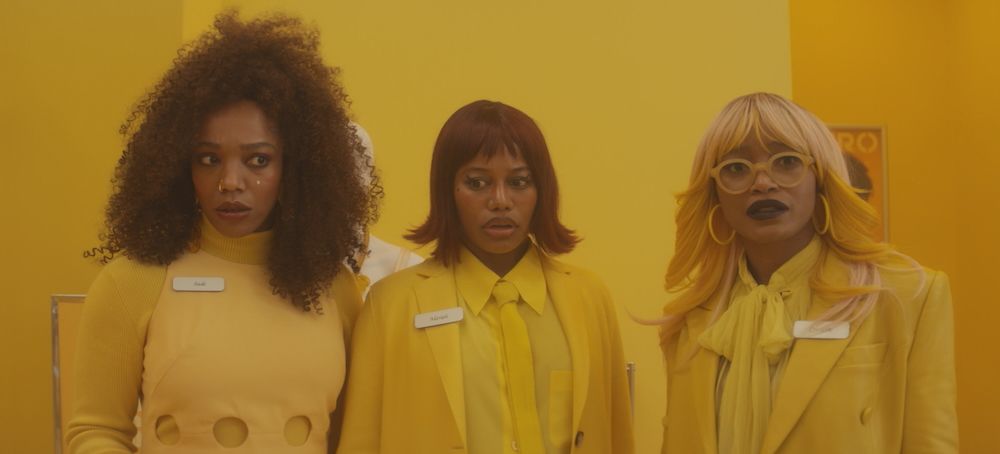
Boosters steal. In Boots Riley’s boisterous follow up to Sorry to Bother You and I’m a Virgo, they shoplift from Metro Designers, a fashion chain carrying monochromatic and showy pieces. The Velvet Gang, made up of Corvette (Keke Palmer), Sade (Naomi Ackie), and Mariah (Taylour Paige), have developed a hilarious yet effective operation; their methods include turning into a white-passing person to swipe garments unnoticed, or hobbling out of a shop looking like the Michelin Man, tracksuits stuffed to the point of bursting.
They’re ‘low-class urban bitches’, per the chain’s designer Christie Smith (Demi Moore). But boosting hardly seems to be the main thievery happening here. The group dub their work ‘fashion-forward philanthropy’, flogging these wacky designs to the public at heavily reduced prices. Metro Designers isn’t exactly the hapless sufferer of injustice either: their shop employees literally launch themselves off of starting blocks in order to make the most of their staggeringly brief lunch breaks and are compensated with pay slips in the double figures. Corvette, herself an aspiring fashion designer, sees one of her designs crop up in Metro Designers shops – yet with no financial recompense or even credit heading her way. And the team joins forces with Jianhu (Poppy Liu), a teleported worker from Metro Designers’ factory in China who wants change: from brutal working conditions, from being paid a pittance, and from occupational cancer. When all is said and done, these rank-and-file workers are afforded the pleasure of paying prices their wages cannot afford – for products made by their bruised and battered bodies, yet are ostensibly not theirs.
But Christie Smith casts her work as liberatory and democratic – after all, she says she’s an innovator bringing creativity, art, and joy to the masses. Elsewhere in this society, the downtrodden are called to self-soothe and bask in the purported benefits of human connection through what is unambiguously a pyramid scheme. Unsurprisingly, none of this pays the bills – the manifestation of this being an actual giant ball of bills that rolls through the city, following Corvette.
On usual form for Riley, the film is brash, absurd, freewheeling, and larger-than-life. It’s a feast for the senses, thanks to Shirley Kurata’s bold and maximalist costumes as well as Tune-Yard’s sonically inventive score. This agitprop also explicitly invokes Marx and Engels in a thrilling plot development, when dialectical materialism becomes central to our team of boosters defeating the ills of capitalism and establishing some dignity for themselves in this hellscape.
All of this is given shape by Riley, who is perhaps best thought of not as a filmmaker (or at least not as a filmmaker first): I Love Boosters could only come from the mind of an artistic multi-hyphenate unencumbered by what is de rigueur in cinema. It’s enthralling to get a peek into this mind, which must surely have antennae constantly up to collect the constellation of outrage that drives this film forward – even if some fragments are admittedly tied up too neatly at its close. Still, Riley has taken to directing heist and action with a remarkable degree of acuity, and his deployment of visual effects and animation bring extra verve for the film’s many gags. Admirable, too, is Riley’s commitment to taking the individualistic and making it collective and solidaristic at every turn, without exception. And this is what separates I Love Boosters from some recent additions to narratives skewering the rich (see Triangle of Sadness, The Menu) – which felt often uninspired, impotent, and reflective of hearts that aren’t truly in it.
I Love Boosters screened at the London Film Festival and is scheduled for release on 30th October across UK and Ireland cinemas.