There is a momentous heaviness hanging over the downstairs auditorium of London’s Prince Charles Cinema, as critic Mark Kermode introduces what we are about to see. We are here to watch Ken Russell’s The Devils, a film once considered so unsightly, so blasphemous, that some censors at the BBFC considered banning it outright. Instead, after an arduous and painful censorship process, Russell was able to release the film in 1971, a butchered shadow of what he had intended. In the UK, the film’s central sequence was excised, alongside a further eighty-nine seconds, whilst the American cut left The Devils further eviscerated as another approximately 2 minutes of footage was wrenched out. Kermode tells us of his friendship with the late Russell, beginning in 1995. He tells us of how fondly the British director still spoke of The Devils years later, of how soul-destroying the censorship process was for him as an artist, about how he, for the longest time, considered the film as it was released as “damaged goods”, and my heart breaks. Then, a miracle. In 2002, Kermode, after much time spent badgering the archival arm of Warner Bros, finally finds the original cut of the film mouldering away in a vinegar-smelling canister, the cinematic equivalent of finding some lost Alexandrian text. Now, 55 years on from the original release and with painstaking care, The Devils is restored exactly as Russell intended – and in a resplendent 4K transfer.
It’s a masterpiece. There is little more to add. In fact, welcome as you are to stick around for my waxing lyrical of this restoration, I would sooner advise going to watch The Devils as soon as you possibly can. My meagre ravings will do little justice to the experience of seeing it for yourself. If you read no further, know that this film is deeply special, and it being here now in all its profane glory is an unequivocal win not just for artistic expression, but also for recognising the worth of art that refuses to compromise.
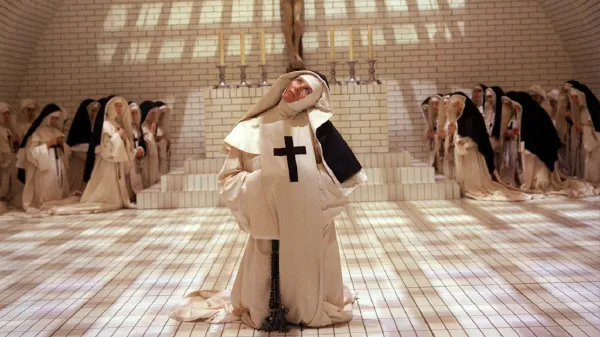
Based on John Whiting’s play of the same name (itself an adaptation of Aldous Huxley’s 1952 non-fiction account The Devils of Loudon), The Devils concerns the French town of Loudon, its religious leader Grandier, and the plot to bring both man and town crumbling down through means of subterfuge both psychological and dogmatic. The film encapsulates a spectrum of sensation, steeped in transgressive eroticism and black humour, whilst also capable of reaching extreme heights of audiovisual frenzy. The film’s most crucial sequence, the Rape of Christ, now free from the censors, is an apotheosis. A legion of Ursuline nuns whipped into sexually-charged clamour cavort naked through their convent-turned-sabbath, tearing down a statue of Christ from the wall and employing it for all manner of perverse gratification. A receding aerial shot of the women writhing against the fallen icon is match-cut with the trembling, doily-textured robes of Father Mignon (the late Murray Melvin, exuding deviousness) as he masturbates in shame. It’s uncomfortable, ballsy in a way that one feels is so sorely lacking from mainstream contemporary cinema. There’s catharsis on this point, a relieving spit in the eye of the social-media-driven shame-panopticon plaguing postmodern culture.
Accentuating the confrontation is a suite of complimentary production elements, especially Peter Maxwell Davies’ discordant score, an aural stampede that threatens to sweep the viewer up. Davies mixes in experimental aspects within certain compositions, as anachronistic sounds such as radio-tuning occasionally bleed into the mix. Elsewhere, famed artist Derek Jarman’s production design matches the film’s thematic material in starkness and theatricality. Jarman presents an unconventionally modernist rendition of Loudon in black, white and grey. The few instances of primary colour (used sparingly in certain examples of costume, or, indeed, gore) pop against such a backdrop, doubly so courtesy of the vivid restoration work undertaken by Warner Clockwork. Jarman’s locales were evidently a treat for Russell to compose against, and at their most breathtaking, certain shots from The Devils have the feel of both Renaissance tableau and Boschian nightmare.
Amongst a crop of performances that revel in a particularly Shakespearean mode, Oliver Reed and Vanessa Redgrave shine especially bright, both handling the film’s sumptuous language with aplomb. Reed is charisma incarnate, demonstrating vast range in his Grandier. He manages a scoundrel, before revealing a damaged man, then peels back layers to expose a righteous, tragic nobility. Those familiar with Dreyer’s The Passion of Joan of Arc will note shades of Maria Falconetti to Reed’s performance in the film’s closing moments. Redgrave’s Sister Jeanne is the overall stand-out, easily on par with the likes of Isabelle Adjani in 1981’s Possession. She has such a discipline to her physicality, never letting the burden of Jeanne’s hunchback fade from her performance, head at rigid, forty-five-degree angles, eyes like manic daggers. It’s some of the most generous work from an actor you can find on screen.
Back in the Prince Charles, Kermode talks of William Friedkin and his concept of the “movie gods”: ineffable forces that spin the threads of cinematic fate. Under their guidance, all that happens in the world of movies occurs as it should. And so, Ken Russell’s The Devils has its second coming at a time where its relevance has perhaps never been greater felt. It may be a singular work of art, one that challenges creative status quo as much as it did back in ’71, but it is also a parable on the importance of fighting misinformation, and of standing up to dogmatic corruption. Without wishing to overstate the point, have you seen the news lately? I dream of a world flooded with work like The Devils, of a community of artists like Ken Russell striving for new, difficult modes of showing the world to itself, and of people who work hard to preserve and champion works born of such ideology long after they have been made. Not just because it’s exciting, but because it’s critical. For now, though, The Devils is risen, and I’m feeling rapturous.
The restored director’s cut of The Devils will be out in cinemas from 16 October.