In the late 1990s, a film era defined by teen romances and youth-driven horror films, writer-director Richard Kelly set out to make a semi-autobiographical film about his adolescence in suburban Virginia. He took inspiration from a story he remembered, possibly an urban legend, about a chunk of ice falling from the wing of a plane and crashing into a teenager’s bedroom, who thankfully wasn’t there when it happened. The moral panic among adults in Reagan’s America and their inefficacy against youngsters in the films of John Hughes also inspired the film’s more humorous scenes. The effect was that of an anti-teen movie, where the youth of this suburban town are genuinely struggling and nobody can help them.
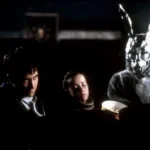
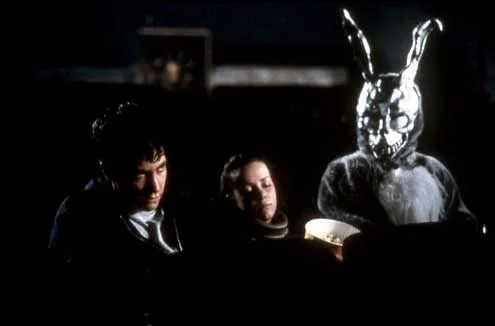
Donnie Darko (Jake Gyllenhaal) is a high schooler in Middlesex, Virginia suffering from paranoid schizophrenia. He has visions of a humanoid rabbit named Frank, who tells him the world will end in twenty-eight days and encourages him to commit acts of vandalism. That night, as Donnie sleepwalks the suburbs, a jet engine falls into his bedroom from seemingly nowhere, with investigators failing to connect it to a scheduled flight. But Donnie has too much on his mind to appreciate his good luck in avoiding death.
A young Gyllenhaal, nineteen at the time of filming, shows incredible talent as a young man carrying the weight of fore-knowledge and so frustratingly aware of the grief of those around him. He is sympathetic to individuals whom the majority would rather mock, namely Gretchen (Jena Malone), the new girl in town whose mother has fled her abusive husband. Gretchen takes a shine to Donnie after a forced meet-cute involving their teacher Ms Pomeroy (Drew Barrymore), who tells Gretchen to sit next to the boy she thinks is the cutest.
The film opens with Donnie waking up on a mountain road in the early morning and laughing to himself. He has a dark sense of humour which his family doesn’t appreciate, and he lashes out at them when they attempt to rein in his idiosyncrasies. He’s also not afraid to talk back to adults and expose them as fraudsters, including polished self-help guru Jim Cunningham (Patrick Swayze), whom Donnie audaciously rips apart at a school seminar. Cunningham is a balm to the panicked adults of Middlesex who think Donnie’s school is a breeding ground for immorality, especially the hilariously prudish Ms Farmer (Beth Grant).
Time travel and alternate realities are explored in conversations between Donnie and science teacher Dr Monnitoff (Noah Wyle). The classic argument of predestination versus free will is presented, but Donnie seems to have no issue with accepting his destiny, instead being determined to try to save the world at the appointed time. The ending is tragic but poignant in its recognition that absence, even of someone so disturbed and unreachable, leaves a wound in their loved ones.
Donnie Darko is an introspective story whose atmosphere is greatly aided by the visually bland setting and washed-out cinematography. Unconventional angles and slow-motion emphasise Donnie’s off-kilter view of the world, depicting teen angst in a way far superior to other films of its kind. It was unsuccessful on first release but found its audience over the following years, now with a vaulted cult status as an alternative Halloween favourite.