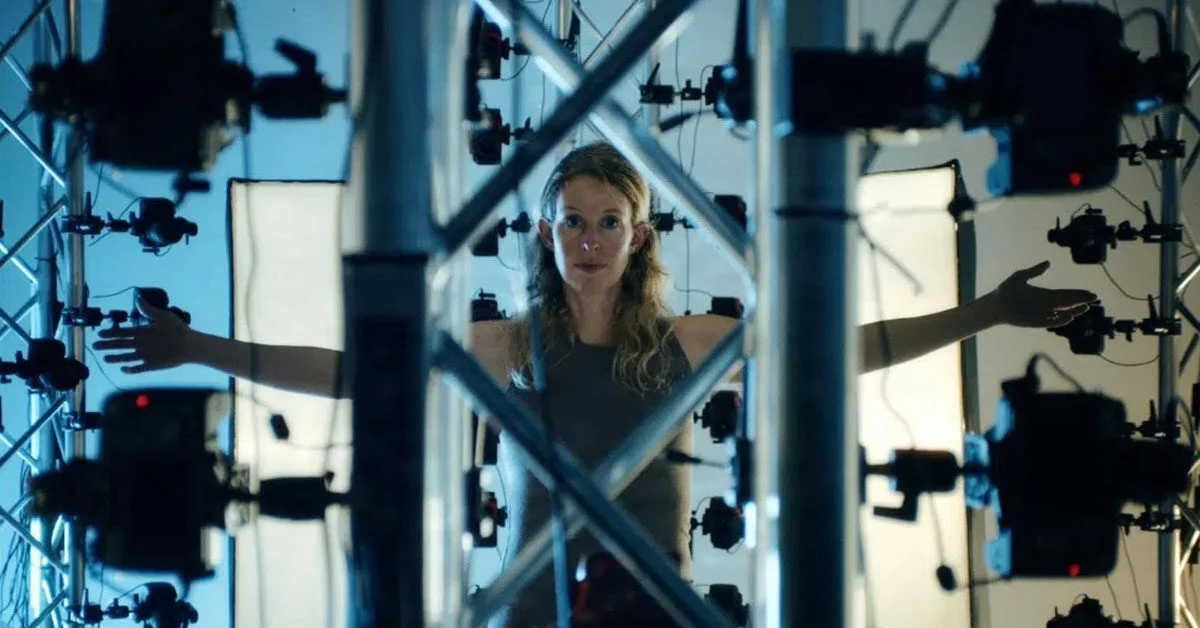
Elizabeth Holmes is both the central figure, and the central question, around which the entire action of You Can See Everything revolves. The setup of this record-breaking documentary is already difficult to believe: Holmes, a disgraced biotech businesswoman responsible for the disastrous Theranos blood-testing fraud, invites comedian, actor and director Nathan Fielder to stay in her and partner Billy Evans’ home, to film and observe their lives just thirty four days before her imprisonment. The idea, as set out by Billy in the first shot of the film, is to know her as a real person, instead of making her something “Other”. The point of the exercise then becomes how quickly the truth crumbles, and where it can be reshaped not only through the testimony of people’s words, but through the subjective art of documentary filmmaking.
Even when Holmes is absent from the film, every conversation is about further probing the nature of her behaviour and dissecting the motivations of her potentially superficial persona. The beauty of this, however, is that after a while, the question stops being “is she telling the truth?” and becomes “what, to her, defines truth?” Without explicitly spoiling how her persona relates to the experimental latter-half of the documentary, let’s just say that the directors – Fielder and Lance Oppenheim – are more than okay with further obscuring, reinterpreting, and in many ways mythologising, the legend of her uniquely untrustworthy presence in this project.
What is fascinating is that the controversial biotechnician (who is now in prison) does not come out of this film looking worse than she did before it came into existence. You could certainly argue with that as an idea (and it’s not like she comes out of it looking any better), but what is clear however is that she comes across as completely unselfaware and frighteningly calculating through every interaction with Fielder, who effectively serves as our unreliable guide in this alien world of potential deception. But it is in her emotional contradictions that she elicits the most sympathy. She is a deeply damaged person, in a way that her supremely hateable partner Billy is perhaps not (Billy seemingly being the more lucid of the two, yet someone who reveals himself to be far more controlling and manipulative by comparison).
What Elizabeth and Billy clearly share, but attempt to disguise through further facades of family motivations and professional scheming, is their utter desperation. They are desperate to alter their public perception, desperate to come across as rational, feeling people. They accomplish the former, but certainly not the latter. The most human characteristic of their relationship however – and what they spend most of the film’s first half doing – is rationalising to themselves, no matter how convoluted the mental gymnastics of this self-deception become. To be able to witness this through slip-ups in wording and expression is really something to behold.
The next-level viewing experience is being able to see one’s self in such insane people. And perhaps I, myself, am weaponising the word ‘insane’ so as to distance myself from them as individuals who I decide are incomparable to myself. But this film is the masterpiece that it is because we understand how people react to the bad things they do. We understand how people retreat into their own bubbles of self-assurance and assemble the pieces of life they can, grasping onto that which provides comfort whilst also repeating the same mistakes. The delicate, precarious nature of this behaviour scares us. We also understand that, when there is nothing left through which to latch onto the real world, people will feel compelled to keep themselves occupied in some way; say, by taking part in a documentary, or an ill-fated venture to restart a fraudulent biotech company.
The setup of this documentary is that, in a month’s time, a family will be forced to change when the mother figure begins an eleven year prison sentence. This inevitability is of Elizabeth’s own doing – a result of her own greed and ego. And yet, she is also the product of Silicon Valley’s backwards, capitalistic goals and inhumane working methods. She is surrounded by people who lie to her almost as much as she lies to herself, if not more. Who wouldn’t, in such circumstances, behave in such a paradoxical manner?
It is easy, in this scenario, to forget about someone equally as indulgent in deception and self-deception at the heart of this story: Nathan Fielder, our charmingly awkward audience-surrogate. He is the movie’s emotional anchor, but he is also a skilled actor, and storyteller, who clearly uses his talents to pull the film in certain directions, mainly by utilising his behaviour to craft cinematic moments out of reality. Nathan’s participation in the movie results in the piece’s thematic growth. Through his involvement and narrative manipulation, You Can See Everything, at a certain point, stops being about lies and starts being about obsession. He too can unnerve us.
The narrative skeleton of this documentary has been meticulously formulated. By gradually accumulating further detail, speculation, and additional stylistic levels of artifice, the resulting shape of the piece becomes something structurally satisfying yet completely ambiguous, like an intricate, illusory sculpture whose form only impresses in as much as it confuses. It is also clearly drawing on works of fiction to infuse each scenario with a visual language and tonal subtext. Phantom Thread is my favourite example of this, as fireplace lighting and unsettling piano music underpin what we are watching with a sense of yearning mixed with a deathly foreboding. Hypnotic for its subjects and irresistible for its aesthetics, the atmosphere of You Can See Everything is thickly layered. The first half ingeniously captures the contradictory sense of solace and terror that comes with isolation from the world. The second half leads the viewer to wonder: can someone become addicted to the feeling of being lied to? Perhaps if anything, a life-consuming project like You Can See Everything showcases that in the case of its director, yes, you can.
You Can See Everything is in cinemas now.