Sony Pictures’ November offering Ghost Soldier (formerly known as Headwaters and later Archangel) received its American release on 11 November to coincide with Veterans Day, which tells you a lot of what you need to know about Will Eubank’s Wyoming-set military thriller. Released in the UK on 27 November with considerably more muted fanfare, Ghost Soldier is unlikely to make any considerable waves. Eubank claimed in an interview to have a reputation for making low-budget productions appear more expensive, and opined that this may be the most inexpensive action movie ever produced by Sony. Whilst the film doesn’t exactly look cheap, the surreal and, at times, schlocky quality of the dialogue, the acting and the action felt incongruous with the big screen this writer was watching on, seeming much more like straight-to-streaming-right-in-time-for-the-holidays fare.
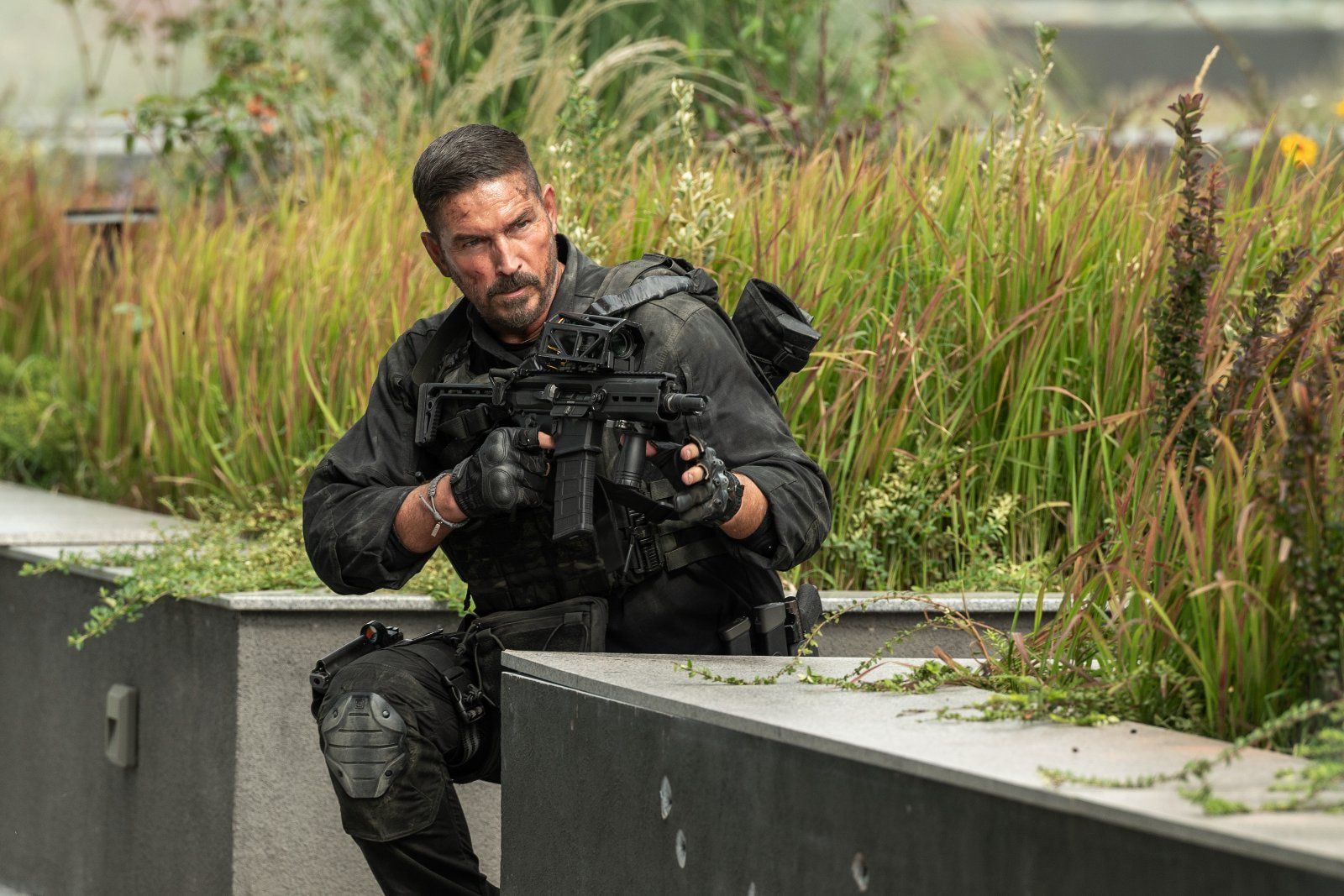
Ghost Soldier is the story of former Green Beret Fitz (Jim Caviezel), who has returned to live in the town he grew up in, in a high-spec house-cum-laboratory designing advanced weaponry for his employer. Brownstone, a billion-dollar corporation, is using the legal framework of eminent domain (somewhat straining credulity) to evict rural Wyomingites from their farms and homesteads to further their evil scheme of monopolising freshwater resources needed to cool new data centres. When Brownstone-hired mercenaries attack the family home of his deceased comrade, Kyle Hernandez, Fitz employs his CGI-enhanced gadgetry to wage a one-man war against a sea of guns-for-hire, who, as the stakes increase, give way to sadistic Serbian mercenaries (Beau Knapp) with questionable accents.
There are two strands running through this story. On the one hand, the core message is of the dangers of corporate exploitation, and the remarkably relevant politics surrounding data centres could be mistaken for a left-wing critique, but here stems from an old-fashioned conservative distrust of city elites who represent a newer and more soulless America, contrasted with the salt-of-the-earth people of the heartlands. Perhaps unsurprising, then, are the nationalistic trappings of a Veterans Day hit. Fitz’s door code is 1776; the young Jack runs into his burning house to save his father’s folded American flag; Fitz’s “blood runs red” because he is a “patriot”. A special screening, attended by the production team, was organised at Naval Air Station North Island in Coronado, California. Producer David Zelon even explicitly described Ghost Soldier as “a very pro-military, pro-America kind of movie”. The target audience is clear and, while this may not quite be an AFFIRM Films production, it is part of the growing cottage industry of conservative white American cinema.
The film opens with a quotation from Mark Twain regarding the ubiquity of dispossession and the violent seizing of land. It is apt given the film’s subject, but like all great quotes, it has been applied here selectively: there is no acknowledgement or mention of, or even allusion to Wyoming being Indigenous land, or to the US as a colonising force. Kyle died in a nameless and nebulous war which is never interrogated but treated like a natural disaster, as something that simply happened to him. Twain later identifies in the same essay that “man is only patriot”, decrying an unnatural filiality to one’s country. As I say, selective application. None of this is surprising given the film’s provenance, as to investigate those subjects would certainly have alienated the largely white target audience. But it is still noticeable.
The technical components of the film are mixed. The acting is inconsistent to say the least: Caviezel is engaging as the cool and collected Fitz, but as soon as he raises his voice, one realises why he mainly sticks to whispering. Jaina Lee Ortiz stands out as Sophia Hernandez, the most recognisably human and least caricatured of the main cast, while many of the villains range from forgettable to hammy. The editing (Rebecca Weigold, Todd E. Miller) is jumpy, often failing to construct a comprehensible geography across the film’s numerous locations. The high point is undoubtedly Brandon Roberts’ score, recalling his tension-fuelled compositions on the second season of Andor. Cinematography (Agustin Claramunt) has moments of greatness, particularly in shots highlighting the natural Romanian beauty of the shooting locations, but is largely straightforward.
The ending is a madcap rush of choppy cuts and dialogue racing to tie up threads in what feels like an external imposition to keep it under a 90-minute runtime (interestingly, we do know that the original cut was considerably more violent before being edited to appeal to a wider audience after test screenings). And the final shot of the film is an American sniper shooting an evil Middle Eastern man in the head. If you’re looking for a fairly mindless but entertaining hour and a half then get yourself a ticket. If you’re looking for almost anything else, I’d see what else is on.
Ghost Soldier is in cinemas now.