
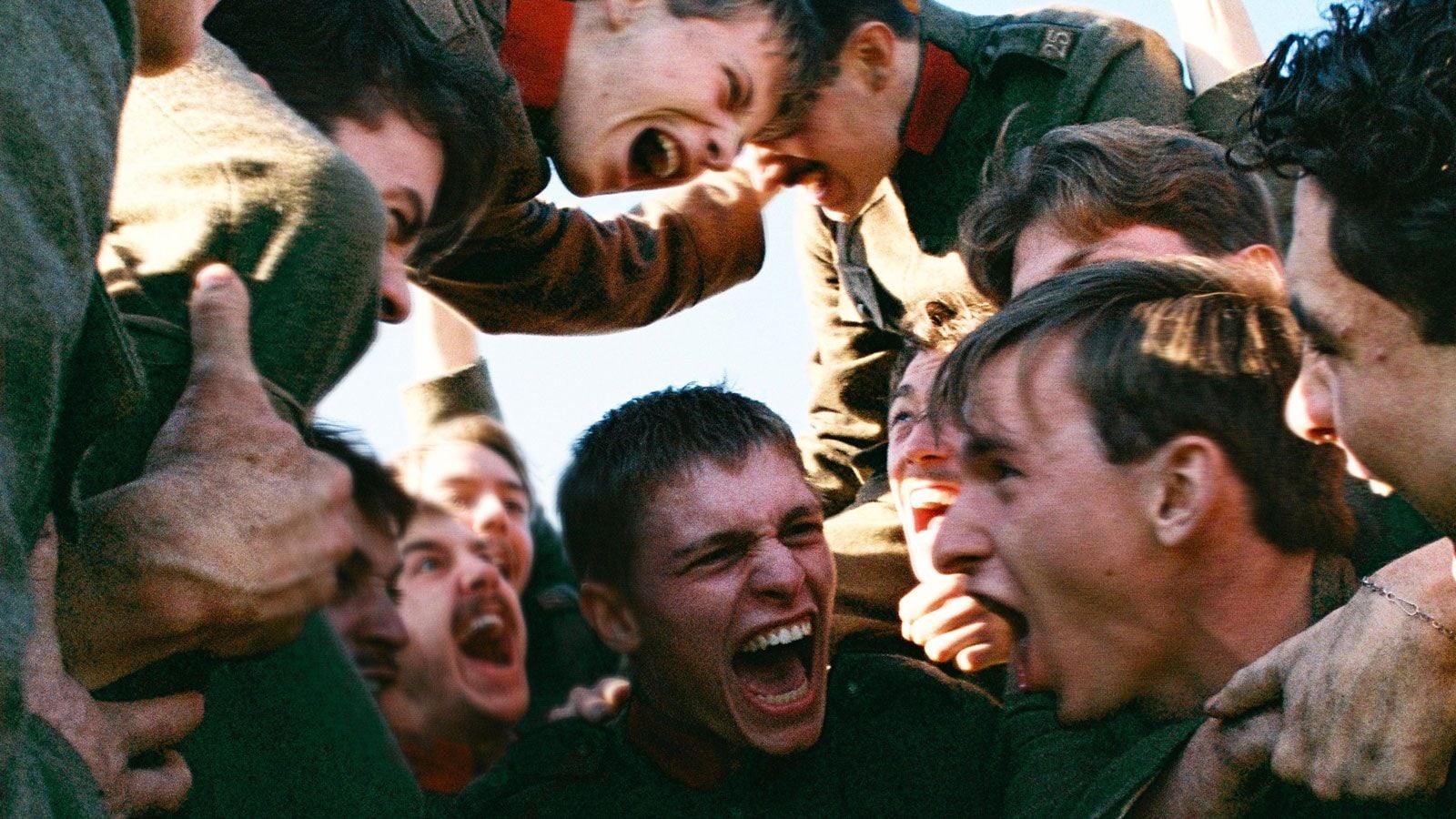
Belgian director Lukas Dhont has long been interested in exploring the unexpected places where queer identity can be found, such as a ballet class (his debut feature, Girl) or a middle school (his 2022 success, Close). His latest film, Coward, demonstrates how the horrors of World War I can coexist with a queer love story, unfolding with the familiarity of a classic romance. Working with young, usually inexperienced actors has almost become Dhont’s signature style, and Coward is no different – and in his version of a war film, everyone in his ensemble get their moment to shine.
In his acting debut, and for which he received an award in Cannes earlier this year, Emmanuel Macchia plays the role of Pierre, a young, unassuming farmer enrolled in the Belgian Army and trying to find his place in this new camaraderie. The film follows the soldiers through a succession of episodes from camp life to the trenches, some repulsive, others strangely heartwarming though never entirely removed from the harshness of their circumstances. These seemingly random, slice-of-life episodes lead to the gradual closeness between young Pierre and Francis (Valentin Campagne), a flamboyant soldier in charge of the camp’s entertainment. The attraction between the two soldiers develops so subtly that it becomes easy to lose sight of the tension behind their interactions. When their feelings finally come to the surface, the shift feels like an explosion of repressed feelings.
This episodic structure also allows the other soldiers around them to share the spotlight, yet we never become deeply attached, despite laughing with them or listening to fragments of their past lives via jokes or sharp exchanges. They form their own collective character, one that reflects how war reduces individuals to a single entity, or a survival-oriented version of themselves. Many of them remain unnamed, because their identity becomes secondary in this place where collective sacrifice and effort are the only things that defy their newly assigned personalities.
Dhont is not interested in making another realistic portrait of the hardships and horrors of World War I – there are already so many that depict it conventionally, from Edward Berger’s All Quiet on the Western Front to Sam Mendes’ 1917. His interest lies instead in the human connection that emerges in the most hopeless of places. In a shot in which the soldiers sit on long wooden tables and Francis is introduced on a stretcher, pretending to give birth, the camera lingers on Pierre’s face, his gaze acting as an emotional point of entry into Francis’s performance. In a place such as the army, where rules are followed strictly and punishments are reinforced with no remorse, the simple act of looking becomes a courageous statement.
Later on, freedom becomes a concept that seems to trouble both protagonists. When Francis states that “we are free here”, he suggests that by performing in front of fellow soldiers and military officials, he gains a certain degree of personal freedom. Through his flamboyant nature and elevated costumes, he can express a part of his queer identity, even if the audience treats it more as a gimmick than as a genuine challenge to traditional ideas of gender.
By following many well-known conventions of a love story between a shy farmer and an extroverted aspiring stage performer, Coward becomes less of a war movie in the traditional sense of understanding and more an exploration of the many layers, ethical dilemmas and fragile forms of intimacy that emerge in enclosed spaces such as military camps. Pierre and Francis, alongside the other members of the entertainment group, perform for their fellow soldiers, offering them a brief escape from the horrors waiting for them in the trenches. Their songs and performances cannot change the conditions they live under, nor can they undo the violence surrounding them, but this does not mean they can’t still try. As they put it – “we are singing to dead bodies.”
Coward screened at the London Film Festival and Bucharest International Film Festival and will be released in UK cinemas on 1 January 2027.