Do we need another Christmas Carol? Despite it being 17 years since the last major Hollywood adaptation of Charles’ Dickens seminal ghost tale, many will still argue we have had our fill. We’ve seen it with Muppets, we’ve seen it with Barbie Dolls, we’ve seen it with Cavemen and Gangsters, transposed to America and Australia, done as a cartoon, a rom-com, a musical, any way you could dream of this story being told. It is however, still a timeless tale of kindness and generosity that appears eternally relevant no matter the decade. That is why it is somewhat alarming and perhaps in line with society’s increasing cynicism that so many 21st century adaptations have shone an increasingly bleak and miserable lens on the story. Robert Zemeckis’ 2009 motion capture adaptation felt more designed to scar audiences than to tell any sort of moral fable, and little has changed when the story is passed to acclaimed horror director Ti West (X, Pearl, Maxxine) for Ebenezer. West has leaned fully into the gothic horror trappings of the tale in a telling clearly designed to raise the hairs on its audience’s neck. Unfortunately, not only is it so grim that much of the magic feels lost, but the presence of Captain Jack Scrooge at its center makes even the scariest scenes hard to take seriously, creating a tonally and morally murky mess.
The set-up is habitual at this point. Humbug Ebenezer Scrooge (Depp) is visited by three spirits across one Christmas Eve night to convince him to change his skinflint ways, lest he suffer the fate of eternal chains and damnation afflicted on his business partner Jacob Marley (Ian McKellen). Along his journey we follow several sleepwalking actors collecting a quick cheque, including Rupert Grint as Scrooge’s Clerk Bob Cratchit, Ellie Bamber as his young flame Belle and Daisy Ridley as Scrooge’s niece-in-law Clara. Andrea Riseborough and Tramell Tillmann take on the Ghosts of Past and Present in takes far more explicitly frightening in design and delivery than previous adaptations with glassy hollow eyes and crumbling facades. While all fine actors in other projects, here every character not named Scrooge has almost nothing memorable to do and so many give performances so uninterested that it feels like their fee is on the end of a rope just behind the camera.
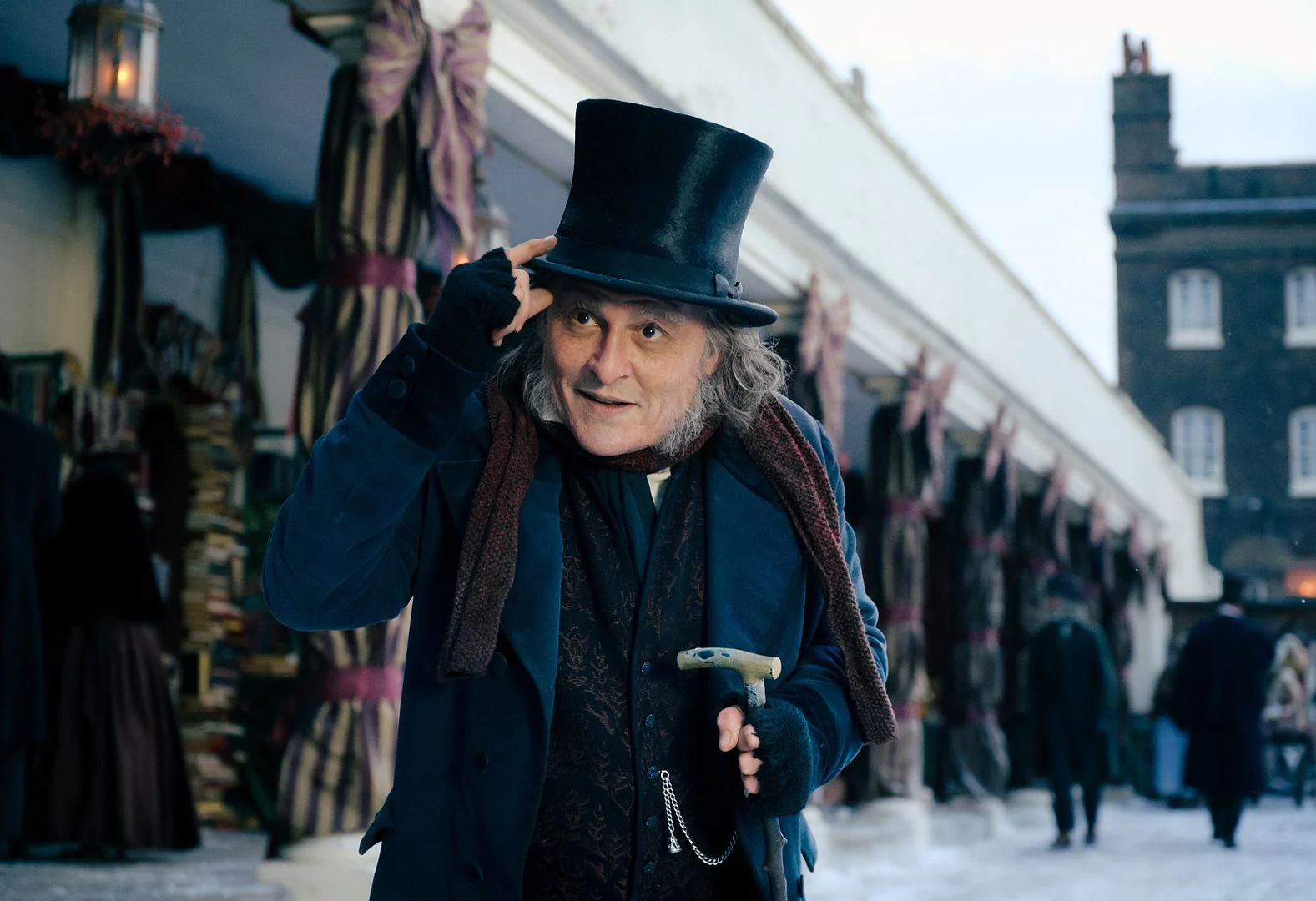
Speaking of our leading man, whether you revere or revile the decision to bring Johnny Depp back to mainstream Hollywood prominence for the first time in eight years the fact remains that the entirety of Paramount’s marketing campaign rests on his shoulders. The film’s first trailer proudly proclaims ‘The Master Of Misfits Returns’, citing his previous work as Jack Sparrow, Edward Scissorhands and The Mad Hatter, and it is clear Depp’s turn as the curmudgeonly miser is an effort to remind audiences of the on-screen oddball that raked in millions rather than the slew of controversy and legal issues that has hung over the star for much of this decade. Unfortunately for Depp, his performance of one of literature’s greatest grumps is one of the worst of his career, gurning and leering with a pantomime piffle that makes Albert Finney look understated. He occasionally casts the odd effective glance, namely in the direction of Marley’s empty chair, but the subtlety that made his turn as Scissorhands so effective is replaced by the spectre of the ghost of show-off’s past. Depp is trying so hard to be unconventional here that any emotion he forces through the unconvincing prosthetics comes across as incredibly hokey. His closest character companion is Jim Carrey’s take on the character in Zemeckis’ adaptation, but at least its animated form gave it additional wiggle room to be larger than life. Here Depp swallows almost every character’s performance whole by going so far the other way that it is hard to take anything seriously. It is even more infuriating when, in the opening scene, we get a rare glimpse of an alive Jacob Marley. McKellen’s mortal Marley is only on screen for about two minutes yet is so much more naturally charismatic, funny, menacing and convincing as an old curmudgeon than Depp is in the entire two hours that follow.
West is a capable director and alongside DP Checo Varrise and production designer Eve Stewart brings a suitably gloomy overtone to Victorian London. They also craft some unsettling or thought provoking moments here and there, such as a striking opening credit sequence juxtaposing Christmas in working and upper classes. An increased focus on seeing the prisons and workhouses Scrooge so callously demands is also an effective change to the material. The problem is the film takes what is directly quoted from the book with such apathy you wonder why they bothered at all. The famous lines are quoted like recited math problems, famous characters such as the charity collectors are given baffling and unwelcomely jaded reworks and iconic characters like Tiny Tim barely feature, with the focus more on the wealthy Fred and Clara than the Cratchits. Fred is played well and with nuance by Sam Claflin, conflicted between his uncle’s actions and his own good heart, but when he and not the Cratchits feel like the primary focus of Scrooge’s moral sadness you have misunderstood the very heart of the material.
Ebenezer is first and foremost a victim of the very star that no doubt greenlit its existence. Depp’s unintentional parody of Scrooge feels in line with the film’s lack of care in adapting much of the charm that made the book so timeless, disregarding its ebbs and flows for sheer relentless cruelty. That could have worked with any meaningful commentary attached, but the film wants to have its cake and eat it with a comically ridiculous lead performance and a novel it quotes purely for nostalgic convenience. A full satire or commitment to its own misery might have at least made some water cooler conversation, but as is it just feels like Dickens’ story has been washed in a bath of wretchedness and then put on display with a clown in its centre, making it sadly much more gravy than grave.
Ebenezer is in cinemas now.