It is purported that Vladimir Lenin once said: “there are decades where nothing happens; and there are weeks where decades happen”. If fêted Japanese director Ryusuke Hamaguchi’s latest shows us anything, it’s that Lenin may have not have been far off the mark. All of a Sudden is like sitting with your closest friend, like losing track of time late into the evening and setting the world to rights. It’s a film that champions the notion that a better world is possible, going a step beyond most works’ sympathy to such a cause by instead attempting to figure out what that world could look like, and how we might get there.
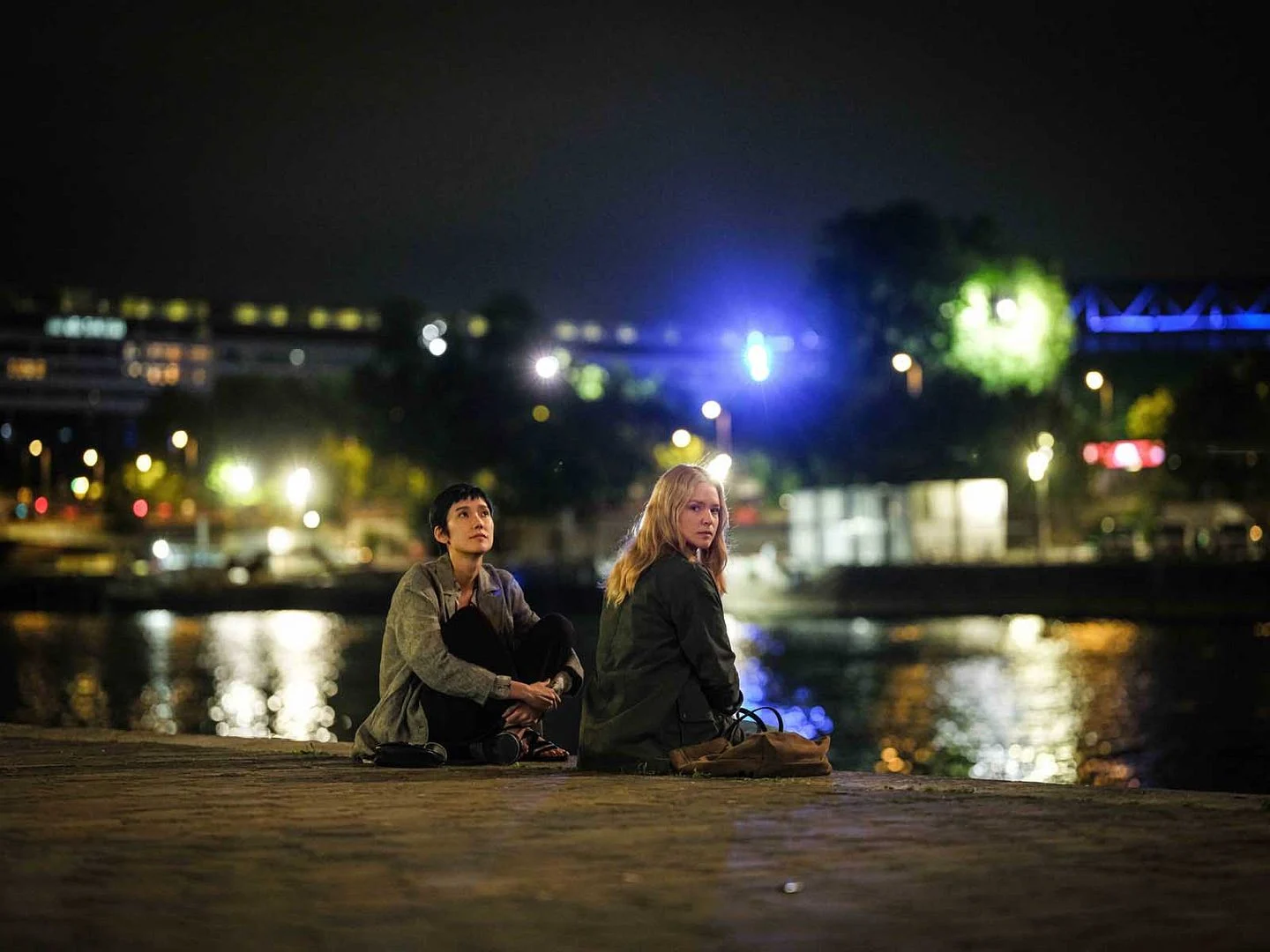
Whilst far less bleak and eerie than 2023’s Evil Does Not Exist, Hamaguchi once again takes things characteristically slow here, doubling down on his meditative style for a whopping three-hour, twenty-minute experience. A French nursing home director, Marie-Lou (Virginie Efira), struggling to implement a holistic treatment programme for the dementia patients within her care, has a chance encounter with a Japanese theatre director, Mari (Tao Okamoto), changing the course of both their lives. The pair of them recognise kindred spirits in each other – they speak each other’s language, share the same ideals, and together inspire one another towards putting revolutionary thought into revolutionary action, one artwork and one foot rub at a time. Only, there’s a problem. Mari is suffering from terminal cancer, a character beat taken from Hamaguchi’s own direct inspiration for the film: a set of letters between two Japanese women, Makiko Mayano and Maho Isono (a cancer patient philosopher and a medical anthropologist respectively), published as a book in 2019. As such, the two wayward souls’ bond is quickly established as a beautiful, yet crushingly finite thing, with Mari’s quietly radical and fathomlessly wise musings especially infused with weighty bittersweetness.
Much of All of a Sudden is spent in gentle, yet topically complex, discussion between the two leads as they begin to unravel the labyrinth problem of late-stage capitalism: how it colonises our free time, makes us proud of sacrificing our self-care, and how its ultimate end point is systemic self-destruction. It’s highly intellectual stuff, and Hamaguchi does well to take his time getting us up to speed with the discourse he’s wrangling here. The exercise wouldn’t work quite as well, however, without both lead actresses’ magnetic chemistry with one another, without which the film and its epic runtime would risk mystifying its audience amidst the alienating vicissitudes of critical theory. The space between Marie-Lou and Mari crackles with an invisible force that grows in intensity as things progress. Whilst the performances suggest tantalising possibilities of intimacy that may grow beyond the realm of the platonic, Hamaguchi’s script wisely and refreshingly chooses to keep things ambiguous between the two women. By refusing to explicitly label their dynamic, both leads’ work is allowed to blossom into something unique and ineffable. Marie-Lou and Mari are not each other’s lovers, but neither are they merely friends. What they are to each other is in no way as important as what they do for each other. If one had to call them anything, it is perhaps most accurate to refer to the two women as each other’s “carers” in a very literal, fundamental sense. They care for one another as simply as such a term can be defined, and in said simplicity lies revolution.
This powerful simplicity is paralleled in the film’s visuals, as Hamaguchi demonstrates once more his ability to reveal the sublime within the bounds of the every day. All of a Sudden radiates peace through every frame. Lingering wides of sunlight hitting furniture in empty rooms, or sprawling Japanese valleys at sunrise. Meanwhile, tighter compositions with palettes of bright pastel softly pop against the day’s glare. Slow pans and dollies evoke Tarkovskian comparisons, lending certain shots a hypnotic, gliding quality. Similar to the aesthetic philosophies one can note in the work of Taiwan New Wave legend Edward Yang, Hamaguchi’s modus operandi is first and foremost in showing his audience that life is an inherently beautiful thing. Its beauty is everywhere, if only we take the time to slow down and look. This visual sensibility in tandem with the inherent watchability of the film’s leads is a potent combination, ensuring that, though we may be moving slowly through its world, we cannot help but be engaged, the same way one might engage with a quiet walk in nature. It is the cinematic equivalent of a lungful of clear, fresh air. Even the score accentuates this feeling by sheer, near-total lack of presence, lulling the viewer into the gentle thrall of the diegesis.
Traditional components of filmmaking aside, the film’s most stand-out feature may be in its mature approach to its subject. Nothing about All of Sudden suggests overgeneralisation, or intellectual certainty. It is not so much a film about finding the answer to modernity’s problems, but more so in showing that an answer is possible both to envisage and implement. It’s very easy to put a foot wrong when making work about “the current climate”, as the problems we face are more obfuscated than they ever have been. Even work that can accurately identify the vectors of current-day social malady commonly risks resorting to shrugging, fatalistic conclusions (see Luca Guadagnino’s recent Artificial), or else buckles under the sheer scale of effort it takes to effectively communicate said vectors in the first place (a problem sadly inherent to Boots Riley’s latest, I Love Boosters). With All of a Sudden, Hamaguchi gives us optimism without being saccharine, and sadness without melodrama. He posits hope, but bases that positing on the caveat that that hope is only won through deep thought, hard work, acknowledging limitations, boundless patience, and compassion. In other words, hope takes time.
If there are empty-feeling decades, and weeks replete with upheaval, then so too must there be hours that can hold eternities. If you’re lucky, and if you’re looking, there may be moments which, in aggregate, can birth futures, and with them brighter days.
All of a Sudden screened at the London Film Festival and will be released in UK cinemas on 5 February 2027.