The exclamation mark says it all. Behemoth! announces itself with scale and grandiosity, only for its true nature to reveal itself oddly smaller and stranger than the beast it is named after. This is the latest feature directorial effort from Tony Gilroy after The Bourne Legacy, Duplicity and Michael Clayton, though most will likely know him for the critically acclaimed series Andor (for which he was creator, showrunner and lead writer), a feat that stood out amongst its Star Wars peers for its complex themes and explorations of fascism and rebellion. For a franchise that too often chooses to infantilise, Gilroy opted to made a series for adults with adult ideas and, more impressively, managed to do so under the hand of Disney.
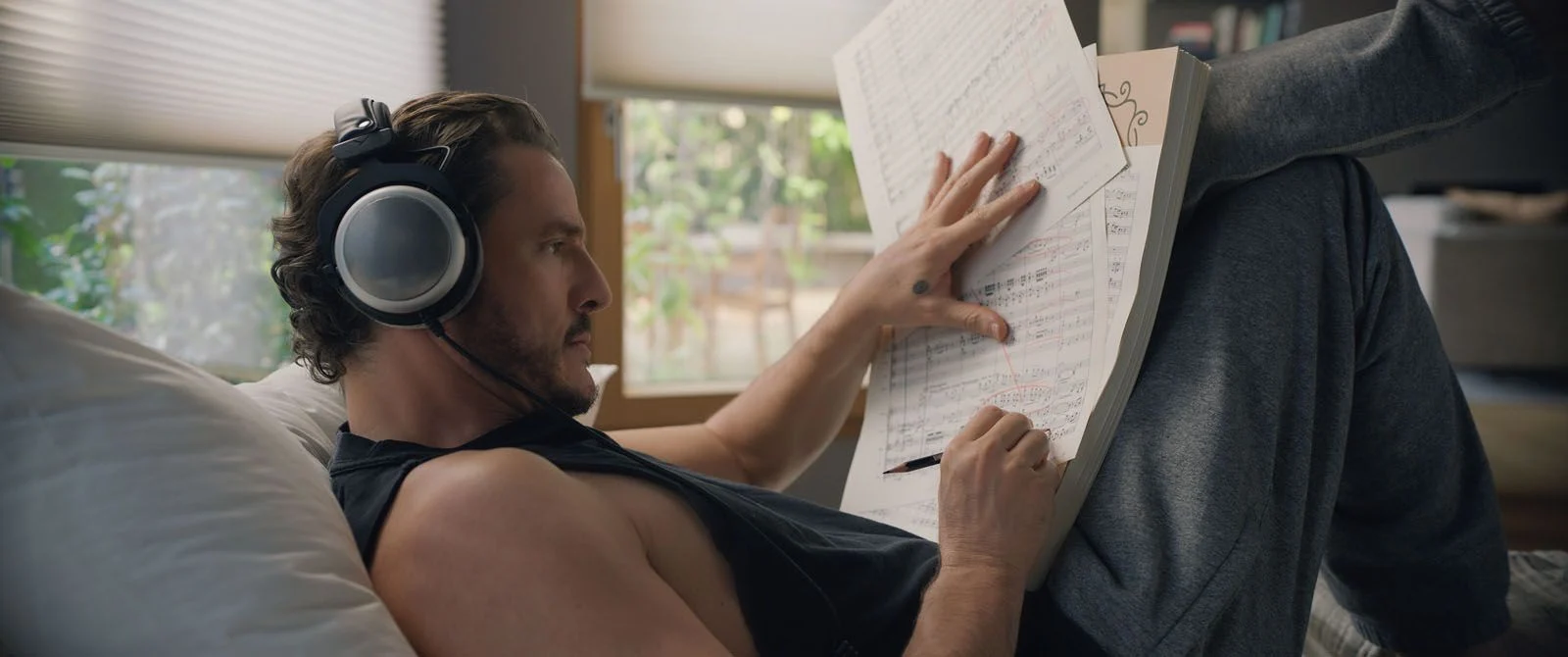
His follow-up project, Behemoth!, follows an aloof yet prolific cellist and session musician Alex (Pedro Pascal) as he navigates his new life working on film scores on recording stages rather than playing in the symphony orchestra of a concert hall, all whilst batting off a series of failed relationships. Pascal spent months learning how to play the cello for the role, and according to my string-gifted musician friends, he did so very well.
One of his exes, Carol (played ever so excellently by Olivia Wilde) is an almost textbook “crazy-ex-girlfriend”, who stalks and looms over Alex throughout with an assertive wide-eyed demeanour. Her character truly feels from another film, one that is overtly a comedy in contrast to the self-serious tone that most of Behemoth! aims for. However, continuing Wilde’s exceptional streak of work this year, she might just be the best part of it, her limited screen presence literally generating cheers from the audience (myself included).
However, Alex’s relationship with Carol only alludes to the greater thematic interest of the film, which is generational trauma, legacy and the cost of its greatness. Alex and his brother Andy (Will Arnett) are both left disillusioned by their abusive deceased father (Hank Azaria), a renowned musician and womaniser in his own right, echoing the patterns of Alex’s own life. Arnett’s Andy even has a podcast episode on their father, if it wasn’t already clear enough. Whilst that weight can be felt on the characters’ shoulders, it never fully goes below surface level, as the cast are often directed with an aloofness and a mismatching tone to their performances and actions.
Its attempts at being a character study are stifled by the reveal of the film’s musically-influenced structure, one of flashing back and forth between a 2010s past and the 2026 present. In an interesting format choice, there are no title cards indicating these time changes, only the colour of Pascal’s hair and the occasional date in the background (such as a 2016 VOTE HILLARY lawn sign) to clue us into the right timeline. The other structural conceit is that most of the scenes are seemingly “scored-live” – prior to a scene, we see present day Alex and the orchestra begin to play a cue for a fictional in-universe film, only for that cue to continue on into the next scene. Academically and on-paper, this is a clever and interesting idea for blurring the lines between musical diegesis in a film – of the film essentially scoring itself. A scene in which Alex is witnessing a fight between Andy and his ex-wife turns cartoonish when the music (played on the radio diegetically here) turns Looney-Tunes slapstick, mimicking the fight – Alex notices this in the music itself and turns it off, yet the gag never reappears. In practice, such variety leads to each scene’s music feeling out of place, as the musical identity and register always ends up being different. It should be noted that this film has score contributions from nine different composers, including actual behemoths such as James Newton Howard, Michael Giacchino and Alan Silvestri. This leads to the film’s overall musical identity feeling very fractured, and not in a way that is thematically or emotionally resonant.
If you have reached this far in the review and are wondering, wait, isn’t Eva Victor in this?, I am simply mirroring the film’s own general approach to revealing its intentions: later rather than sooner. When Victor’s character Nadia, a violinist in Alex’s orchestra, finally comes in, we see them first get together in 2010 and watch their relationship grow over a decade. Flashing between 2026 and the 2010s, then, Behemoth! lets on – again, too late – how much of an impact this relationship has had on Alex, something he is forced to reconcile with. In the same way, as the film hits its crescendo and final notes, it never quite resolves the conflict between musical identities, its atonal tone and its incurious approach to its characters. There are many occasions where the operatic score of the film calls for us to be moved by what we are seeing and hearing. Yet, the film has not laid the foundation for that emotional catharsis. One of the reasons Gilroy wanted to make this film was as an homage to his scoring sessions with Giacchino (for his uncredited work on Rogue One), and as a love letter to those seasoned session musicians. But whilst many are featured and heard in the film, Behemoth! never gives them or their musical talents the right key to play in.
Behemoth! screened at the London Film Festival and will be released in UK cinemas on 4 December 2026.