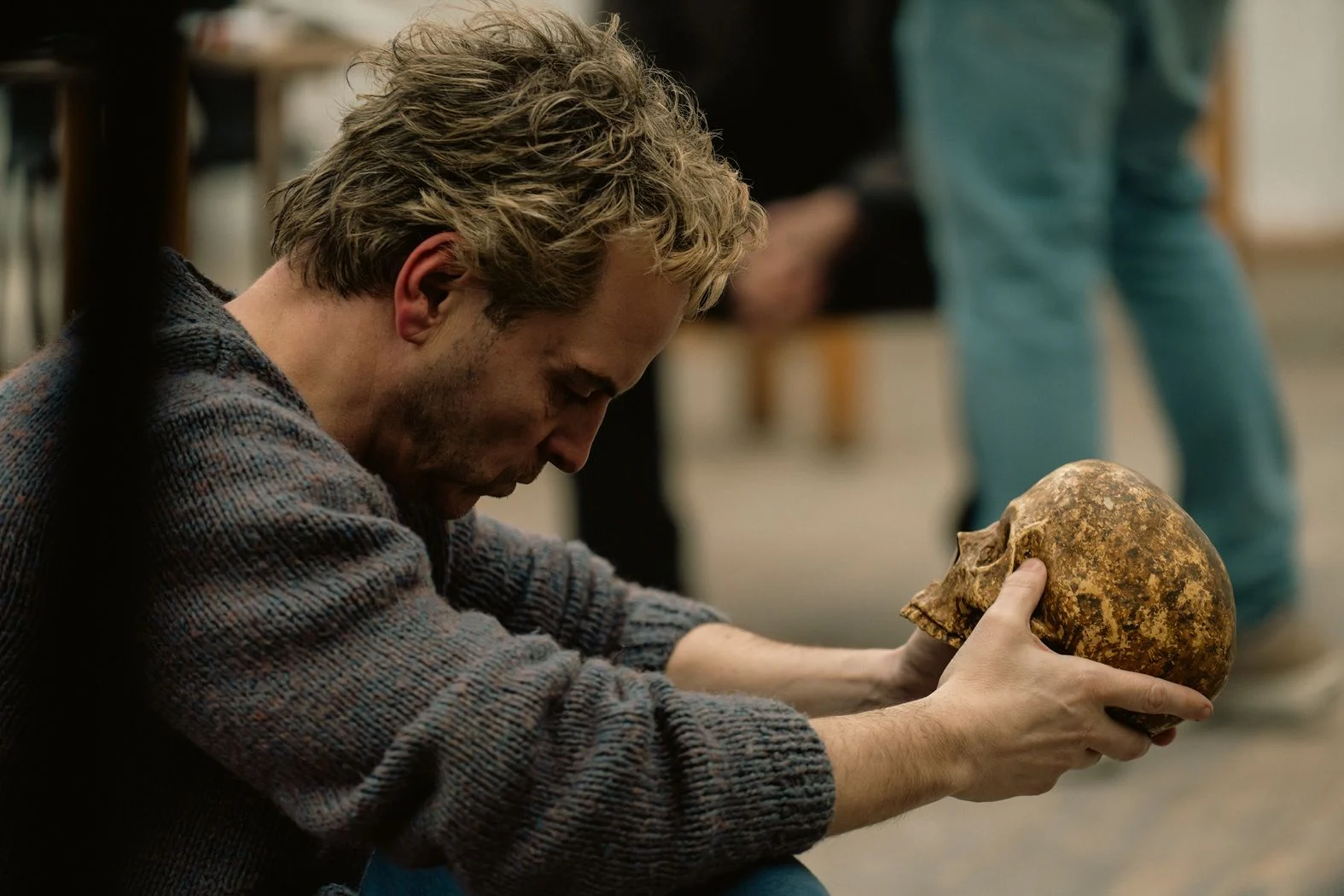
In 1989, during Richard Eyre’s production of Shakespeare’s Hamlet at the National Theatre in London, Daniel Day-Lewis broke down mid-performance, walked offstage and refused to return. The aftermath was a blur and the mission for this director simple – find a new Hamlet, and fast. Then, who better than someone who had played him before, who could quickly pick up the threads of such a complex character and save the production? Enter Ian Charleson, best known for his role in Chariots of Fire, and what more, also mildly irritated by those who point it out and remind him of the theme tune. He is hungry for something novel, for a challenge, for something that will make him feel alive – he is also, slowly, succumbing to AIDS, in an age that was yet to have the appropriate response and care. Simon Stone’s heart-wrenching Elsinore captures his final weeks, and his preparation for the role of a lifetime.
There is no doubt that Andrew Scott as Charleson is outstanding, his own role of a lifetime – even more significantly for me, I had the pleasure of seeing him play Hamlet onstage back in 2017, which gave Elsinore a more tangible effect as I watched him alter, adapt, mimic his rendition of the Dane almost ten years ago. Scott has a way of making Shakespeare accessible – he isn’t afraid of pauses, of sudden, vengeful rage, of speaking the words in a more contemporary tone. It is truly wondrous to behold, and even more special to see him embody Charleson, Charleson reading and understanding and playing with Shakespeare’s words, and finally, crucially, Charleson-as-Hamlet. Scott is equally visceral in moments offstage, in which he must face the very real and terrifying concept of his own mortality – notably, etched into his skin in the form of purple blotches, or what rumours around town call “the beginning of the end”.
But what makes Elsinore grow beyond the traditional biopic is its ensemble cast – each are given a moment, if only brief, to shine and lend a hand, and permeated throughout is a sense of familiarity and chemistry between actors. It is as though they know, both actor and character, what is occurring when they are not in the picture, offscreen, and it makes every scene heavy with emotion and love. There is Johnny Flynn as Eyre, who questions Charleson as Hamlet not because he has a duty to the theatre, but because he has a duty to protect his friend’s health; Billie Piper as Patsy, Charleson’s best friend who nurses him and feeds him stew against his will; Luke Thompson as Georgie, the past lover who shares his diagnosis; Joe Locke as Nicholas, a young man on Charleson’s ward who dreams of nothing but dancing; and of course, Olivia Colman herself as Margaret Johnson, Charleson’s doctor who was the first dedicated HIV doctor at the Royal Free Hospital.
Yes, Elsinore is about the power of a support system, about the people who hold you back when you go too far and the people who push you forward when they know you’ve got just enough strength in you to achieve the seemingly impossible – despite its evident tragedy, would it be wrong to call it feel-good at times, when Charleson is surrounded by such love and support? If not that, then Stephen Beresford certainly imbues a great deal of humour into the heartbreak, never forgetting his ode to the men who died of AIDS and those who continue to be affected by it today. To be or not to be, he says, but whatever we do, one can only hope to live as truthfully as Ian Charleson.
Elsinore screened at the London Film Festival and will be in UK cinemas from 29 January 2027.