
Say the words “investment banking” and a certain image immediately springs to mind. Men in gilets, barking into phones, posturing for their colleagues, and working hours that would be inhumane and unimaginable in any other industry. Finance is perhaps the industry most closely tied to masculinity. Aggression, risk-taking and competition are its key tenets and it boasts a social hierarchy as rigid as it is unspoken.
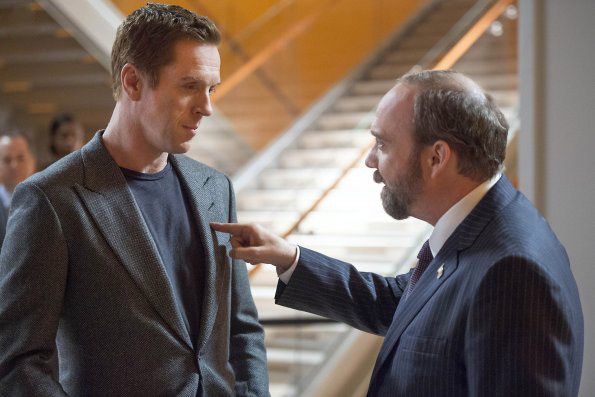
Billions, Showtime’s drama which premiered ten years ago, dives headfirst into this world, the US legal system and the prosecution of white-collar crime. It sets up its conflict as a study in two very different brands of masculinity. On one side, hedge fund billionaire Bobby ‘Axe’ Axelrod (Damian Lewis), an outsider who has forced his way in. He is self-made, brash, and has a chip on his shoulder, having amassed his wealth rather than inheriting it. On the other, US Attorney Chuck Rhoades (Paul Giamatti), a blue-blooded New Yorker born into privilege, connections, and a family legacy that looms like a shadow. His father is the embodiment of old money, a man whose ambitions for his son involve political office. The show sets out their differences from the get go. One has inherited his place at the top of the food chain. One has clawed his way up. Yet, for all their differences, both are locked into a rigid masculinity that demands respect, control, and creates an almost pathological refusal to be second best. Neither can tolerate being challenged, and both are obsessed with asserting their dominance. Their rivalry is less about the law or the ethics of the investment banking industry and more about a relentless, childish need to prove who the alpha is. It’s cat and mouse – and billions are at stake.
Axe’s brand of masculinity is all about performance in how he moves through the world, best displayed through the standards he sets for the men in his orbit. At Axe Capital, his authority is rooted in the belief that he alone can make the impossible calls, take the wildest risks, and consequently, always come out on top. He has surrounded himself with people who mirror his hunger, such as his right-hand man Wags (David Costabile). He demands that they prove they can survive the pressure cooker of high-stakes finance, going so far in one scenario as to use a terminally ill employee, Donnie (David Cromer), to get one over Chuck. Donnie pretends to gather information on Axe for Chuck, because Axe knows he will not live long enough to testify. In the most vile turn of events, he later convinces Donnie’s nurse to withhold information on treatment which would prolong his life so as to maintain this – as a result, Donnie’s final weeks are spent as a pawn. It’s a lack of humanity that indicates Axe’s belief in the biggest mistake to exist – letting someone else get the upper-hand.
There’s a very specific masculinity on display here. Being a man means being the toughest, the most unshakeable presence in the room. If you doubt, you are weak. The prospect of being defeated is unthinkable, as is letting your judgement be questioned by anyone. Unless they’re Axe. The hedge fund is built upon fierce loyalty, but it is conditional. His employees are encouraged to challenge the market, the numbers in front of them, their own opinions, but this does not extend to Axe. There are moments throughout the show where the office functions more like a gladiator arena than a workplace. Axe is undoubtedly incredible at what he does – whether this is down to his instincts, access to insider information, or a mix of both, he gets returns on his investments at levels that feel surreal, and this reputation has earned him the opportunity to construct a world where his own brand of masculinity is the gold standard. His excellence is not down to the low-brow college he attended (a fact which is brought up by his traders) or his background, but it is all within Axe – and that is what gives him control.
What is most telling about Axe is how he reacts when the illusion of control slips. For all of his swagger and bravado, he is incredibly sensitive to being undermined or made to look foolish. Winning for him is not making a good trade, it is about maintaining his image, because like Chuck, he is a man who cannot lose. This competitive environment brings out the worst in him, and no doubt the Axe from humble beginnings would likely feel disgusted at the prospect of exploiting a terminally ill man to win over an enemy. This is exactly why Billions is such an interesting show. It is not only about insider trading but the psychology behind the men involved in it and prosecuting it. When Axe fails to win, he does not see it as a setback: he takes it personally and immediately looks towards retribution. This inability for self-reflection is inevitably what shapes his relationship with Chuck.
Chuck’s masculinity is cut from a different cloth, but the need for control is just as relentless. The authority he wields is baked into his background and the weight of the US legal system that stands behind him. Despite this, he is constantly striving for more, for higher office or securing a conviction. His masculinity has been shaped most notably by his relationship with his father, a man who sets the bar for him at an impossibly high level and refuses to rest until there is a President Chuck Rhoades. The ideas of legacy and leaving an impact on the world in Billions are something everyone must contend with, but the way the show presents it is immediately correlated with questions of gender. Chuck’s father does not hesitate to suggest his wife should quit her job so she can support his run for public office and the women (for the most part) of Billions are not embroiled in these questions and issues surrounding legacy and impact. Chuck’s pursuit of Axe is driven by his motivations for political office, so that one day, children learning about their country’s history may see his name and profile amongst many esteemed men. And as his pursuit intensifies, it becomes clear that his motivations are not always as noble as he would like to believe. His political ambitions are certainly of importance, but it becomes clear in one of the most impactful sequences, the settlement meeting, that it is his disdain for losing that takes centre stage in his quest for justice.
It is the sixth episode of the first season. By this point, both men strongly dislike each other and are involved in a Cold War. Chuck hunts down insider traders who operate within Axe’s world, never directly hunting him (as he is aware the evidence is insufficient), but waging proxy wars with his friends and contemporaries to instill fear in him. The worst thing that could happen to Axe is wearing that orange jumpsuit. In the next few episodes after this failed settlement, Axe wages another proxy war using Donnie to convince Chuck he finally has the crucial evidence he needs to prosecute. At the settlement conference, it is agreed Axe can continue to trade securities but must pay a huge fine – $1.8 billion. This would end their cat-and-mouse chase, all while avoiding putting Wendy Rhoades (Maggie Siff), both Chuck’s wife and Axe Capital’s in-house performance coach, in the middle. However, the conference falls through when Chuck adds a last minute condition – no security trades. Axe leaves and rips up the cheque. There is no end to their rivalry. For Chuck, his urge to beat Axe overrides common sense. A settlement cheque of that size could contribute to public good, the evidence to prosecute Axe is non-existent and, as if that wasn’t enough, his wife is in the middle – a perfect set of reasons to motivate someone to put an end to this. But to settle is to lose – and losing is not an option.
What keeps their rivalry so engrossing is that neither man is willing to walk away. Their conflict spirals into a cycle of provocation and retaliation, each round another opportunity to assert dominance. Just winning is not enough – the other guy has to know he’s lost and wallow in it. There is something juvenile about their need to have the last word, and yet the fallout is anything but childish. The battle between them ruins their lives, their careers and relationships. It poses one central question – if masculinity is always about having the upper hand, if there is always more money, another rank to climb, when do you ever get to feel secure?
The wildcard in this endless game is Wendy Rhoades, the character who offers a different lens on this masculine posturing. Only she truly understands the psychology of the men around her. She is smart, perceptive, and wields her own kind of influence. Yet despite all of this, she is constantly caught in the crossfire of a rivalry that threatens to consume everything in its path. Both men lean on Wendy, but it is always on their own terms. Axe prizes her expertise and loyalty to the firm. A trader has lost his confidence? Send him to Wendy for a tune-up. A few weeks later he has made millions in trades and improved his returns. Meanwhile, Chuck’s expectations of her are tangled up in their marriage and his future ambitions for political office. Both men are quick to acknowledge her value when she is on their side, but her independence becomes inconvenient when it clashes with their interests. There is a certain irony here. In a show obsessed with masculinity, it is Wendy who is left to do the emotional heavy lifting. Both men are emotionally immature and because of this, Wendy is expected to decipher their motivations, mop up the mess they make, and absorb the fallout, while the men get to keep being invulnerable to the hurt and conflict they cause.
Wendy’s role in the show also exposes Chuck’s hypocrisy. Across multiple episodes, he insults her work and informs her that she is working for a criminal, yet he engages in criminal activity to pursue Axe and is a beneficiary of Wendy’s earnings (approximately $1.5 million in the first season). Despite his wealthy background, his inheritance is in a trust due to his legal career, meaning he cannot instruct it or withdraw money from it. With a salary of $185,000, he insists on their two children going to his school due to tradition, at a cost of $70,000 per child. Yet he is disgusted and disparages the way his wife makes her money, and is full of resentment for her continued work at Axe Capital and her closeness to the man himself.
Careers in the legal and financial sector are predicated on reason. The law involves moral, logical and deductive reasoning and investment banking involves analytical, financial and quantitative reasoning. Yet despite this, both men operate in deeply irrational ways throughout the show’s seven seasons. There is no rational reason to use the last few months of a terminally ill man’s life to beat someone at a game you have concocted yourself, nor is there to throw a bomb into a settlement meeting when a $1.8 billion cheque is at stake. where the cheque of $1.8 billion would be the biggest settlement the office had. It is safe to say that the man-equal-rational and woman-equal-emotional trope certainly does not apply in Billions. In the end, it isn’t really a show about the ethics of the investment banking sector and insider trading. It is about losing and winning. Axe and Chuck come from opposite worlds and they wield different kinds of power. But they both have the same fatal flaw. As the show progresses and loyalties change, it reminds us that there is always another rival, another battle, another chance to prove you are the one on top. And maybe that’s the real billion-dollar question at the heart of Billions. What does it mean to be a man when your entire identity is built on the idea of never losing? The show presents us with two men who, on paper, have everything society tells us should make them successful. Wealth, power, influence and a loving family. Yet, neither of them are secure. For all of their bravado, power and influence, they are locked in an exhausting endless loop of trying to prove themselves to each other. In a world where men are so desperate to show their strength, neither is comfortable enough in his own masculinity to recognise that winning may not always be the best outcome.