
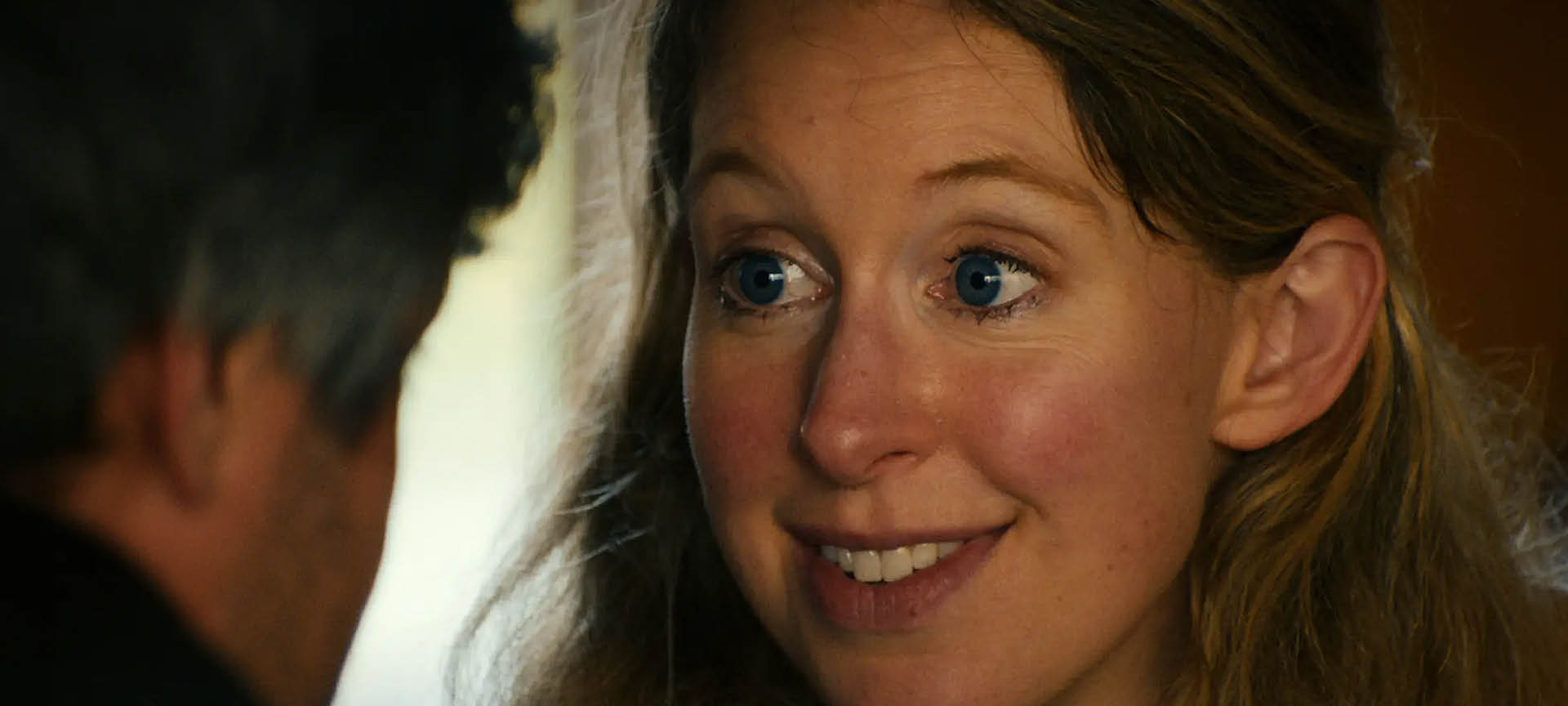
Nathan Fielder’s latest documentary, You Can See Everything, has finally arrived in American cinemas. Unfortunately, here in the United Kingdom, we can’t see everything. At least, not until the 20th of November. But the good news is there’s plenty to watch in the meantime. From The Dropout to Nathan for You and The Rehearsal, here’s why the wait might actually be worth it.
Co-directed by Fielder and Lance Oppenheim, You Can See Everything follows Elizabeth Holmes, the disgraced founder of Theranos, in the weeks leading up to her imprisonment. Holmes, once celebrated as Silicon Valley’s youngest self-made female billionaire, convinced investors that her company had developed revolutionary blood-testing technology. There was just one small problem: it didn’t work as promised.
The documentary, filmed over three years, promises an unusually intimate look at a woman whose entire public identity was built around convincing people to believe in something that wasn’t quite what it seemed. And who better to investigate the performance of authenticity than Nathan Fielder?
But before we get to him, we need to talk about Elizabeth.
The Dropout: Silicon Valley’s greatest performance
Released on Hulu in 2022, The Dropout tells the story of Holmes’s rise and fall, from an ambitious Stanford dropout to the founder of a multibillion-dollar company built on increasingly questionable promises.
Created by Elizabeth Meriwether, the mind behind New Girl, The Dropout is surprisingly funny, through the sheer irony of watching incredibly intelligent, incredibly wealthy people become convinced by something the audience already knows is falling apart. We watch Holmes pitch impossible technology to powerful investors, modelling herself after Steve Jobs with an almost religious devotion to black turtlenecks and a ridiculously deep voice. There’s something wonderfully absurd about it all, particularly when the series reminds us just how seriously everyone takes themselves.
Of course, the consequences of the Theranos scandal were anything but funny. The company’s misleading blood-testing claims put patients at risk, and the series doesn’t shy away from the people who suffered because of it. Still, its ability to find humour in the absurdity of corporate ambition without trivialising its consequences is one of its greatest strengths.
What I found particularly interesting, however, was how vividly the series recreated Silicon Valley during the technology boom of the 2000s and 2010s. The Dropout wasn’t simply interested in Theranos. It gave us a glimpse into an entire culture obsessed with innovation, disruption, and the next big idea. There are references to other emerging technology companies, including Uber, and a sense of how quickly the industry is transforming. At times, it almost feels like a period piece about a period that doesn’t seem quite old enough to qualify as history.
But more importantly, the series captures the peculiar mentality that allowed Theranos to exist in the first place: a world in which confidence could be mistaken for competence, ambition for achievement, and an impressive pitch for an actual product.
Amanda Seyfried is nothing short of extraordinary as Holmes, delivering a performance that earned her both a Primetime Emmy and a Golden Globe for Best Actress in a Limited Series. Rather than turning her into a caricature, Seyfried gives her an unsettling combination of awkwardness, determination, insecurity, and arrogance. Her performance is especially fascinating because we rarely feel that we’re watching someone who is entirely comfortable being herself. Instead, we’re watching someone trying to become the person she thinks the world wants to see.
Naveen Andrews is equally compelling as Sunny Balwani, Holmes’s business and romantic partner, whose increasingly controlling relationship with her adds another uncomfortable dimension to the story. Meanwhile, the supporting cast, including Stephen Fry, Laurie Metcalf, and William H. Macy, helps make the world surrounding Theranos feel populated by real people rather than convenient obstacles in Holmes’s narrative.
The series also deserves credit for giving space to the scientists, employees, and whistleblowers who challenged the company. Without them, The Dropout could easily have become another glamorous story about a fascinating fraudster. Instead, it reminds us that behind the spectacle were people genuinely concerned about what was happening.
Ultimately, what makes The Dropout so entertaining is also what makes it disturbing: it shows how easily a convincing performance can become more valuable than the truth. And watching Seyfried’s Holmes desperately attempt to appear powerful, charismatic, and completely in control is often painfully uncomfortable.
Speaking of convincing performances that are painfully uncomfortable to watch, let’s talk about Nathan Fielder.
Nathan For Who?
If you’re unfamiliar with Nathan Fielder, describing his work is surprisingly difficult. He’s a comedian, writer, director, and performer whose projects frequently blur the boundaries between documentary, reality television, social experiment, and elaborate practical jokes. His humour is so dry that sometimes it’s difficult to tell whether something is supposed to be funny at all. And that’s what makes it funny.
His earlier television projects are especially useful for understanding what he brings to You Can See Everything. Fielder has built a career around placing real people in increasingly absurd situations, often presenting himself as a socially awkward but completely sincere participant. The result is a very particular kind of comedy, one in which the audience is never entirely sure who is in on the joke.
In Nathan for You (2013–2017), Fielder plays a version of himself who offers struggling businesses unconventional strategies to improve their sales. On paper, it sounds like a fairly ordinary business makeover show. In practice, it’s one of the strangest comedies ever made.
The funniest part isn’t necessarily the strategies themselves, although they’re certainly ridiculous (for instance, when he helps a struggling funeral home by offering clients the option to hire professional actors to pose as grieving family members and close friends at the service). It’s watching how far Fielder is willing to take them, and how the people around him respond. His commitment to remaining completely serious, even when the situation has become objectively insane, creates a level of awkwardness that few scripted comedies could reproduce.
What makes the show particularly fascinating is how easily people seem to accept his authority. Fielder presents himself as a business expert, and suddenly even his most absurd suggestions become something worth considering. It’s difficult not to think about the culture depicted in The Dropout, where confidence and an impressive pitch could persuade people to believe almost anything. Of course, Fielder’s intentions are entirely different, but the underlying observation about human behaviour is remarkably similar.
The Rehearsal (2022–present) takes his commitment several steps further. The premise is simple, at least initially: Fielder helps ordinary people prepare for difficult moments in their lives by allowing them to rehearse those moments beforehand.
To do this, he constructs elaborate replicas of real environments, hires actors to impersonate the people involved, and recreates possible scenarios so his participants can practise their responses. In the first episode, for example, a man wants to confess a long-held lie to a friend. Rather than simply encouraging him to tell the truth, Fielder builds a replica of the bar where the conversation will take place and stages multiple versions of the interaction.
As the series progresses, the rehearsals become increasingly complicated, and Fielder himself becomes more deeply involved in the situations he’s supposedly observing. The distinction between preparing for reality and actually living it becomes progressively harder to identify.
What’s particularly interesting about The Rehearsal is that, beneath all the absurdity, its central premise is surprisingly relatable. Who hasn’t rehearsed an uncomfortable conversation in their head, imagining every possible response and planning exactly what to say? Fielder simply takes that very human instinct and gives it an enormous production budget.
But the more elaborate his rehearsals become, the more obvious their central contradiction seems: no matter how carefully you prepare, you can never entirely predict another person’s behaviour. And there’s something both hilarious and strangely unsettling about watching someone go to such extraordinary lengths to avoid that uncertainty.
What makes Nathan for You and The Rehearsal particularly interesting is the way they expose human behaviour. People want to be polite. They want to appear cooperative. They want to feel in control of how others perceive them. And Fielder knows exactly how to exploit those instincts. There are moments when you genuinely wonder why nobody has simply told him to stop. Then you realise that their reluctance to do so is part of the joke.
Nathan’s work is hilarious, but also an unexpectedly revealing study of social conventions, authority, and our willingness to participate in situations that make absolutely no sense. It’s also a reminder that documentaries aren’t necessarily neutral windows into reality. The presence of a camera changes how people behave, and Fielder seems more interested in exploring that transformation than pretending it doesn’t happen.
Sound familiar?
So, can we really see everything?
What connects The Dropout, Nathan for You, and The Rehearsal is their fascination with the distance between who people are and who they want others to believe they are.
Elizabeth Holmes constructed an image of herself as a visionary entrepreneur. Fielder’s business owners try to present themselves as capable professionals, even when they’re participating in increasingly ridiculous schemes. The participants in The Rehearsal attempt to perfect their behaviour before exposing themselves to the unpredictability of real life. They’re all performing, in one way or another.
And perhaps that’s what makes You Can See Everything such an intriguing proposition.
For years, Holmes controlled her public image with extraordinary precision. Now, she’s invited a filmmaker whose entire career has been built around exposing the uncomfortable contradictions between performance and reality into her home.
But there’s another interesting contradiction here. Fielder himself is hardly an impartial observer. His entire comedic persona is carefully constructed, and his documentaries frequently involve elaborate artificial situations designed to provoke supposedly authentic reactions. In other words, he’s also something of an expert in controlling what people see.
Of course, that doesn’t necessarily mean we’re finally going to discover the real Elizabeth Holmes. If anything, Fielder’s previous work suggests that the more closely we examine someone, the more complicated the idea of authenticity becomes. Perhaps the documentary’s greatest question isn’t whether Holmes is telling the truth, but whether a camera can ever reveal the whole truth about anyone.
In the meantime, British audiences have a little longer to wait.
Fortunately, The Dropout, Nathan for You, and The Rehearsal offer more than enough material to keep us occupied. One explains how Holmes became the woman at the centre of the scandal – the others introduce us to the peculiar mind of the filmmaker now attempting to understand her.
And by the 20th of November, we might finally be ready to see everything.
Or, knowing Nathan Fielder, we’ll leave the cinema even less certain.
The Dropout is available on Disney+. Nathan For Who is available on Amazon Prime Video. The Rehearsal is available on HBO MAX. You Can See Everything will screen in UK cinemas from 20 November 2026.