
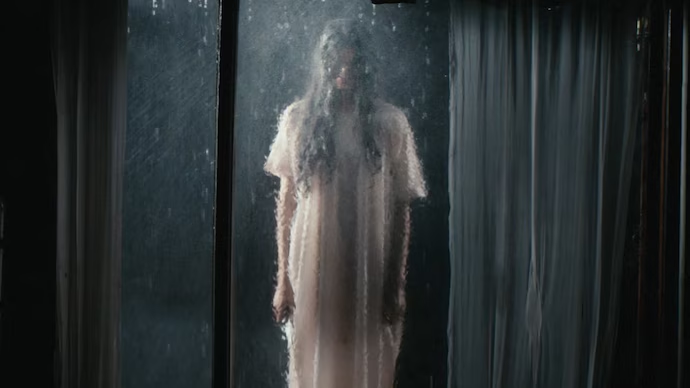
There is somewhat of an identity problem within 418, a Telugu language supernatural horror “presented” by blockbuster director Prashanth Neel (Ugraam. KGF). Anyone who sees the trailer would be forgiven for thinking Neel is behind the creative vision for this latest chiller in which an abandoned mental asylum turned university lodging is haunted by the spectre of a former resident. In fact, he is not, and the honour instead goes to directorial debutant Kiran Nagadouga, a prodigy of his. This tactic of piggybacking a famous name onto a horror project for promotion can be traced across all film cultures. Sometimes it is successful, with Guillermo Del Toro using his name to land J.A Boyona a successful Hollywood career after the success of Spanish language horror The Orphanage. Other times however it can swamp a project, with Justin Tipping’s 2025 film Him undermined by the fact it wasn’t directed by its producer Jordan Peele despite his name dominating the marketing, leading to accusations the film was overcompensating mediocrity with a big name to sell it. In this case, Neel’s name does a lot of heavy lifting, a shame given Nagadouga clearly possesses some fine compositional talent. Unfortunately the script and narrative, like its authorship, remains frustratingly unclear.
The film’s tension is built through the mystery of what lies within Room 418, which is bolted up and forbidden to students. This does feel quite derivative of The Shining’s Room 237, and nothing unsettles nearly as much as Lorraine Massey, but there is certainly an unsettling tone. Much of this can be attributed to its technical elements, with the collaboration between Nagadouga, cinematographer Dinesh Divakaran and sound designer Anupam C making each inevitable break of the lodgings two strict rules (no women allowed and no one in the titular room) highly uncomfortable as people edge closer and closer to an unseen hell. A shrieking faulty sound system pierces the skull while the jingle of ghungroo bells on feet send shivers up the spine. There is a level of flamboyance in the visual imagery, with enough Dutch Angles and zooms to keep the viewer suitably off balance. A highly effective scene involves young men in their cramped lodgings getting high on cannabis, whip panning around in one take while crafting an inebriated and unwise collective consciousness with disastrous consequences. It could have done without the overuse of montage and cuts to black as a method of building momentum and tension, but it’s hard to deny that one isn’t left at least a little on edge.
The characters are mostly one-note caricatures, vessels for plot to happen to rather than anything to remember past the credits. Protagonist Vivek (Surya Raj Veerabathini) is present only to crumble and emotionally fall apart, while Saisha (Preethi Pagadala) operates as a rebellious figure to move the plot along and conjure some form of peril. By far the standout character and performance comes from Devika (Chaitra J. Achar) who is given a reasonably interesting backstory in an extensive flashback after the intermission. This is the high point of the emotional resonance as it is revealed how far the quest for motherhood combined with personal and societal pressure can push someone to do things they would otherwise not dream of. Her profession as a Yakshagana artist (a combination of dance, drama and music) allowed for some striking visuals of her dotted in red and black paint, a devilish and ominous image that lingers.
A real shame then that the film has no idea what to do with this information, swinging wildly around in a third act with no real cohesion. The film doesn’t know what it wants its eventual antagonist to be and so squanders much of its potential with an incomprehensible narrative and no clarity around any form of motivation. Any reveal of what lies behind the door is both not worth it and quickly muddled and over complicated, making it hard to follow and easy to frustrate. Even in the first half cohesiveness proves a problem with quick jumps between humour, drama and emotional outburst making it hard to follow a clear journey. But a rocky road becomes one impossible to traverse by its end, making it difficult to truly care about anyone or anything happening. It also regrettably retreats to its horror cliches at every opportunity, crafting a climax, and arguably a full narrative, fit not for the characters it created but for the characters Nadagouda has seen in other, better horror films.
There is certainly promise in Nadagouda’s debut, with some interestingly localised themes, striking visuals and a good performance by Achar, and the film is far from a total misfire, mostly watchable until its final act. There is certainly scope for him to use what worked here to build better future features. To do so would require a tightening of runtime, as even with Telugu cinema’s expected excess, the film takes 156 minutes to do what most western horrors do in 85. It would also require clearer character motivations, a tighter screenplay and protagonists you actively root for, rather than merely observe. With a narrative to match the visual flair we could certainly see Kiran Nagadouga as a household name in Telugu language cinema. Without it however, I fear we will only see “Prashanth Neel Presents”.