It’s hard to think of a cinematic project more daunting than adapting Valmiki’s Ramayana for the big screen. A sacred text four times the length of Homer’s Iliad and twice the length of the entire Christian Bible, Prime Focus Studios and director Nitesh Tiwari certainly had quite the task on their hands. The first of two parts has now roared into UK cinemas just in time for Diwali, with the second set for release in 2028. The western backing for this project is greater than any other Bollywood project I can recall, packaged with a huge marketing campaign by distributor Sony Pictures, scored by Hans Zimmer and with the titanic DNEG on board for visual effects (Dune, Blade Runner 2049). The effort pays off in spectacle and scale, providing an often exciting epic with entertaining action and larger than life bombast, even if character depth and storytelling lands a much lesser blow.
The story will likely be second nature to its national audience but for the unfamiliar, Ramayana follows Ram, prince of Ayodhya and human avatar of the deity Vishnu. Raised as a prodigy and trained by sages to immense power, Ram is bound by a sense of immense duty to family, love and kingdom. This is put under strain due to political infighting, false promises and the stranglehold of Ravana, king of Lanka, who through pilgrimage and penance is granted conditional immortality by the deity Brahma. Alongside wife Sita and brother Lakshman, Ram finds himself on an increasingly likely collision course with Ravana, as his desire to let fate take its course is increasingly tested.
It is fascinating that Christopher Nolan’s The Odyssey released the same year as Ramayana, two big budget adaptations of foundational texts of western and eastern literature that share some keen similarities. Both revolve around duty bound protagonists who must embark on a quest to restore order, both contain giant creatures in forests for our heroes’ to contend with, and both even feature a key sequence surrounding suitors attempting to string a bow for a woman’s hand. Like The Odyssey, narrative simplicity and traditional tropes can be more easily excused as their status as ancient poetry typically makes them their originators. Where the two diverge is their method of visual effects, Nolan’s practical imagery replaced by a very CGI heavy final product. Many of the landscapes and backgrounds achieve impressive grandiosity and every cent of its half a billion dollar budget is visible onscreen, but some of the more humanised figures like the giants are sadly quite poorly designed, resembling something closer to the uncanny monsters in Na-Hong Jin’s Hope than Nolan’s magnificent cyclops.
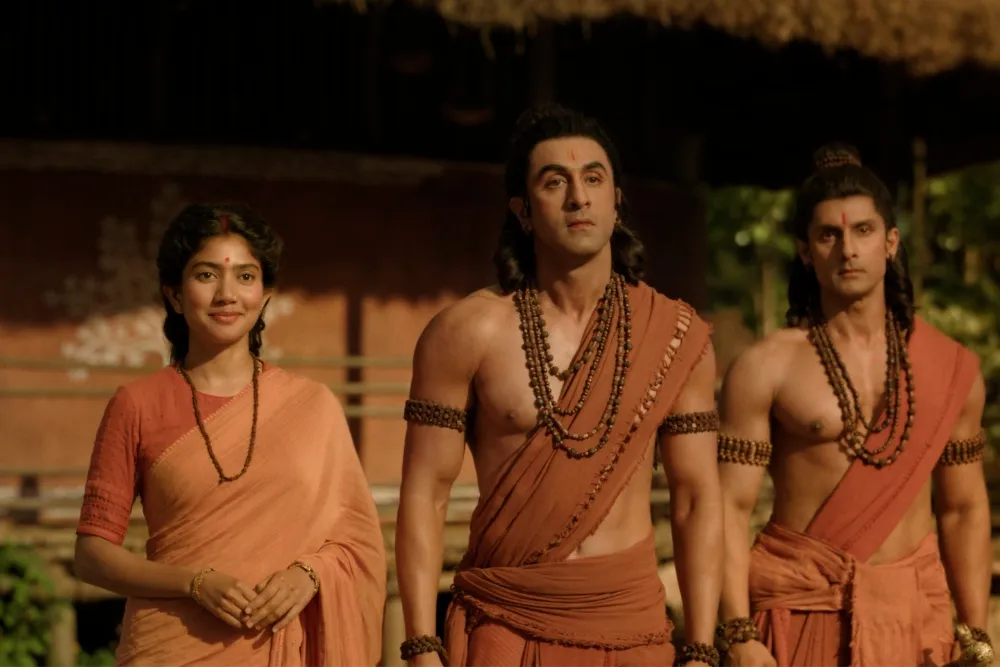
Performances vary, typically in correlation to the depth offered by Shridhar Raghavan’s screenplay. Ranbir Kapoor certainly looks the part as Ram, with abundant confidence and an often serenely calm expression that matches the character’s internal peace. Unfortunately his ability to fully shine is hamstrung by the immovable simplicity of his character on the page, which means that development is intentionally delayed until the eleventh hour. The character may work well in literature as a vessel for a moral tale, particularly given it seems likely his development will come in the sequel, but over a three hour run-time the consistent refusal to evolve makes the character increasingly naive and dull to a modern viewer. The same can be said of Sai Pallavi’s Sita, who we see engaging in exciting combat drills early on but has little to do once married other than dote on her husband. As Lakshman, Ravi Dubey is effective in his serious moments, when resolve falters and the human qualities of bitterness and resentment take over, but struggles when his character functions as comic relief, with almost all the quips falling flat. By far the standout is Yash as Ravana, who delivers a deliciously intimidating villain with near unlimited power, presenting a conflicted narcissist plagued with every part of the human psyche leading him down different roads.
To say the film is spectacular in scope would be an understatement, almost every shot filled with as much mise-en-scene as can be crammed into a single frame. The camera swoops, zooms, cranes and whips through the various kingdoms our characters occupy while the highly cranked collaborative score between Zimmer and AR Rahman amps every emotion up to fifty. For sheer spectacle the film can assault you into submission, particularly in some of the action sequences, including a third act fight with a giant eagle that is breathtaking to watch. The film has a mammoth one hundred and ninety five minute running time in its original Hindi, though viewers wishing to see it with an English dub will find it cut to one hundred and sixty five. Upon researching what is cut however, it must be advised to seek out the Hindi version as key plot developments don’t find its way into the Western cut and will lessen the viewing experience. It is bizarre too given that there could easily have been trims to pacing elsewhere in the narrative, with some plot developments taking upwards of five minutes to tell what could be told in at least half the time. Why they chose to leave those in and fundamentally weaken the central character’s already thin motivations boggles the brain.
If you are willing to surrender yourself to the prodigious pageantry of Ramayana then there is something to enjoy here. Its characters do still have a story worth telling and the ambition of the project speaks for itself. It is overlong, overcranked and narratively underdeveloped, something a sequel is unlikely to resolve. However, knowing what is to come it can be hoped that the positives of part one will be more strongly emphasised in part two, leaning into the spectacle that made the high points of Ramayana: Rise of a Legend fun to watch.