
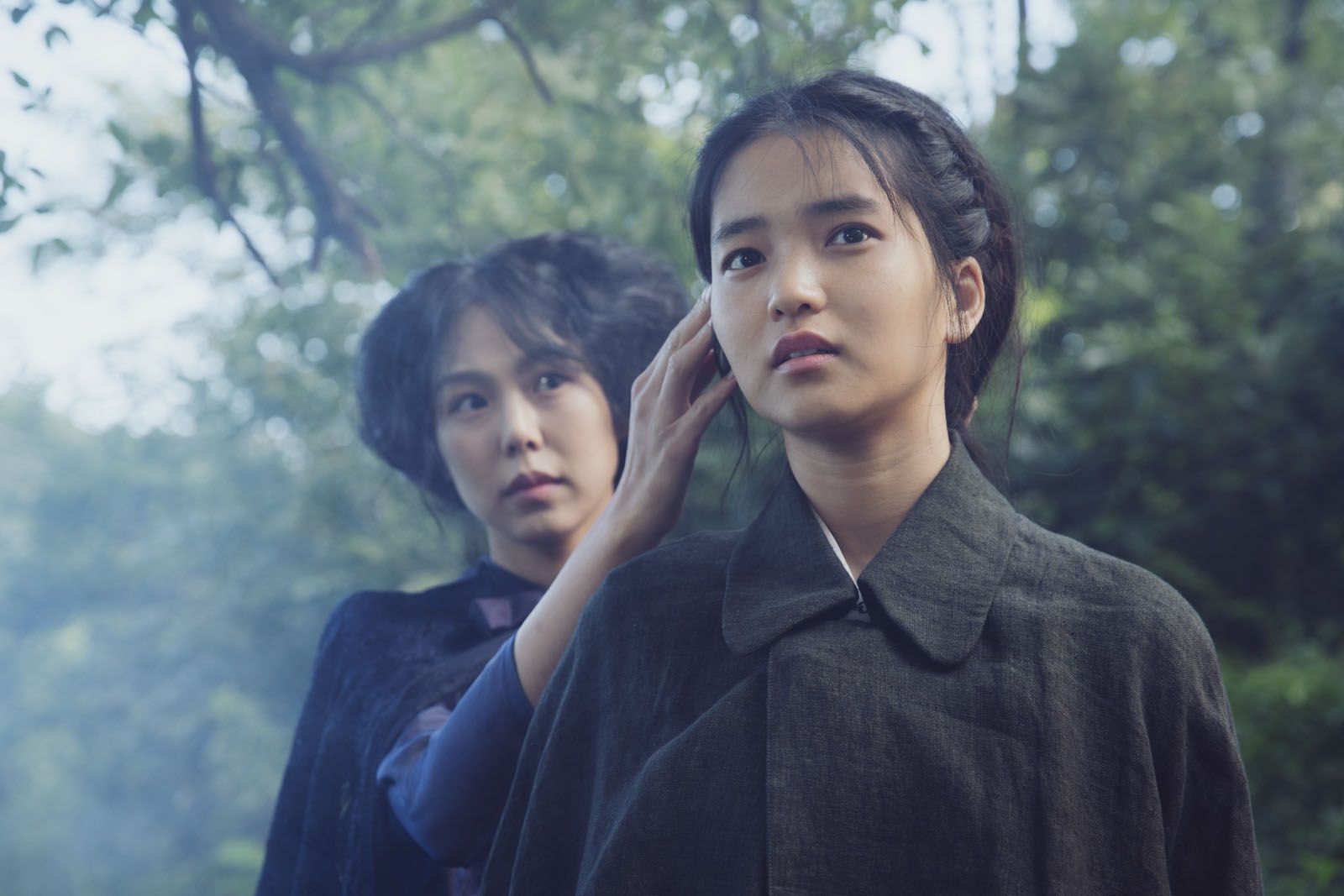
Inspired by Sarah Waters’ twisting Victorian-era crime novel Fingersmith, Park Chan-wook’s The Handmaiden transplants the story to Japanese-occupied Korea, telling the story of a young Korean maid hired by a conman with aristocratic pretensions to swindle a Japanese heiress. What might seem on the surface to be a simple costume drama turns out to be a web of shifting motivations and deep-seated trauma.
Director, co-writer and co-producer Park originally planned to set the film in the same period as the novel, but moved the setting to Korea to escape the shadow of the well-received BBC miniseries Fingersmith (2005). The resulting film is much better for it, as not only do the themes of social inequality, prejudice and female exploitation translate well, but the audience gets to witness outstanding performances from Kim Min-hee, Ha Jung-woo and newcomer Kim Tae-ri, among others.
Sookee (Kim Tae-ri) has been raised in an orphanage as a pickpocket and assists her hosts with the care of the babies that come to them. An associate (Ha Jung-woo) who styles himself as ‘Count Fujiwara’, a Japanese aristocrat, arrives to hire Sookee for an important job: to help him seduce and propose to Izumi Hideko (Kim Min-hee), the niece by marriage of another Japanese nobleman, in order to take her inheritance. Sookee agrees and, using her carer’s instincts, grows close with the sheltered and seemingly childish Hideko. As the plan is put into motion, Sookee becomes infatuated with Hideko and is reluctant to drive her towards marrying the Count. The truth unravels and new plots are hatched as both Sookee and the Count plan to leave with Hideko and her fortune.
A central thread of the film is the agency and resistance of women in a highly male-dominated society. Sookee, brought up far from the lavish houses and strict manners of the upper classes, counters Fujiwara’s terms with her own and displays her emotions sincerely. Though a prisoner of her uncle, Hideko holds her own sway over his acquaintances and is not easily won over by the Count. The story’s traditional setting is overturned by its central queer romance and the machinations of female characters against the males, not to mention the strong presence of sex and sensualism.
In recent years, the theme of inequality and its equalising by social climbing has been prominent both within and without Korean cinema. Only three years after The Handmaiden, Bong Joon-ho’s Parasite depicted a poor family infiltrating a rich one to massive international acclaim. Similarly, the series Squid Game showed just how desperate many people in a society like South Korea can be to better their circumstances, and just how relatable that is to the masses.
As the gap widens around the world and more light is shed on the people at the top, The Handmaiden offers a vivid but credible villain for us to be disgusted by in the form of Hideko’s uncle Kouzuki (Cho Jin-woong). It’s a disturbing thought that men like Kouzuki are the ones who run the world, but there is hope in future generations if they can recognise the shadows in their upbringing and choose to expose them.
With a grim but gorgeously realised setting, an intricate plot and career-best performances, The Handmaiden is arguably Park’s masterpiece. Its sexual liberty and feminist leanings made it noteworthy upon release and have only helped it age well since.