
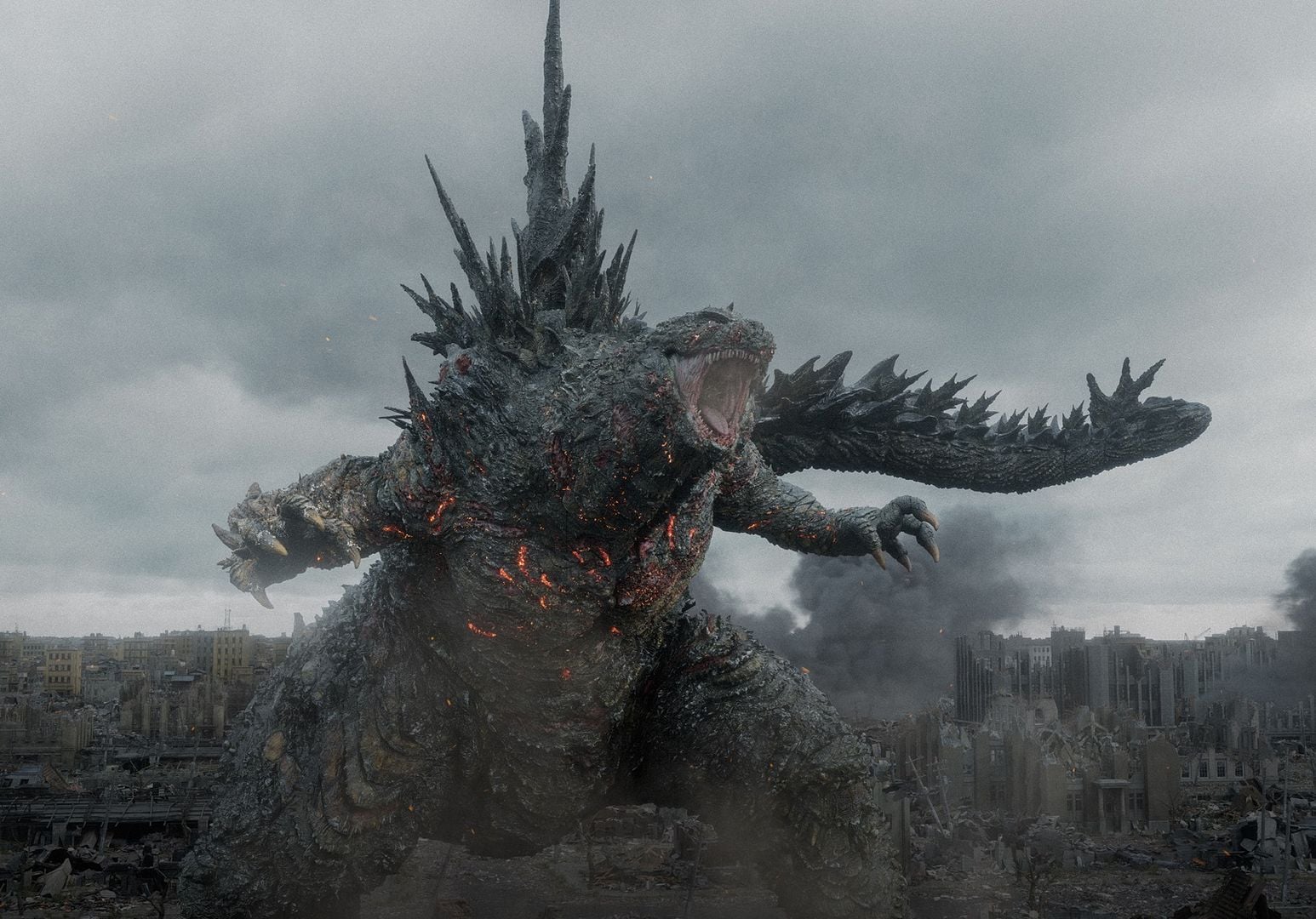
Godzilla: Minus Zero is more, and less, than Godzilla: Minus One. It remains a story of Japan’s post-war trauma, though broadening here to reflect directly on the devastation and grief caused by the atomic bomb, and on the complicated relationship with the United States over the years that followed. It is, at times, goofy and overly theatrical in its drama, but ultimately demonstrates, again, that Godzilla is Japan’s monster – it is an embodiment of a struggle with their anger, their pain, and their sins in the wake of the Second World War, and in anyone else’s hands it is shallow and empty.
Continuing on a few years after the events of Minus One, the recently established Disaster Response Bureau, headed by Kenji Noda (Hidetaka Noshioka), is tasked with dealing with a new threat. Former kamikaze pilot Shikishima (Ryunosuke Kamiki) is pulled into the conflict, struggling to balance what is best for his adoptive family and his beleaguered nation. His now wife, Noriko (Minami Hamabe), who miraculously survived Godzilla’s last attack, also finds herself faced with a hard choice in the wake of the looming disaster threatening Japan.
It is worth mentioning that Godzilla itself does not have much screentime in Minus Zero, but that when it does, it is spectacular: director Takashi Yamazaki and his SFX team are firing on all cylinders, with a bigger budget behind them this time. There are some truly stunning sequences that are absolutely worth experiencing in the cinema, augmented by phenomenal sound design. There are moments, however, that at times appear oddly rushed and even unfinished, with the narrative increasingly relying on contrivance as it scrambles to wrap up. The human drama at the heart of the story is emotionally intense but rather weak in execution – as in Minus One, the acting and writing is overwrought and unsubtle. As is tradition in Japanese Godzilla films, the American performances are also cartoonishly ridiculous, and while this is entertaining, the amateurishness of it diminishes much of the impact that the presence of the US military is clearly meant to evoke.
Where Minus One’s great strength was its focus on Shikishima’s personal trauma after the war, with Godzilla appearing as a hateful manifestation of everything he was running from, here its role is a little more distant and abstract. This is reflected in the design of the monster itself – in Minus One it appeared crazed, with a kind of lunatic spitefulness in its eyes directed at Shikishima himself in a way that centred their terrible and intimate bond. In Minus Zero, Godzilla looks more impressive – no doubt the best it has ever looked and sounded in fact – but most of that intimacy is lost. If Minus One is most similar in tone to the 1954 original, Minus Zero seems much more like the Godzilla of the Heisei era, the basis of much of its pop-cultural identity.
Thematically, the film remains as strong as its predecessor, wrestling with Japan’s post-war identity and its bitterness towards the United States. It is fitting that their relationship with Godzilla has altered as time has passed from Minus One, much as Japan’s own sense of itself would have once the dust settled from the war. Godzilla’s role as divine punishment, and protector, is emphasised throughout, reflecting Japan’s history and connection to its frequent natural disasters, as well as a reckoning with its own soul. It makes a bold statement in its dark reverence of Godzilla as an inescapable part of Japan’s identity, even in some sense addressing American attempts to portray the monster in film, by saying essentially that Godzilla is ours, for better or worse – it is our curse, our trauma, our immortal demon to battle.
If you can stomach the melodrama, there is a powerful story here about grief, personal and national responsibility, and what it means to bear the burden of an unstoppable monster that can never be put to res (and that is something beautiful to behold on the big screen). Godzilla may not appear much in Minus Zero, but when it does it is clear why it has endured for so long, and why Japan is its one true home.
Godzilla: Minus Zero is in UK cinemas now.