
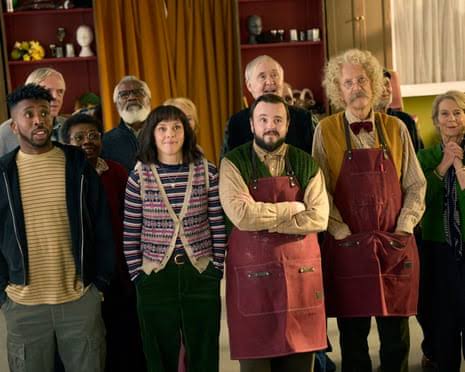
Jack Spring directs the new Christmas comedy Merry Christmas Aubrey Flint, a semi-interpretation of the Charles Dicken’s novel A Christmas Carol – minus the three ghosts, the singing and dancing, and the character of Tiny Tim. The result is something that feels genuinely insane – formulaic, witty, yet tonally all over the place at the same time.
Aubrey Flint (John Bradley) is a miserly modern day Scrooge. Christmas is an inconvenience at best to him, and serving customers who deign to incorrectly propose the wrong coat of paint on a soldier’s cloak – well, you can forget a kind word being thrown your way from him. But when a misunderstanding – in a Christmas shop of all places – ends up with our plucky title character in community service, he must find the magic of the Christmas spirit, save a retirement home from closure through the magic of community theatre, and discover the goodness inside of him along the way.
It starts with a John Lewis-esque scene – a young boy from France arrives at a new school and, bullied and alone, discovers an old antique in a shop run by Mr. Hopkins (Richard E. Grant). When his mother buys the antique for Christmas, tragedy strikes on Christmas Day, starting his Scrooge like turn into adulthood. The film in this respect is as predictable as expected – there are the obvious comedy beats, with witty lines thrown here and there, dialogue attempting to be humorous, and an array of British character actors constantly appearing in small bit parts. Celia Imrie (playing a former actress), Grant (as the shop owner), Jim Broadbent (as the narrator), and Sophia Di Martino (as a care home worker determined to save the day) appear to provide ample weight to the cast – all playing their usual roles as the whimsical, charming, and – yes – sometimes even inspiring characters. There are monologues about how elderly people are discriminated against, lines about the importance of theatre, and even a moral lesson or two about being together during Christmas. It’s a bit sentimental and obvious, but it is, all in all, well meaning.
There are however some wild moments: Imrie is introduced in the most bizarre camera choice I’ve seen all year (I can’t say what it is but I thought the film was going to take a very dark turn), while the aforementioned opening sequence goes from magical to tragic with the spur and zest of emotional whiplash. Motivations are rushed through, plots are never given enough time to breathe, and the feel of a Christmas film tends to be overwhelming rather than a source of investment. The brisk ninety eight minute runtime drags on as well.
Yet, the film has its heart in the right place. This is, after all, a movie about community, about finding love and new family. It’s about beating the odds, and coming together with a seemingly impossible task to prevent the end of something that is good and honest. A community theatre production of A Christmas Carol is a key element of this film, complete with moving ending and feelgood production. I had my grumblings, but I did feel a small tear come to my eye at the close of the curtain.