
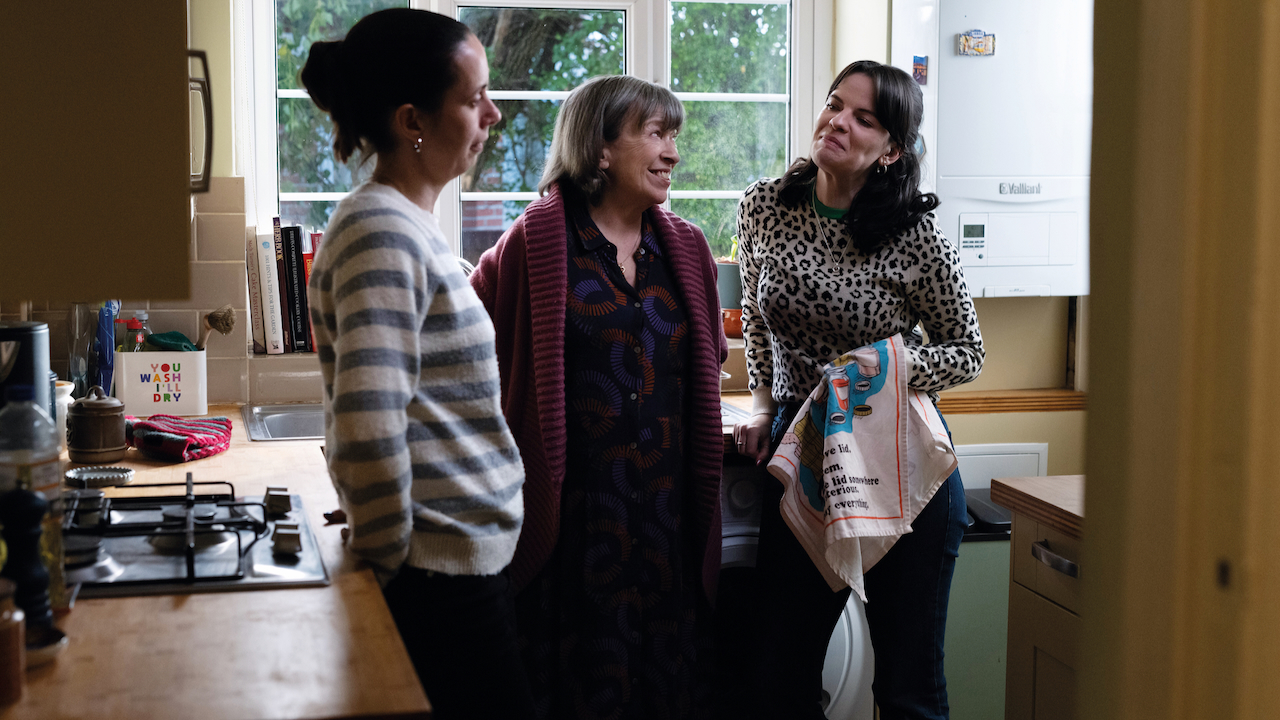
Mike Leigh returns for his self-declared final film with Tender Loving Care, a heartfelt tale of social workers living in an increasingly oversaturated system. More so than it is about the administration itself, Leigh’s latest focuses instead on the home lives of these women, what happens when the front door is shut and the day is over. It’s an enjoyable (for want of a better word) watch certainly, and one that is adept at portraying the different levels of care that can be given and received by close ones, but in its trademark efforts to remain organic, there is something inherently rehearsed about this latest deep dive into British bureaucracy and care system, leaving behind a sense of disillusionment rather than reconciliation.
Amy (Kate O’Flynn), a government child protection officer, moves back in with her friend Rosie (Alice Bailey Johnson), a social services worker, after a difficult breakup. Both managing angry and upset people on a day-to-day basis, their evenings are marked with a therapy chat and glass of wine, along with an occasional visit to Amy’s parents, Birdie (Marion Bailey) and Geoff (Paul Jesson), a picture perfect couple who giggle gleefully together and worry over their daughter from their living room sofa. Tricky conversations, misfortune in love, children being taken away from their parents – there is an inherent need for care in this world, and through the lens of this little, reconstructed family, Leigh shows us the variety of ways in which it can be given and received, whether it is desired or not.
Leigh is known for finding the script in rehearsals, something he highlighted during his Q&A during the London Film Festival, and yet in Tender Loving Care there is almost a hyperawareness from O’Flynn and Bailey Johnson that they are acting, that they need to sound a certain way. The result is something of a girl’s night in where the repeated question is “do people really speak this way in the comfort of their own homes?” – O’Flynn is somewhat of a quieter performance, her eyes translating many a worry and deep-rooted anxiety. Bailey Johnson meanwhile seems to be perpetually playing the carer, articulating every sentence as though to the hard of hearing – at times, it is mildly grating despite her good humour and ability to lighten an uncomfortable atmosphere. It is in moments of grief rather than joviality that both find their footing, a quick glance, a watery eye, a hand held. Outside of their one-on-one interactions, there is perhaps a lot more to like, mainly thanks to Bailey and Jesson, who I would happily watch potter around their home all day – it is here that Tender Loving Care really comes alive, in this little living room where Birdie serves tea and biscuits and worries over her daughter being single in her thirties. An interesting dynamic emerges from this foursome, an entanglement between generations, as the couple who have been together watch over a modern dating world they do not understand, in which Amy hangs onto a doomed relationship for five years and Rosie is stood up by a fireman. Yet, Leigh is quick to react here – these are four caring people by nature, and Birdie and Geoff’s inherently soothing presence serves as an evident juxtaposition to the troubled people Amy and Rosie deal with every day. Care, in all senses of the word, comes about time and again – the care we long for, the care we refuse, the care we do not have access to. At which stage does an organisation have to intervene, and when can a person close to you be enough? These questions are, fittingly, tenderly explored with no judgement accorded to any of the parties – and if anything, there is always a glass of wine to be had.
Tender Loving Care screened at the London Film Festival and will be released in UK cinemas on 17 February 2027.