
“Siento que ninguna de las horas me ha pertenecido porque no las he vivido.”
“I feel that none of the hours belong to me because I haven’t lived them.”
As I implored a friend in near desperation to see La Bola Negra, which I knew would change his life as it had changed mine, he asked that most normal and expected of questions which in this instance left me utterly confounded: ‘what’s it about?’.
This film, which has occupied much of my mind since my first watch in Cannes back in May, is simultaneously about so much that I was unsure where to even begin. On the surface, it is the story of three men across time struggling against the forces around them and against themselves, united by an invisible string that pulls slowly for over two and a half hours until they cohere. It is an exploration of homosexuality with its chain of bittersweet universalities shared across epochs. It is an unflinching portrait of Spain as a nation, with all its painful contradictions and their inextricability from the character of its people. Above all, perhaps, it is about love, as a story that we tell, and pass on. And it is a call to arms: to live.
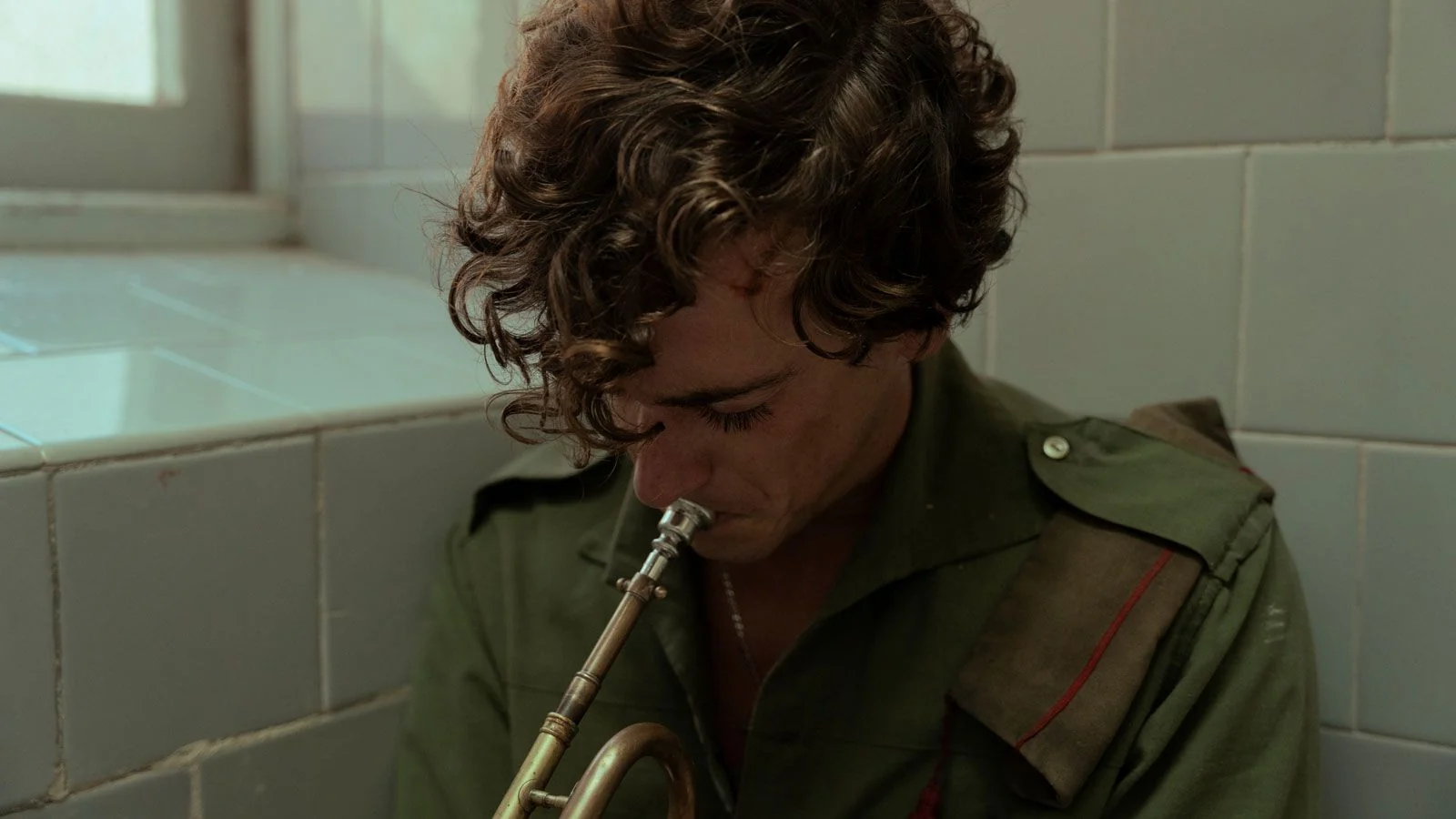
The story begins in 1937. A rural village in southern Spain eagerly (and apprehensively) awaits the arrival of Mussolini’s troops. Children raise arms in a fascist salute without understanding its meaning as the planes fly overhead, before the townspeople are indiscriminately gunned down, the survivors slaughtered by the approaching ground troops. Whether this was a mistake or a betrayal by the Italians is never learned, as indeed civilians in war zones are rarely apprised of the full circumstances of their decimation. And it is here we meet the first of our protagonists, Sebastián (Guitarricadelafuente), a shy trumpet player whom we follow in a remarkable extended tracking shot as everyone he loves is killed around him before he escapes his village, its most memorable sequence leading him through the bombed church of his onomastic namesake, literally pulling himself over the ruined statue of persecuted gay icon Saint Sebastian by the metal arrows protruding from his torso with all the allegorical subtlety of an SM.81. When finally captured by the fascists, he protests he is one of them, eking out acceptance from his oppressors in order to survive, as all gay men have done many times in our lives.
As the film progresses we meet the characters that make up the trifecta. Alberto (Carlos González), a history student researching lost queer culture, is pulled into the story by the death of his estranged maternal grandfather and the subsequent inheritance in his will. Carlos (Milo Quifes) applies for membership of an exclusive Granada casino in 1932, only to be given the eponymous bola negra by the jury (in literal translation and modern English parlance, ‘blackballed’) because of his homosexuality, although the relevance of his tale to the other characters does not become clear until later. In a military hospital, Sebastián meets prisoner and patient Rafael Rodríguez Rapún (Miguel Bernardeau) with whom he forms a tantalising, forbidden and indissoluble connection. From here the stories play out to their respective ends (but how inevitable these ends are is a primary concern of the film) expertly tied together by Los Javis and their co-writer Alberto Conejero, upon whom the character Alberto is based. The duration of each scene contracts until the editing brings all three characters together across time into a unity of experience and understanding, and if my screenings are anything to go by, there will be hardly a dry eye in the house.
Directors Javier Ambrossi and Javier Calvo, known affectionately as Los Javis for their TV shows Veneno and Paquita Salas as well as for being judges on the Spanish version of RuPaul’s Drag Race, make their Cannes competition debut in what is already shaping up to be one of the highest-grossing Spanish films of all time, as well as eyeing an eye-watering number of potential award nominations, having already taken the Best Director prize at Cannes. It should be impossible for this film to be heard over the deafening buzz surrounding it, and yet, seeing it again in November after having spent months wondering if I had overblown its merits in my mind since first watching it, it was somehow even more astonishing a second time round. Subtleties of the intricately woven screenplay revealed themselves to me that I had missed in the furore; thematic strands emerged earlier due to the knowledge of where the plot was going; its technical aspects, from editing (Alberto Gutiérrez) to cinematography (Gris Jordana), served at all times to bring these three stories together, uniting their protagonists across time and geography and throwing them into heartbreaking relief.
Whilst much of the screen time is dominated by its predominantly male cast, La Bola Negra is not disinterested in its women. The female cast comprises abandoned daughter turned troubled mother Teresa (Lola Dueñas), dedicated friend and carer Goyita (Yenesi), Carlos’ sister Valentina who longs for another life (Natalia de Molina) and his instantly identifiable supportive mother who recognises and understands him before he does (María Morales), the quintessential gay icon Nené Romero sculpted in the mode of Christina Aguilera and Madonna (Penélope Cruz) and American Hispanist and lifelong Lorca scholar Isabelle Durand (Glenn Close). Through this roster we encounter not only the range of women that play indispensable roles in the lives of gay men across history, but characters who have their own relationships with, and opinions on, patriarchy and gender roles. Perhaps the most curious of all is ‘la nieve’, or ‘the snow’ (Mona Martínez), which literally and figuratively caps off the film in what is perhaps its most mystifying and transcendent moment.
The tension between the desire to map our own destinies and the notion, instilled in us by a society whose norms contradict our very existence, that we can’t, is the aspect of the gay experience most painfully captured in La Bola Negra. Every character is a product of their lineage, beholden to an array of unspoken expectations, desperate, consciously or unconsciously, to break free. The tragically ubiquitous pitfall that we must all be wary of is that while living in a framework designed by others for others, we forget to actually live. The most radical act in a homophobic world is to live, freely, openly, and happily.
Solo existe el ahora. There is only now.
La Bola Negra is in cinemas now.