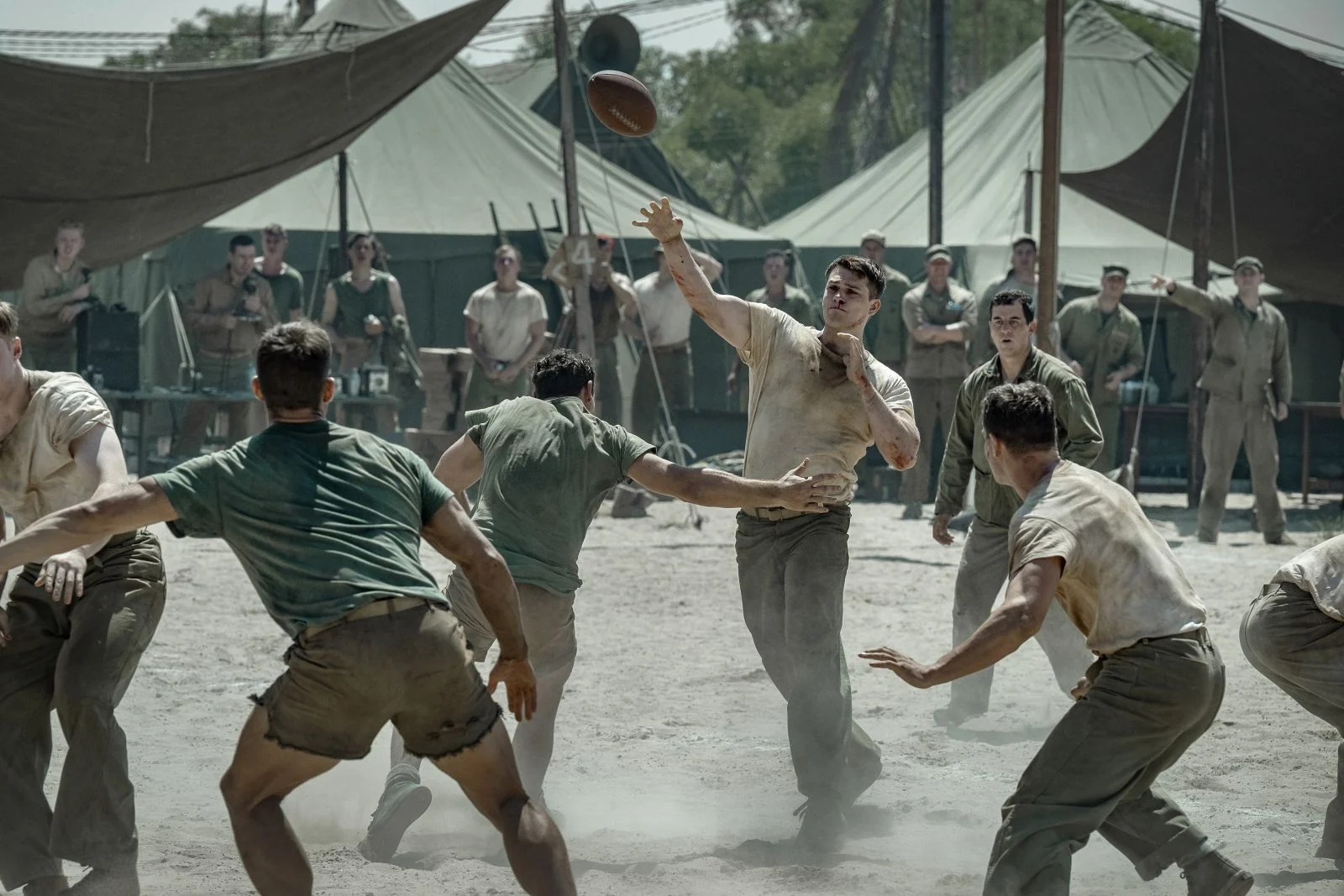
On Christmas Eve 1944 on the Pacific island of Guadalcanal, teams from the 4th and 29th Regiments of the U.S. Marine Corps played football as a morale booster before going to fight in Okinawa, one of the bloodiest campaigns of the war against Japan. Fifteen of the sixty-five players would die there.
The film starts by introducing the four leads in their element, mud-soaked and showing off their football prowess to adoring crowds. Nicholas Galitzine plays John McLaughry, star of the Brown University team, a thoughtful man who loves the thrill of the game. On another field, Wisconsin Badgers David Schreiner (Tom Francis) and Robert Baumann (Bill Skarsgård) are up against ‘Touchdown Tony’ Butkovich (Ray Nicholson), who grins his way to the end zone whenever he gets the ball. Schreiner is a straight-laced perfectionist, frustrated at his inability to counter Butkovich and irritated by his showmanship. Baumann is an easygoing, salt-of-the-earth cattle farmer’s son, susceptible to mischief when it cheers up his pals.
These two games take place on 6th December 1941, the day before the attack on Pearl Harbor. Follows a quick-cut montage of clips of the real attack and of Japan’s conquests elsewhere, along with the moments McLaughry, Schreiner, Baumann and Butkovich sign up to join the Marines. They say goodbye to their families and sweethearts, arrive at training and begin their descent into hell. A football Baumann packs in his suitcase is emphatically skewered with a bayonet – war is not a game, insists his drill sergeant. The men’s first taste of combat is the chaotic landing at Tarawa, where their landing craft runs aground and the men are forced to bail before enemy artillery finds them. Bold as it may be to say, this sequence rivals the Omaha Beach landing in Saving Private Ryan – while clearly using it as inspiration – for sheer noise, confusion and hopelessness. Once the Marines are ashore, most lacking any gear after being tossed about by the waves, they find the Japanese defenders to be astonishingly ferocious. Attention is given to each man’s first kill, the act crystallising their loss of innocence. The unique combat fervour of imperial Japan’s soldiers is widely renowned and a level of brutality is practically required in depicting them. Nothing profoundly new is shown here, but every disturbing act is drawn from truth. On Tarawa, the new Marines witness a lone surviving defender slice himself open rather than surrender in shame. Civilian women on Okinawa jump to their deaths to avoid capture and combatants set booby traps for the unsuspecting Americans. Every vicious act chips away at the Marines’ sanity, until all they can be are killers.
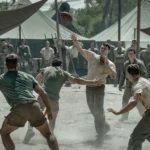
The years pass, war takes its toll and a USO tour’s visit to Guadalcanal is of little help, so a superior officer orders Schreiner and Baumann to organise a football game to boost morale. At first the men disdain the idea, but as soon as a player in the opposing regiment starts to trash talk, they fall right back into the spirit of the game and are determined to put on a show. The game, as intended in the story, is a cheerful high point and a welcome reprieve from the brutalities of combat. The men let loose and enjoy themselves, many for the last time.
Writer, director, producer and actor Peter Berg has had a solid run of films that appeal to American patriotism, and with The Mosquito Bowl there is the perfect opportunity of football meeting the war against Japan. While it is, along with Lone Survivor and Patriots Day, generally sober and avoids sugarcoating the reality of what it depicts, it is not immune to a Hollywood-esque jingoism and a desire to cast America as the hero in its wars. With Japan in World War II this is fairly easy, but it would be interesting to see Berg tackle Iraq or Vietnam. There are two moments in fact that appear to reference the former, with McLaughry positing to a comrade that the entire war is a fight for oil, then later asking his sergeant why they have to stay on Tarawa when their objective of destroying the Japanese airstrip is already achieved (“Mission accomplished, right?”). It’s a fairly effective attempt to draw a parallel between these conflicts separated by time, but those who sanctify the Second World War as a more black-and-white struggle may take umbrage.
Sport/war films constitute a curious subgenre with few examples for comparison. The Mosquito Bowl strikes a good balance between the adrenalin rush of a football game and the harrowing intensity of war, focusing on their impact on the men involved. Berg is adept at the war film genre and treads somewhat familiar ground in the combat scenes, which nonetheless accentuate the tragedy of all the lives lost. Dedications are made at the end of the film to the dead of Okinawa and the war as a whole. As a previously untold episode of the war, the film succeeds in shining a light on these men whose specific talents brought a moment of cheer to a horrifying conflict.
The Mosquito Bowl is in UK cinemas now.